Introduction
Biodiesel is a renewable fuel manufactured from vegetable oils, animal fats, waste cooking oil, etc. It can be used to power motor vehicles in pure form or in blends with motor vehicle diesel.
Not all diesel vehicles are compatible with biodiesel or its blends with motor vehicle diesel. Vehicle manufacturers generally accept the use of motor vehicle diesel containing up to 5% biodiesel to power their vehicles. However, a higher biodiesel content may cause incompatibility problems to certain vehicle models. Subject to the advice of vehicle manufacturers, the incompatibility problems could be overcome by replacing certain engine components.
Environmental Benefits
Biodiesel is not derived from fossil products but a kind of renewable energy. Since the amount of carbon dioxide released in the use of biodiesel is close to the amount of carbon dioxide absorbed when growing the crops, the wider use of biodiesel in lieu of fossil diesel, which is non-renewable, is therefore conducive to reducing greenhouse gas emissions and mitigating global climate changes due to the rising greenhouse gas level. In respect of the potential to improve roadside air quality, Euro V diesel and biodiesel are similar.
Regulatory Control on Motor Vehicle Biodiesel
The regulatory control on motor vehicle biodiesel is set out in the Air Pollution Control (Motor Vehicle Fuel) Regulation, Cap. 311L (for details, please click here).
The key elements of the regulatory control are as follows:
(a) Motor vehicle biodiesel specifications (Sections 2, 10 and Schedule 3)
Motor vehicle biodiesel includes pure biodiesel and biodiesel blends that are blended from pure biodiesel and motor vehicle diesel and their respective specifications are
(i) pure biodiesel that is supplied or sold for motor vehicle use has to comply with the specifications as stipulated in Schedule 3 of the Regulation. The specifications are in general comparable with European Union standard EN14214; and
(ii) biodiesel blends that are supplied or sold for motor vehicle use must be blended from pure biodiesel and motor vehicle diesel, the specification of which is stipulated in Schedule 1 of the Regulation (i.e. Euro V standard for motor vehicle diesel).
(b) Labelling requirements (Sections 11, 12 and Schedule 4)
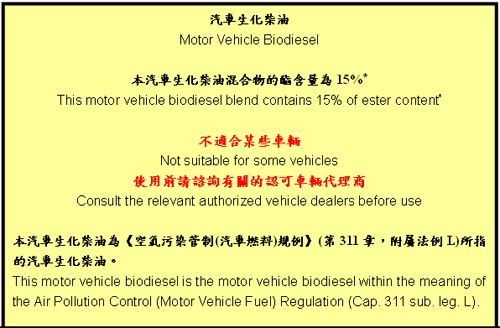
(i) a label (sample given below) is required for selling the motor vehicle biodiesel with biodiesel content over 5%; and
(ii) the biodiesel content in the motor vehicle biodiesel expressed in percentage should not deviate from the percentage of biodiesel content indicated on the label by more than one percent (For example, a motor vehicle biodiesel with its biodiesel content of 15% specified on the label should have its biodiesel content between 14% and 16%, both inclusive).
Label Sample
(c) Penalty for non-compliance (Sections 10, 11 and 12)
(i) the penalty for non-compliance with the motor vehicle biodiesel specifications in (a) will attract a maximum fine of $50,000; and
(ii) Non-compliance with the labelling requirements in (b) will attract a maximum fine of $50,000.
The above is to provide the general public with a brief introduction of the regulatory control on motor vehicle biodiesel under the Air Pollution Control (Motor Vehicle Fuel) Regulation, Cap. 311L (the Regulation). It is not to serve as a legal interpretation of the Regulation. In case of doubt, the reader should consult the Air Pollution Control (Motor Vehicle Fuel) Regulation, Cap. 311L, Laws of Hong Kong. The Regulation can be accessed at the website below:
https://www.elegislation.gov.hk/hk/cap311L!en?INDEX_CS=N
Tax Incentive
To promote the use of biodiesel as motor vehicle fuel, motor vehicle biodiesel is duty-free.
Biodiesel supply in Hong Kong
At present, there are two biodiesel production plants producing biodiesel in Hong Kong.
Advice to drivers on using motor vehicle biodiesel
Drivers should check whether a label as prescribed under the Regulation is stuck on the dispenser or the container. If there is no label, the motor vehicle biodiesel should contain not more than 5% biodiesel and is suitable for use in all vehicles. If there is a label, drivers should check the biodiesel content on the label and consult your vehicle dealer before use.
If in doubt, please check the biodiesel content from the motor vehicle biodiesel vendor.
Enquiry
For enquiry or report on any suspected motor vehicle biodiesel not meeting the regulatory requirements:
Tel: 3863 0602
Fax: 2824 9361
Address: Hong Kong Environmental Protection Department Mobile Source Group, 7/F, North Tower, Tseung Kwan O Government Offices, Tseung Kwan O, Sai Kung, New Territories.
Relevant Regulation
Air Pollution Control (Motor Vehicle Fuel) Regulation (Cap.311L)
Study Report
Feasibility Study of Using Biodiesel as Motor Fuel in Hong Kong 
|


