Guidelines for the Design of Small Sewage Treatment Plants
| DESIGN PARAMETERS |
| |
|
| 3.1 |
The designer should give a reasonable estimate of population and a detailed breakdown of the total flow rate in the calculation. |
| |
|
| 3.2 |
The basic design parameters for residential populations shall be taken as follows:
- 0.19 to 0.37 m3/h/d (cu.m. per head per day) depending on types of development (R1-R4 in Appendix 2).
- 55g BOD/h/d
- 55g SS/h/d
Appendix 2 also lists out the flow and load for other common developments. For other types of population, reference should be made to the Guidelines for Estimating Sewage Flows for Sewage Infrastructure Planning (Version 1.0) on the EPD homepage. If service trades (shops, restaurants etc.) occur in the development, the flows and loads of the trades shall also be included as per Appendix 2.
|
| |
|
| 3.3 |
The design peak flow arriving at the STP as a proportion of dry weather flow (DWF) shall be taken as:
- 6 DWF for population equal to or under 1 000
- 4 DWF for population over 1 000 but not less than that based on 1 000 population.
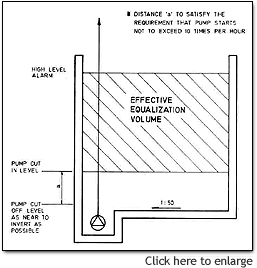
Either the STP can be designed for the above peak flow rate or it can be designed to cater for a peak flow of 3 DWF, excess flow over 3 DWF being equalized in an equalization tank. In the latter case the feed pumps must be sized accurately to avoid excessive peak flow rate production.
Equalization tanks should be designed to hold the excess flow for a period of two hours. Only the tank volume above the duty pump cut-in level should be considered as effective equalization volume. Air ejectors should be provided to prevent septicity of sewage.
|
| |
|
| 3.4 |
Primary sedimentation tanks shall be designed for:
- maximum surface loading of 40 m3/m2/d at peak flow,
- minimum retention time of 2 hours at peak flow,
- maximum weir loading of 250 m3/m/d at peak flow.
|
| |
|
| 3.5 |
Final sedimentation tanks shall be designed for:
- maximum surface loading of 35 m3/m2/d at peak flow if they are preceded by Rotating Biological Contactor (RBC) or biological filters,
- maximum surface loading of 22 m3/m2/d at peak flow if they are preceded by the extended aeration process,
- minimum retention time of 2 hours at peak flow.
|
| |
|
| 3.6 |
The reduction of total BOD by different stages of the primary treatment processes should be taken as follow:
-
-
-
| fine screen (max. opening 2 mm) |
- |
7.5% |
-
| primary sedimentation |
- |
30% |
-
| fine screen and primary sedimentation |
- |
30% |
The net BOD load going into the subsequent biological processes should be computed accordingly.
|
| |
|
| 3.7 |
Biological processes should be designed to the following organic loading:
|
|
: |
10 g total BOD/m2/d (i.e. per sq.m. of RBC surface) entering into the RBC or as recommended by manufacturer, whichever is smaller, |
|
|
: |
0.07 kg total BOD/kg MLSS/d and MLSS in the range between 2 000 and 3 500 mg/L, |
- Plastic biological filter (Biofilter)
|
: |
0.5 kg total BOD/m3/d (i.e. per cu.m. of media volume) or as recommended by manufacturer, whichever is smaller. |
- For other biological treatment methods, such as sequential batch reactor, contact stabilization and other patented processes etc., organic loadings proposed in the design should be justified by supporting documents such as relevant literature, local monitoring results and catalogues.
|
|
| |
|
| 3.8 |
Chlorination tanks should be designed for minimum 30 minutes contact time at peak flow. |
| |
|
| 3.9 |
Sludge quantities generated from the processes should include:
- solids removed from primary sedimentation, which should be taken as 70% of the influent SS.
- sludge yield from biological processes, which should be taken as 0.5 kg solids/kg BOD removed when preceded by primary sedimentation, or 1 kg solids/kg BOD removed when not preceded by primary sedimentation. In the latter case no inclusion of primary sludge is necessary.
|
| |
|
| 3.10 |
Solid concentration of sedimentation tank sludge shall be taken as:
- 1% for extended aeration sludge,
- 2% for RBC, biological filter and primary sludge.
|
(Text Alternative)
|
|
     |