The Waste Disposal Ordinance provides for controls on the management and disposal of waste.
Chemical Waste
Producers of chemical waste have to be registered with the Environmental Protection Department (EPD), while waste collectors and disposal facilities have to be licensed. The movement of waste from its generation to its final disposal point is monitored by a trip ticket system, and 34 000 trip tickets were used in 2022.
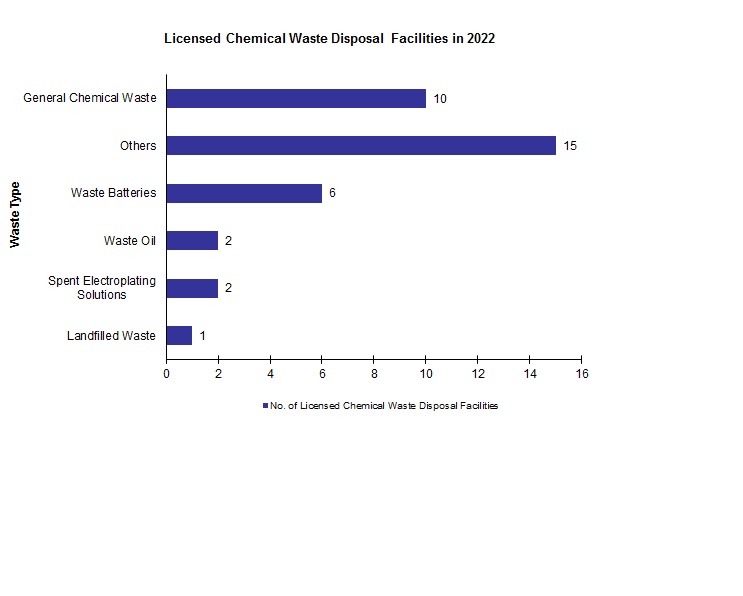
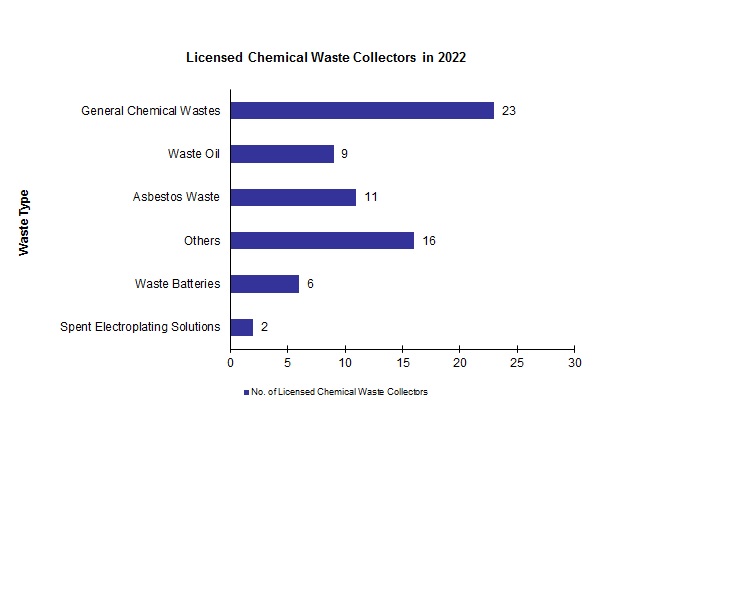
Registered Chemical Waste Producers 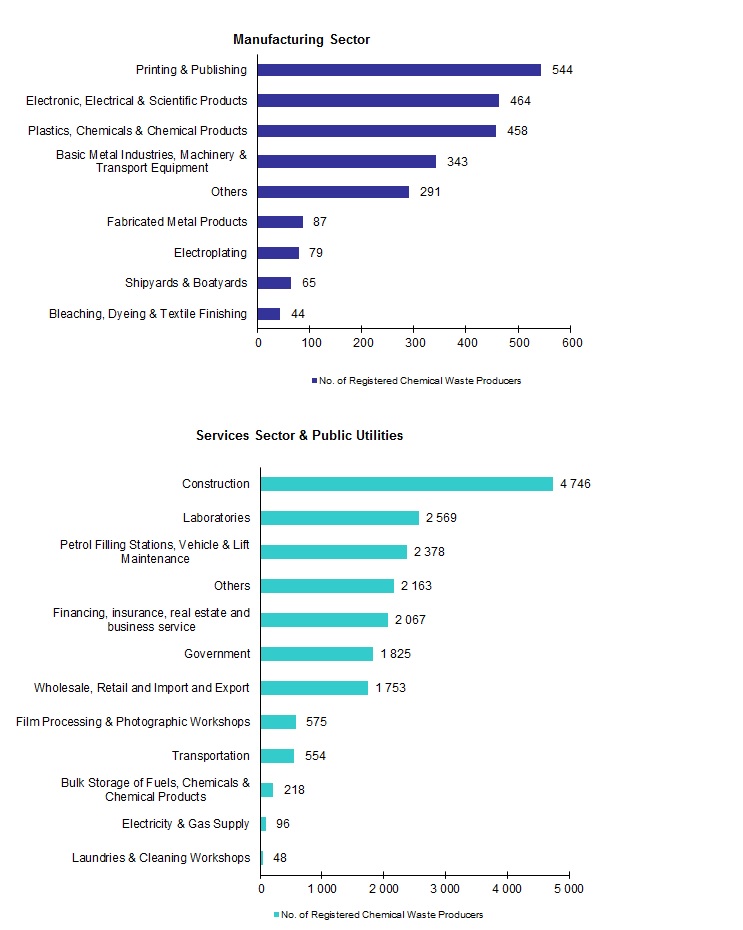
See Data
Livestock Waste
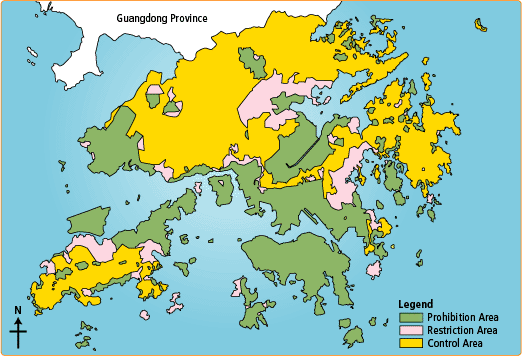
Under the Waste Disposal (Amendment) Ordinance effective on 1 July 1994, Livestock Waste Prohibition Areas were extended, and Restriction Areas were introduced. No new livestock farms are allowed in Restriction Areas, but existing livestock keeping activities can continue to operate. Since 1 July 1999, all treated livestock waste discharges have been required to meet a 50:50 standard [Biochemical Oxygen Demand (mg/L) : Suspended Solids (mg/L)]. About $946 million in financial aid has been paid to help affected farmers to date. About 90% of livestock waste is now disposed of in an environmentally acceptable manner as farmers have adopted appropriate livestock waste treatment and management measures.
Since the launching of two Voluntary Surrender Schemes in 2005 and 2006, the number of livestock farms and the quantity of livestock waste arising have been reduced. In addition, the buyout scheme for live poultry trade had been launched in 2008. This led to further reduction in the quantity of livestock farms and waste produced.
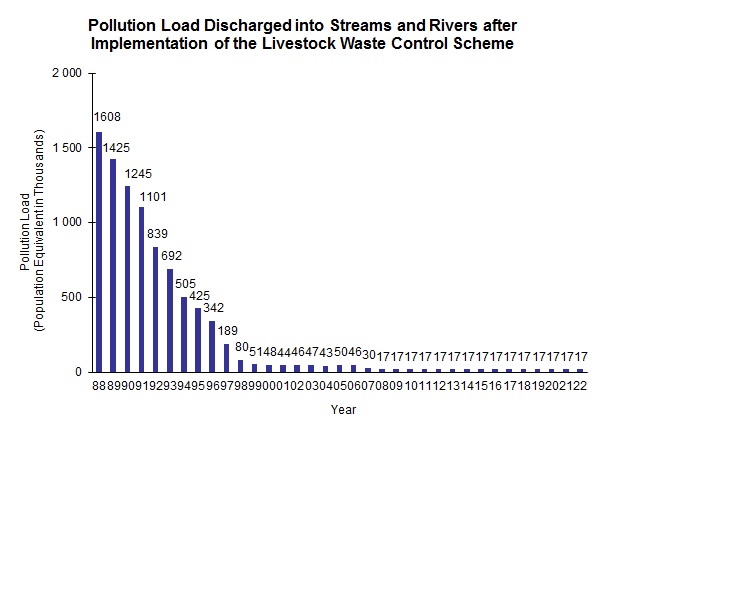
Livestock Waste Prohibition, Restriction and Control Areas
Import and Export of Waste
Import and export of waste has been controlled through permits since 1 September 1996. Any person who wishes to import or export wastes requires a permit issued by the EPD unless the wastes are uncontaminated recyclables and are intended for a genuine recycling or re-use purpose.
In collaboration with the Customs and Excise Department, the EPD, based on risk assessment approach, inspects waste consignments at various import and export control points and borders to deter illegal shipments of wastes. Our strategic landfills are also kept under close surveillance against illegal disposal of imported waste.
Waste Import and Export Permit and Transit Consent in 2022
|
No. of Permits Issued : |
27 |
|
No. of Transit Consents Issued: |
8 |
Prosecutions on Illegal Import and Export of Waste in 2022
|
Total No. of Prosecutions : |
20 |
|
Range of Fines: |
$5 500 - $20 000 |
Clinical Waste
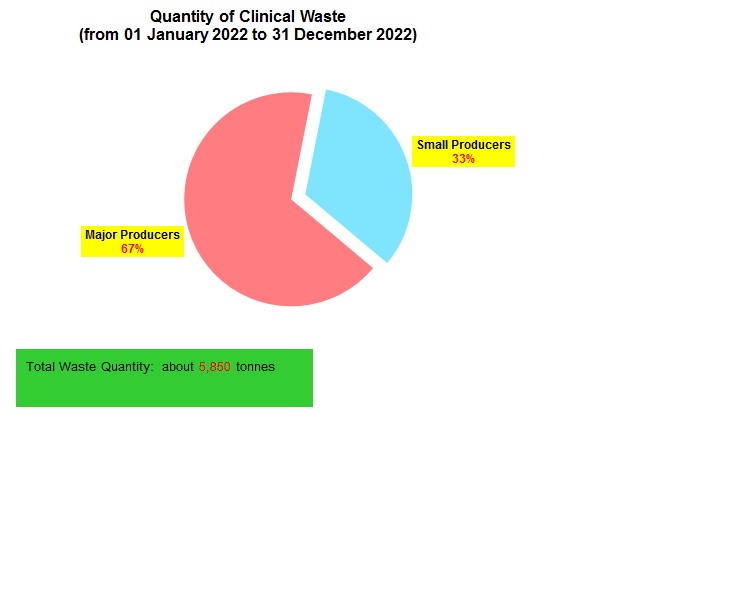
The Waste Disposal (Clinical Waste)(General) Regulation became effective on 1st August 2011. All Clinical Waste Producers are required to safely handle clinical waste and arrange for its proper disposal. Each Clinical Waste Producer is assigned a Premises code (P-code) to identify the premises where clinical waste is generated. As at the end of 2022, there were about 11,920 operating clinical waste producers with P-codes issued by EPD. Around 720 P-code holders were Major Clinical Waste Producers which comprise public and private hospitals, government clinics and medical laboratories managed by government. The remaining P-codes holders were Small Clinical Waste Producers which includes private medical and dental clinics/practices, private dental, medical, veterinary or pathological laboratories, private Chinese medicine clinics/practices, residential care homes for the elderly, nursing homes, private veterinary clinics/practices, medical research facilities, universities and other relevant organizations.
In accordance with the Waste Disposal Ordinance, the collection and removal of clinical waste must be operated under a clinical waste collection licence issued by EPD. As at end of 2022, 12 licensed operators provide clinical waste collection service in Hong Kong. Each consignment of clinical waste is tracked with a trip ticket. In 2022, there were around 93,000 clinical waste consignments. Around 5,850 tonnes were delivered to licensed disposal facilities, i.e. the Chemical Waste Treatment Centre (CWTC) and West New Territories (WENT) Landfill for disposal. Due to maintenance of the incinerator at CWTC and other reasons, about 570 tonnes of clinical waste were diverted to WENT Landfill for disposal.
E- Waste
Disposal licensing control, import and export control and disposal bans at designated waste disposal facilities of e-waste (viz. abandoned regulated electrical equipment (REE) including waste air-conditioners, refrigerators, washing machines, televisions, computers, printers, scanners and monitors) under the Waste Disposal Ordinance (WDO) have come into effect on 31 December 2018. Unless with exemptions, any person who is engaged in the storage, treatment, reprocessing or recycling (but not repair) of e-waste must obtain a waste disposal licence (e-WDL) issued by the EPD under the law. A permit issued by the EPD is also required for import or export of e-waste.
Number of licensed e-waste disposal facilities as at end of 2022: 18 (including the WEEE • PARK operator)
Number of permits issued for import and export of e-waste in 2022: 0


