


 |
|
|
The following shows some mitigating measures for some types of environmental noise.
Subsequent sections
will provide details and examples of some
of the above mitigating measures. Follow the text
or alternatively click the icon next to a mitigating
measure to access to details on it.
(Click on the above headings to link to corresponding
sections below)
|
| Land
Use Planning |
 |
One important
planning tool to minimize the impact of environmental
noise is to ensure compatibility of different
uses adjacent to each other. Outline Zoning Plans
(OZPs) are drawn under the Town Planning Ordinance
to govern land uses for different purposes.
For any amendment of existing OZPs or drafting
of new OZPs, implications on the environment including
any possible noise impact will be addressed.
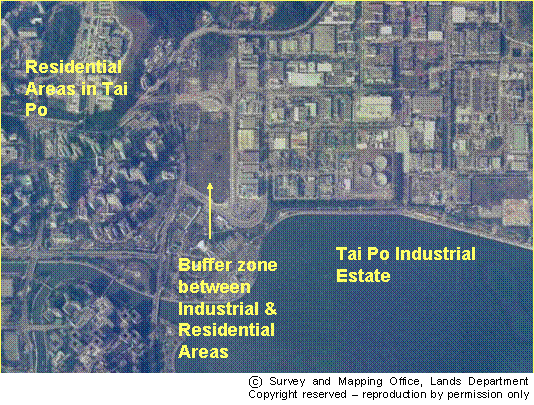
The aerial photo below illustrates how land use planning
provides separate zones for the industrial undertakings
at the Tai Po Industrial Estate and the residential buildings
in the nearby housing estates to avoid incompatibility in
land use. A buffer area for non noise sensitive use between
the two zones can further help to reduce noise impact to the
residents arising from the industrial operation.
|

| Alternative
Siting / Alignment |
 |
One most effective way to deal with noise is to plan away the problems by selecting alternative site or alignment that avoids serious problems.
If a certain locality is found to be unsuitable for the development of a certain noise sensitive use or a certain noise source due to adverse environmental noise impact on existing sensitive development, then an alternative location or site may have to be explored. Similarly, noise impact from road traffic can be minimized through suitable choice of alternative alignment. The following plan shows the various proposals of the Tseung Kwan O Western Coast Road. Please click on the demo button to read the details.
The original
design, shown in red, employs elevated roads
running along the coastal areas. This scheme
might expose noise sensitive uses to excessive
traffic noise and noise barriers or enclosures
might be required to improve the situation.
A number of alternative proposals have been
put forward and they are being evaluated at
the time this Package is being prepared. All
these alternative proposals employ tunnels
which, among other consideration, can help to
design out traffic noise impact on the nearby noise sensitive uses.
|
| Screening
by Noise Tolerant Buildings |
 |
This is an illustration of how a noise tolerant building such as a multi-storey carpark building is used to protect residential buildings from road traffic noise. Placing a noise tolerant building in between the road traffic and the residential building causes the noise in the "shadow zone" to be reduced. This brings about a reduction in the traffic noise affecting the residents. Please click on the demo button to read the details. Then click on the stop button to stop the sound/demo.
|
| Building
Disposition |
 |
The impact of environmental
noise can also be reduced by the proper disposition
of noise sensitive buildings within
a development.
The following plan shows residential blocks in
blue and the Sai Sha Road as the major noise source
in yellow. As shown, the residential buildings
are sited away or set back from the Sai Sha Road
as far as possible. (The development also employs
noise barrier to reduce the impact of traffic
noise. The issue of noise barrier will be discussed
later. Follow the text or click here
to jump to the part on barrier.)
|
| Decking
Over |
 |
This illustration
shows how the use of decking over reduces impact
of road traffic noise on a number of residential
buildings.
Please click on the demo button to read the details.
Then click on the stop button to stop the sound/demo.
One such example
in Hong Kong is the Sceneway Garden at Lam
Tin, as shown by the following plan and photographs:
|
| Podium |
 |
Putting residential
buildings on top of a podium can provide shielding
against traffic noise from roads in their vicinity,
as illustrated by this animation.
Please click on the demo button to read the details.
Then click on the stop button to stop the sound/demo.
The development
at Island Place, North Point uses this measure
to reduce the impact of traffic noise from
the busy King's Road on the residents.
|
| Noise Barrier/Enclosure |
 |
Noise Barrier
A noise barrier
or acoustic shield reduces noise by interrupting
the propagation of sound waves. With proper
design and selection of material for the noise barrier or
acoustic shield, noise reaching a noise sensitive
receiver would be primarily through diffraction over
the top of the barrier and around its ends.
The acoustical "shadow zone" created
behind the barrier is where noise levels are
substantially lowered.
To function well, the barrier must prevent the
line-of-sight between the noise source and the
receiver.
Effective noise barriers can reduce noise levels
by as much as 20 dB(A).
The following are some common types of noise
barriers used in Hong Kong.
Please click on the demo button to read the
details. Then click on the stop button to stop
the sound/demo.
 |
(a)
|
Vertical
Barrier
|
|
(b) |
|
The following
table shows some examples of barriers erected
in Hong Kong. Click on the mimic diagrams
to see more details :
| Project |
Characteristics |
Mimic
Photographs |
Vertical Roadside Barrier
for Route 5 - Shatin Approach near Mei
Lam Estate
|
- Simplest
form of noise screening structure
- Effective
in protecting low-level sensitive
receivers
- Can
be installed on one side or both sides
of carriageway
|
|
Cantilevered
Barrier
for West Kowloon Expressway - near Lai
King |
- Effective
in protecting low to mid-floor sensitive
receivers
- Can
be installed on one side or both sides
of carriageway
|
|
Central
Barrier
for West Kowloon Expressway - near Mei
Foo Sun Chuen and Nam Cheong Estate |
- Vertical
barrier installed located in the central
reserve of dual carriageway
- Effective
for protecting low to mid floor sensitive
receivers from wide dual carriageways
|
|
Noise Enclosure
To function well, a noise barrier must
prevent the line-of-sight between the noise
source and the receiver. This is not always
possible, especially with high-rise noise
sensitive uses. In this circumstance, noise
enclosures are required to provide appropriate
protection against environmental noise for
the noise sensitive uses.
In general, an enclosure can reduce noise
by more than 20 dB(A).
Similar to noise barriers, noise enclosure
should be designed to serve both acoustic
and aesthetic purposes.
The following are some common types of noise
barriers used in Hong Kong.
Please click on the demo button to read the
details. Then click on the stop button to
stop the sound/demo.
 |
(a)
|
|
|
(b) |
|
The following
table shows some examples of enclosures erected
in Hong Kong. Click on the mimic diagrams
to see more details :
| Project |
Characteristics |
Mimic
Photographs |
Semi-enclosure
for Tate's Cairn Tunnel Approach at Choi
Hung Estate and Richland Gardens |
- Effective in protecting high-rise sensitive receiver at one side of the carriageway
|
|
Full
Enclosure
for Wong Chu Road |
- Effective
in protecting high-rise sensitive
receivers located on both sides of
carriageway
|
|
|
| Architectural
Features/Balcony |
 |
Certain architectural
features such as fins and balcony can help reduce
impact of road traffic noise on residential buildings.
|
| Building Orientation and Innovative Layout |
 |
The following illustration explains the idea of using building orientation and innovative layout to reduce the impact of traffic noise :
In such a design, the building is oriented
so that less noise sensitive uses such as kitchen, bathroom and store
rooms are located to one side of the flat while noise sensitive uses
such as living rooms and bed rooms are located on the other side. The
building is so oriented that the side of flat containing less noise
sensitive uses is facing the major noise source such as a busy trunk
road. This building arrangement can sometimes help to render sensitive
development at an otherwise "environmentally unacceptable site"
acceptable.
|
| Open-Textured
Road Surfacing |
 |
There are two
main sources of noise from vehicles: the engine
and road/tyre interaction.
When traveling on level roads and at high-speed
traffic, road/tyre interaction noise dominates.
On inclined road or level at low-speed traffic,
engine noise becomes dominant.
Most roads are paved with surface that has microscopic grooves which cause the noise to resonate, thereby increasing the noise. But a different material on the road will reduce the noise arising from road/tyre interaction.
Friction course, a special type of bituminous highway surfacing, was originally designed to improve skid resistance by virtue of its open texture. The open-textured bituminous highway surfacing consists of tiny holes making up 20% of the volume and can reduce traffic noise induced by the interaction between road surface and vehicles tyres of high-speed traffic by up to 5dB(A). Please click on the demo button to see the details.

For information
on how road resurfacing using low noise materials
helps reduce traffic noise in Hong Kong, please
click here.
|
| Acoustic
Insulation of Receiver |
 |
The provision
of window insulation and air-conditioning is the
"last resort" in an attempt to abate
the residual impact from noise sources not controlled
under the NCO, such as aircraft, road traffic
and helicopter.
The acoustic insulation
will practically deprive the receivers of outdoor
activities and an "open-window" life
style. While acoustic insulation is commonly found
in some western countries, the warm and humid
climate in Hong Kong makes it more expensive for
noise sensitive uses due to the need to provide
air-conditioning for a "closed-window"
environment.
The suitable window types for noise insulation
are shown in the following table. The table indicates
the suitable window type that should be used when
the estimated noise level will exceed the relevant
standard by ß value.
A typical example
of this measure is the School Insulation
Programme. For details of this programme,
please click here.
|
|
|
|
|