Part II : SEA Mechanisms in Hong Kong
Administrative Requirements
In order to provide environmental information appropriate for decision makers to make an informed decision, project proponents would normally carry out SEA for PPPs that might have potentially substantial environmental or sustainability implications.
-
A revised administrative circular on the Environmental Review of Major Development Project, issued by the Hong Kong Government in 1988, requires new town developments and major land use/ development projects to conduct EIA and this represents the first application of SEA for spatial planning in Hong Kong.
-
A policy initiative promulgated in the 1992’s Governor’s Policy Address further extended the application of SEA to cover policies and strategies. Under the initiative, papers on major policies to be submitted to the Executive Council (the highest decision making body in Hong Kong) have to contain an environmental implication section setting out clearly the likely environmental costs and benefits arising from the followings1:
- proposals for new policies or strategies;
- amendments to existing ones;
- specific matters that involve environmental issues;
- proposals or projects for which suitable EIAs have already been carried out; and
- environmental strategies, policies and proposals.
1992 Policy Address
Submissions to Executive Council"..with immediate effect is for an environmental impact assessment to be included in papers submitted to the Executive Council. Currently this rule applies only to major development projects. From now on, I want this practice to be extended to all policy proposals where there is likely to be a significant cost or benefit to the environment."
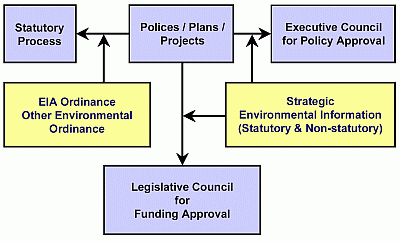
Figure 4 - Key Decision Making System
1 - Environment, Transport and Works Bureau Technical Circular No. 13/2003, Appendix A, HKSAR Government
With this provision, decision makers could take into account environmental factors, along with other issues, such as economic and financial implications, and consultation responses to assist decision and policy making.
-
This Policy initiative targets to ensure all major policy and strategies initiatives go through full assessment of their social, environmental and economic implications. It is important in 2002 by way of "Sustainability Assessment" and "Sustainability Implication", as mentioned below.
-
Since 2002, "Sustainability Implication" section is also required to be included in the submissions to the Executive Council.
-
+- The 2005 Policy Address states that in future all new major government policies will be subject to environmental protection scrutiny.
| [ << BACK PAGE ] [ 4 / 5 ] [ NEXT PAGE >> ] |