Contents
12 Sewerage and Sewage Treatment Implication
12.2 Sewerage and Sewage Treatment Legislations, Standards, Guidelines and References
12.3 Description of the Environment
12.4 Identification of Environmental Impacts
12.6 Existing conditions, Prediction and Evaluation of Sewerage and Sewage Implications
12.8 Environmental Monitoring and Audit Requirements
12.9 Conclusions and Recommendations
Table 12.1: Recommended Unit Flow Factors
Table 12.3: Sewage Flow under Existing Sewerage Condition
Table 12.4: Sewage Flow during the construction phase
Table 12.5: Population and Sewage Flow Estimation for the Project (Residential Housing)
Table 12.6: Population and Sewage Flow Estimation for the Project (Commercial Activities)
Table 12.7: Total Sewage Flow from the Development Site
Table 12.8: Responsible Party for the Sewerage Facilities under different phase
|
Existing and Proposed Sewerage Arrangement |
Appendices
|
Design Calculation on the Backwash Volume of Indoor Swimming Pool |
|
|
Detailed Hydraulic Assessment on the Existing DN1500 Trunk Sewer and the Downstream Sewerage
|
|
ADWF |
Average Dry Weather Flow |
|
CDWE |
Comprehensive Development with Wetland Enhancement |
|
CISUS |
Commercial and Industrial Floor Space Utilization Survey |
|
DSD |
Drainage Services Department |
|
EIA |
Environmental Impact Assessment |
|
EPD |
Environmental Protection Department |
|
GESF |
Guidelines for Estimating Sewage Flows for Sewage Infrastructure Planning Version 1.0 |
|
GFA |
Gross Floor Area |
|
LC |
Lut Chau |
|
LCNR |
Lut Chau Nature Reserve |
|
NR |
Nature Reserve |
|
NSW |
Nam Sang Wai |
|
PlanD |
Planning Department |
|
PWWF |
Peak Wet Weather Flow |
|
SIA |
Sewerage Impact Assessment |
|
SPS |
Sewage Pumping Station |
|
TPB |
Town Planning Board |
|
UFF |
Unit Flow Factors |
|
WEA |
Wetland Enhancement Area |
|
YLEPP |
Yuen Long Effluent Polishing Plant |
|
YLSTW |
Yuen Long Sewage Treatment Works |
12
Sewerage and Sewage Treatment
Implication
12.1
Introduction
12.1.1 This section presents the assessment of the sewage discharge impact to the existing sewerage system during construction and operational phase of the Project in accordance with Section 3.4.10 of the Study Brief (ESB-244/2012). The necessary mitigation measures and proposal for sewage discharge have been recommended with a principle of having no adverse impact to the existing sewerage system.
12.2
Sewerage and Sewage Treatment Legislations, Standards,
Guidelines and References
12.2.1 The standards and guidelines for assessing the existing sewerage system and design of the proposed sewerage system include:
● Sewerage Manual published by Drainage Services Department (DSD);
● Guidelines for Estimating Sewage Flows for Sewerage Infrastructure Planning Version 1.0 by EPD;
● Hong Kong Planning Standards and Guidelines (HKPSG); and
● Technical Memorandum on Environmental Impact Assessment Process - Annex 14
12.3
Description of the Environment
12.3.1 The Project comprises two separate areas, namely Nam Sang Wai (NSW) and Lut Chau (LC), there is no existing sewerage system within the Project’s site. Part of the NSW area would be developed as a Development Site, which has residential development while the rest of the NSW and the LC area would be developed as a Nature Reserve (NR) and Wetland Enhancement Area (WEA). The location of the two areas is shown in Figure 2.1. Since the two areas are separated, their sewerage impacts will be assessed separately in this Chapter.
12.4
Identification of Environmental Impacts
Construction Phase
12.4.1 Section 2.6 in the EIA report has described the component of the Project, which includes a LCNR and NSW WEA, a Development Site, a public park with a visitor centre, proposed bridge, and a private underground sewage pumping station (SPS).
12.4.2 During construction phase, sewage will be generated by the workforce. As mentioned in Chapter 6, adequate numbers of portable toilets will be provided on-site at conveniently accessible locations and the sewage generated would be regularly collected by a suitable waste collector for disposal.
12.4.3 The sewage generated during the construction phase, and its impacts will be discussed in Section 12.6.
Operational Phase
Lut Chau
Natural Reserve
12.4.4 At the LCNR, the main operational activities include the provision of wetland habitat including ponds and fish stocking activities with some site maintenance works. As LCNR will not be open to the public, no public toilet facilities are required. Therefore, there will be no facilities at Lut Chau area which will generate sewage, and no sewerage and sewage treatment implications are anticipated.
Nam Sang Wai
Development Site and WEA
12.4.5 Sewage will be generated from the typical operational activities of the Development Site and WEA in NSW, as well as operation of the visitor centre, club house, elderly centre, and commercial centre facilities. According to the latest development schedule, no sewage flow will be conveyed to future Yuen Long Effluent Polishing Plant (YLEPP) before 2030.
12.4.6 The sewage generated from these activities will utilise some of the capacity of the existing sewerage system which will be discussed in Section 12.6.
12.5
Assessment
Methodology
Background
12.5.1 This section aims to assess the Sewerage and Sewage Treatment Implications for the development mentioned in Section 2.6.
12.5.2 The following approach and methodology have been adopted in this sewerage impact assessment:-
● Carry out a desktop study to collect the relevant information for assessment, including the existing sewerage facilities’ available capacities, with the consideration of planned developments within and in the vicinity of the assessed sewerage system. The assessed sewerage system defined as:
– From the manhole FMH1008726 (which is the manhole located upstream of the proposed discharge point of the proposed development)
– To box culvert FBP1000120 downstream connecting to the Yuen Long Sewage Treatment Works (YLSTW) / future YLEPP;
which will be detailed in Section 12.6.
● Determine the potential sewage generation from the proposed residential development;
● Assess the potential impact from the generation of sewage from the proposed development to the existing sewerage infrastructure (if any) by comparing the two scenarios:
– Without the proposed development scenario: existing flow and the flow from planned developments will be considered;
– With the proposed development scenario: existing flow, the flow from planned developments and flow from the proposed development will be considered ; and
● Propose option(s) to mitigate the sewerage impacts, if required.
Design
Parameters
Unit Flow Factors
12.5.3 Based on the referenced documents stated in Section 12.2.1, the unit flow factors as shown in Table 12.1 have been adopted in calculating the sewerage flow from the Project.
Table 12.1: Recommended Unit Flow Factors
|
Development Type |
Unit |
Unit Flow Factor (m3/day) |
|
Domestic1 |
||
|
Residential R3 |
person |
0.37 |
|
Commercial Activities2 |
||
|
Commercial Employee |
employee |
0.08 |
|
Job Type J4 |
employee |
0.20 |
|
Job Type J10 |
employee |
1.50 |
|
Job Type J11 |
employee |
0.20 |
Notes:
1. The development type R3 has been adopted for the domestic sewage flow estimation for residential housing. The Unit Flow Factor (UFF) was referenced from EPD GESF Table T-1.
2. The UFF of Commercial Types J4, J10 and J11 was referenced from EPD GESF Table T-2. For J10 and J11, the "per-employee" unit flow factor takes into account the flows of customers and/or tenants (Notes of GESF Table T-2).
Peaking Factors and Contributing Population
12.5.4 The peaking factors given in Table T-5 in EPD’s GESF has been adopted for the peak flow calculation. The peaking factors are listed in Table 12.2.
|
Population Range for Sewers |
Peaking Factor (including storm water allowance) for facility with existing upstream sewerage |
Peaking Factor (excluding storm water allowance) for facility with new upstream sewerage |
|
<1000 |
8 |
6 |
|
1000 – 5000 |
6 |
5 |
|
5000 – 10000 |
5 |
4 |
|
10000 – 50000 |
4 |
3 |
|
>50000 |
Max (7.3 / N0.15, 2.4) |
Max (6 / N0.175, 1.6) |
|
Note: N is the contributing population in thousands. According to Clause 12.1 of EPD’s GESF, the contributing population is defined below: Contribution Population = Calculated total average flow (m3/day) / 0.27 (m3/person/day) |
||
12.6
Existing conditions, Prediction and Evaluation of Sewerage
and Sewage Implications
Sewerage
Condition
(without proposed development)
Existing Sewerage System
12.6.1 The area with the proposed development is served by the North Western New Territories sewerage catchment and there is no existing sewerage system within the Project’s site.
12.6.2 Currently, there are existing sewerage network located at the opposite side of Shan Pui River west to the proposed development, this network conveys the sewage to the YLSTW/ future YLEPP for treatment, as shown in Figure 12.1. The schematic Diagram 1 has been made to illustrate the existing sewerage system in vicinity of the proposed development.
Diagram 1. Existing Sewerage System
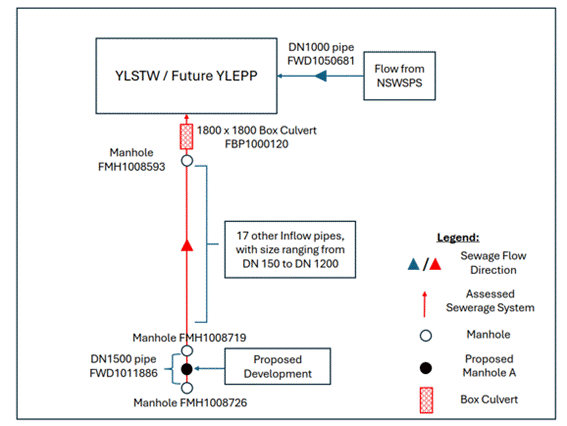
12.6.3 As mentioned in Section 12.5.2, to assess the sewerage impact from the proposed development, sewerage network from the manhole FMH1008726 (upstream manhole of the proposed discharge point of the proposed development) to the downstream box culvert FBP1000120 connecting to the YLSTW / future YLEPP (i.e. the inlet (1)) will be reviewed.
12.6.4 For the YLSTW / future YLEPP, there are two inlets: (1) the 1800 x 1800 box culvert (FBP1000120) and (2) a circular sewer pipe (FWD1050681) connecting to the NSWSPS.
12.6.5 The location of these sewerage system has been identified and shown in Figure 12.1.
Estimation of the Sewage Flow (without proposed development)
12.6.6 As mentioned above, there are other inflows along the assessed sewerage network. As a conservative approach, the flow from the downstream box culvert FBP1000120 would be used as the inflow the assessed sewerage system (i.e. inflow of the pipe FWD1011886).
12.6.7 To obtain the existing flow rate in this downstream box culvert FBP1000120, the two-year average monthly sewage flow of the existing YLSTW (2022 September – 2024 August) has been obtained from DSD. The existing flow in the downstream box culvert has been calculated by subtracting the average daily sewage flow to the YLSTW by the flow from the NSWSPS within the same period (i.e. 2022 September – 2024 August) provided by DSD.
12.6.8 After the existing flow is calculated, the future sewage flow from the planned development is added to form the ADWF in the without the development scenario. The ADWF will then be reviewed with appropriate peaking factors according to the Table 12.2 to become the PWWF for the assessment. The sewage flow under existing sewerage condition has been summarised in Table 12.3.
Table 12.3: Sewage Flow under Existing Sewerage Condition
|
ADWF of YLSTW (m3/d) |
ADWF of NSWSPS1 (m3/d) |
ADWF of Planned Development2 (m3/d) |
Total ADWF (m3/day) |
Peaking factor3 |
PWWF (m3/day) |
|
24,667 |
3,878 |
8,000 |
28,789 |
3.62 |
104,320.4 |
Notes:
1. Based on DSD’s information, the average daily flow of NSWSPS was 3,878 in the period of Sep 2022 to Aug 2024. m3/d. This value was subtracted in the calculation of total ADWF.
2. Based on EPD’s latest record, the sewage flow of the planned developments utilizing the assessed sewerage network is 8,000m3/d.
3. The calculation of the peaking factor is detailed in Appendix 12.2, including stormwater allowance.
Sewerage
Condition (with the proposed development)
Proposed Sewerage
System
12.6.9 As described in Section 12.6, there is no existing sewerage system within the development. To convey the sewerage from the proposed development to the public sewerage system, a private underground SPS will be constructed. As advised by the Project Proponent, this SPS will be operated and maintained by the Project Proponent with a maximum capacity of 4,000 m3/day. The sewage generated from the Project will be collected by the new internal sewerage network and conveyed to the private underground SPS, then pumped across Shan Pui River through new twin rising mains mounted on the proposed bridge. The proposed twin rising mains with associated facilities will be connected to the existing DN1500 public gravity sewer though a new manhole constructed over the DN1500 public gravity sewer between the manhole FMH1008719 and FMH1008726 located next to the existing public car park at Wang Lok Street, namely ‘Proposed Manhole A’.
12.6.10 This DN1500 public gravity sewer serves to convey sewage generated from the Yuen Long Town and Yuen Long Industrial Estate to the future YLEPP for treatment and ultimate disposal. The twin rising mains will provide standby capacity for enabling maintenance during operation. The sewerage arrangement of the Project has been shown in Figure 12.1.
Predicted Sewage
Flow
Construction Phase
12.6.11 During the construction phase, there will be less than 1000 workers working in the construction site, thus the ADWF of the sewage generated would be less than 230 m3/day, as shown in Table 12.4.
Table 12.4: Sewage Flow during the construction phase
|
Commercial Activities |
Unit (per employee)1 |
UFF |
ADWF (m3/day) |
Remarks |
|
Construction |
1,000 |
0.23 |
230 |
J9 Construction |
Notes:
1. Assuming a maximum of 1000 employee per day.
Operational Phase
12.6.12 The calculation of the estimated ADWF for residential housing and commercial activities under the updated development schedule are presented in Table 12.5 and Table 12.6; the calculation of the total sewage flow has been presented in Table 12.7.
Table 12.5: Population and Sewage Flow Estimation for the Project (Residential Housing)
|
Flow Type |
Residential Type |
Unit |
Occupancy (People per Unit)1 |
Population |
UFF |
ADWF (m3/day) |
|
Domestic |
R3 |
2,521 |
2.8 |
7058.8 |
0.37 |
2611.8 |
Table 12.6: Population and Sewage Flow Estimation for the Project (Commercial Activities)
|
Commercial Activities |
GFA |
Unit (per employee)3 |
UFF |
ADWF (m3/day) |
Remarks |
|
Clubhouse – Staff 2 |
3,441 |
114 |
0.28 |
31.9 |
J11 Commercial Activities + Commercial Employee |
|
Visitor Centre – Staff 2 |
1,230 |
27 |
1.58 |
42.7 |
J10 Commercial Activities + Commercial Employee |
|
Elderly Centre – Staff 2 |
6,754 |
223 |
0.28 |
62.4 |
J11 Commercial Activities + Commercial Employee |
|
Commercial Centre – Staff |
1,575 |
52 |
0.28 |
14.6 |
J4 Commercial Activities + Commercial Employee |
|
Sub-total |
- |
416 |
- |
151.6 |
|
Notes:
1. According to the 2021 Population Census, the average household size in the Yuen Long District is 2.8 persons.
2. For Commercial Types J10 and J11, the "per-employee" unit flow factor takes into account the flows of customers and/or tenants(Notes of GESF Table T-2).
3. For Clubhouse, Elderly Centre, and Commercial Centre, the worker density of Community, Social & Personal Services Group is assumed to be 3.3 workers per 100m2 in accordance with Commercial and Industrial Floor Space Utilization Survey (CISUS) issued by PlanD.
Table 12.7: Total Sewage Flow from the Development Site
|
ADWF |
|
|
Residential Housing (m3/day) |
2,611.8 |
|
Commercial Activities (m3/day) |
151.6 |
|
Clubhouse- Swimming Pool (Filter Backwashing) (m3/day)1 |
- |
|
Estimated sewage flow in m3/day |
2,763.4 |
|
Estimated sewage flow in l/s |
32.0 |
|
Notes: 1The calculation of backwash of swimming pool, which is taken in account in the PWWF from the development site, is detailed in Appendix 12.1. |
|
Sewerage Impact Assessment
Construction Phase
12.6.13 During the construction phase, the sewage generated will be collected by licensed waste collector to transport the sewage effluent to a suitable government sewage treatment facility offsite for proper treatment, therefore no sewerage impact is anticipated.
Operational Phase
Impact to Existing DN1500 Trunk Sewer at the Proposed Discharge Point of the Proposed Development and the Downstream Sewerage System
12.6.14 To assess the Project’s impact to the existing DN1500 trunk sewer at the proposed discharge point of the proposed development and the downstream sewerage system, as described in the Section 12.5.2, the flow in the with and without proposed development scenario has been considered with suitable peaking factor to assess the potential impact to this sewer. The calculation of the flow from the proposed development is detailed in Appendix 12.2.
12.6.15 For the scenario with the proposed development, as described in Section 12.6.9 to 12.6.10, considering that the proposed twin rising main will be connected to the new proposed manhole (named “Proposed Manhole A”), a new manhole has been added between FMH1008719 and FMH1008726 for the hydraulic assessment.
12.6.16 The detailed hydraulic assessment on the existing DN1500 trunk sewer including the proposed discharge point of the proposed development and the downstream sewerage system up to the box culvert FBP1000120 before entering future YLEPP has been presented in Appendix 12.2. With the proposed development, the capacity of the existing DN1500 trunk sewer at the discharge point of the proposed development and the downstream sewerage system is considered to be sufficient and the proposed development would increase a maximum of 8% of flow capacity of the sewerage system with the maximum utilization of 98% after the additional flow from the proposed development. Therefore, it was considered that significant impact from the development to the existing sewerage network is not anticipated.
Impact to Future Yuen Long Effluent Polishing Plant
12.6.17 The capacity of the YLEPP Phase 1 would be 100,000 m3/day.
12.6.18 As shown in Table 12.3 and Table 12.7, with the proposed development, the total sewage flow considering the flow from existing, planned developments, the proposed development and the NSWSPS (assuming full capacity will be utilized in the future as the worst case scenario) will contribute to a flow ADWF of 74,474m3/d, which the estimated utilization rate of YLEPP Phase 1 would be 74%. It was concluded that the upgraded YLEPP has sufficient capacity for the sewage generated from the proposed development.
Emergency Discharge
12.6.19 As discussed above, all the sewage generated from the Project would be discharged to the public sewer and treated at future YLEPP before ultimate disposal. It also was assessed above that there would be adequate capacity at the future YLEPP and the existing sewerage system to cater for the additional sewage flow generated from the Project.
12.6.20 Also, twin rising mains with associated facilities will be provided to ensure continuous operation when one of the mains is damaged or under maintenance. Standby pumps and electricity supply at the private underground SPS will also be provided to ensure the continuous operation during maintenance or mechanical failure. Due to the measures adopted, it is considered unlikely for any emergency discharge to the watercourse.
12.7
Mitigation Measures
12.7.1 Based on the above assessment, the capacity of the existing offsite sewerage network and sewage treatment facilities are adequate to receive the sewage flow generated from the Project. Therefore, no upgrading works to the existing sewerage system and treatment facilities would be required for the Project.
12.7.2 For the proposed sewerage system conveying the sewage to the existing public sewerage network, recommendations for the design, operation and maintenance of the proposed sewerage system are provided in the following sections.
Design, Operation
and Maintenance Requirements
12.7.3 The design of the sewerage system should follow the guidelines stipulated in:
● Sewerage Manual Part 1 & Part 2 by DSD; and
● Drainage Services Department Standards Drawings
12.7.4 The detailed design of the proposed sewerage system should be circulated to DSD, EPD and other relevant parties for comment during the detailed design stage to ensure acceptance by relevant parties, hydraulic assessment shall be provided as appropriate. Access to plant, equipment, and personnel for maintenance of the works should be adequately provided.
12.7.5 The design of the private underground SPS should follow the requirements stipulated in the Sewerage Manual Part 2. The number of pumps installed would depend on the capacity of the pumping station with the provision of standby pumps should ensure the operation in case of mechanical failure or maintenance Also, the electrical equipment selected should be able to operate under high temperature, high humidity, and presence of corrosive gases.
12.7.6 Mitigation measures should be designed appropriately to control noise and odour problems should be designed under the detailed design stage. Sewerage Manual Part 2 could be referenced for the typical methods for noise and odour control.
12.7.7 For the twin rising main, the maximum velocity at peak flow should not exceed 3m/s. Due consideration should be given to the various combinations of number of duty pumps in operation with the desirable range of velocity should be 1m/s to 2m/s.
12.7.8 Considering the septicity of the sewage during the operation of sewage pumping facilities, the retention time of sewage should be minimized in accordance with the Sewerage Manual Part 2. The mitigation methods should be considered under detailed design stage.
12.7.9 The new proposed manhole should be designed in accordance with Section 7 of Sewerage Manual Part 1.
12.7.10 The Project Proponent/developer is responsible for the construction of terminal manhole within development to convey sewage to the existing public sewerage system. The sewerage system within the Development Site, including the private underground SPS will be maintained by the developer/operator.
12.7.11 For proposed sewerage facilities outside the development, agreement and comments would be sought from Drainage Services Department (DSD) or relevant government departments before handing over to them for operation and maintenance. Details of these facilities will be agreed with DSD in advance during the detailed design stage so that the proposed sewerage works would meet the requirement of DSD in the aspects of design, construction, operation, and maintenance.
12.7.12 The responsible party for design, construction, operation and maintenance stage for all the sewerage facilities under the proposed sewage disposal scheme has been summarized as follows:
Table 12.8: Responsible Party for the Sewerage Facilities under different phase
|
Sewerage Facilities |
Responsible Party |
||
|
Design stage |
Construction stage |
Operational and Maintenance stage |
|
|
Private Sewage Pumping Station |
Project Proponent |
Project Proponent |
Project Proponent |
|
Twin Rising Mains with Associated Facilities |
Project Proponent |
Project Proponent |
Project Proponent |
|
Terminal Manhole |
Project Proponent |
Project Proponent |
Project Proponent |
|
Proposed Manhole A |
Project Proponent |
Project Proponent |
DSD |
Evaluation of
Residual Impacts
12.7.13 As there are no identified adverse impact from the Project, no adverse residual sewerage impacts are identified.
12.8
Environmental Monitoring and Audit Requirements
12.8.1 With the implementation of the proposed sewerage system according to the specifications stated in Section 12.7, no sewerage or sewage treatment implications are anticipated. No specific sewerage monitoring programme is thus required for the Project.
12.9
Conclusions and Recommendations
12.9.1 During the construction phase of the Project, the sewage generated from the construction of the Project in LC and NSW will be adequately collected and treated, therefore no adverse impact is anticipated from sewerage and sewage treatment implication perspective.
12.9.2 For the operational phase of the Project, to show the effect from the proposed development, two scenarios have been considered. The first considered the worst-case scenario without the proposed development and the second one considered the worst-case scenario with the proposed development.
12.9.3 The result has shown that the proposed development will increase the utilization by a maximum of 8% compared to the scenario without the proposed development, resulting in a maximum pipe utilization of 98%.
12.9.4 The sewerage generated will be conveyed to the future YLEPP via a new twin rising main with associated facilities and a private underground SPS to the existing sewerage system.
12.9.5 As such, it is concluded that no adverse residual sewerage impact from the Project would be anticipated.
|
|