Contents
1.4 Purpose of this Executive Summary
2.2 Opportunities and Constraints of the Project
2.4 Consideration of "Without Project" Scenario
2.5 Consideration of Alternative Development Layout Options
2.7 Development Programme for the Project
3 Key Findings of the Environmental Impact Assessment
3.3 Ecological Impact (Terrestrial and Aquatic)
3.6 Waste Management Implications
3.9 Landscape and Visual Impacts
3.10 Cultural Heritage Impacts
3.11 Sewerage and Sewage Treatment Implications
4 Environmental Monitoring and Audit
5 Summary of Environmental Outcomes
Table 1.1: Development Site Area Changes in Town Planning Applications
Table 1.2: Summary of Parameter of the Major Development Components
Table 2.1: Number of Bird Species Recorded at NSW, LC and MPNR
Table 5.1: Summary of Key Environmental Problems Avoided and Sensitive Areas Protected
Table 6.1: Summary of Environmental Impacts / Benefits
|
Key Project Components |
|
|
Location of the Project |
|
|
Proposed Landscape Buffer Along the Boundary of the Project Site |
1.1.1 This Project “Proposed Comprehensive Development with Wetland Enhancement (CDWE) at Nam Sang Wai (NSW) and Lut Chau (LC)” (herewith “The Project”) aims to conserve and enhance the ecological value and functions of the existing fishponds or abandoned wetlands by creating new wetland habitats and putting into place long term conservation management plan while providing a comprehensive residential development. On the other hand, the Chief Executive’s 2022 Policy Address proposed to develop a Wetland Conservation Parks (WCPs) System, with a view to enhancing conservation of Deep Bay wetlands and increasing the environmental capacity for the development of the Northern Metropolis. The Project is anticipated to potentially contribute to the wetland ecosystem of the Inner Deep Bay region. The NSW Wetland Enhancement Area (WEA) and LC Nature Reserve (NR) are both located within the proposed NSW WCP, which will be an important element of the WCPs System, and is a crucial component of the Northern Metropolis Development Strategy.
1.1.2 In 1993, an application for planning permission for the development of 2,550 residential units and a golf course at NSW covering 98.3ha and a 41ha NR in LC was made. The application was approved by the Town Planning Appeal Board (TPAB) in 1994 and the decision upheld by the Privy Council in 1996.
1.1.3 In 1994, the Town Planning Board (TPB) gazetted the first Outline Zoning Plans (OZPs) for this area. LC was designated as “Site of Special Scientific Interest (1)” (SSSI(1)) and NSW as “Other Specified Uses” annotated “Comprehensive Development and Wetland Enhancement Area 1” (OU(CDWEA1)). Although the sites fall under different OZPs, both require the sites be developed together and that the development be subject to submission of a comprehensive development scheme covering the residential development and the conservation components of the sites. Accordingly, LC was proposed to be enhanced as a NR with no development permitted, while part of NSW was proposed to be a WEA with a residential development portion permitted.
1.1.4 In 1995, about 1,500ha of wetland in the Mai Po and Inner Deep Bay area including LC (but not NSW) was listed as the Mai Po Inner Deep Bay Ramsar Site.
1.1.5 In 2012, a new application for planning permission (Application No. A/YL-NSW/218) was made to the TPB for a scheme complying with the OZPs. The scheme consisted of 1,600 houses to be built along man-made water courses covering about 49ha (the “Canal Scheme”). That application was rejected by the TPB. Upon application for review of the TPB’s decision under Section 17 of the TPO, the development footprint was reduced to about 40ha. Nevertheless, the TBP still considered the development footprint too large and the “no-net-loss of wetland” principle was not met. The application was rejected, and an appeal was lodged with the TPAB (Appeal No. 3/2014).
1.1.6 In 2015, a further application (No. A/YL/NSW/242) was lodged with a significant decrease in the Development Site area from 40ha to about 11.6ha. The scheme comprised a mixture of towers and houses, an elderly centre, a visitor centre, and an interpretive trail through the edge of the NSW wetland and the NSW WEA and LCNR. This application was rejected by the TPB, and an appeal was lodged with the TPAB (Appeal No. 1/2017).
1.1.7 In 2020-2021, the TPAB considered the two appeals together. During the hearing, it became clear that the second scheme with its much smaller development footprint better satisfied the planning requirements. In view of this, the Project Proponent withdrew the appeal for the first scheme (Application No. A/YL-NSW/218). After detailed examination of the critical assessments of the second scheme, including the ecological and landscape and visual impact assessments, the TPAB issued its decision on 31 December 2021 and granted approval for the Application No. A/YL/NSW/242.
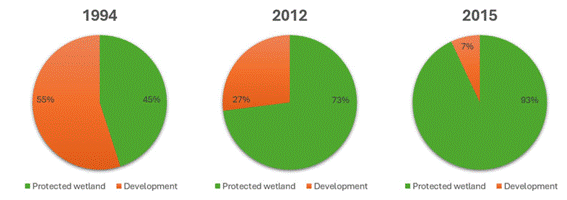
1.1.8 During the prolong planning process, the area of the Development Site was one of the major considerations to minimise the ecological impacts and satisfy the town planning requirement. The development site area has been decreasing during the town planning process and the development scheme with the smallest development footprint is adopted for this Environmental Impact Assessment (EIA). The changes in Development Site area are shown in Table 1.1.
Table 1.1: Development Site Area Changes in Town Planning Applications
|
Year |
Application No. |
Change of Development Site Area and Managed Wetland |
|
1994 |
DPA/YL-NSW/12 |
Development Site area about 98.3ha; Managed Wetland area about 41ha |
|
2012 |
A/YL-NSW/218 |
Development Site area reduced from 98.3ha to 40ha; Managed Wetland area increased from 41ha to 127.7ha |
|
2015 |
A/YL/NSW/242 |
Development Site area reduced from 40ha to 11.6ha; Managed Wetland area increased from 127.7ha to 154.4ha. |
Environmental Impact Assessment Ordinance Submission
1.1.9 A Project Profile (PP-461/2012) for the “Proposed Comprehensive Development with Wetland Enhancement (CDWE) at Nam Sang Wai and Lut Chau” (“the Project”) was submitted to the Environmental Protection Department (EPD) on 27 March 2012 under Section 5(1)(a) of the EIAO. On 7 May 2012, EPD issued an EIA Study Brief for the Project (ESB-244/2012).
1.1.10 The EIA Study commenced in August 2012. While the EIA Study was underway, the Project Proponent gave due consideration to alternative schemes including but not limited to the layout and scale, comparing the benefit and dis-benefits to the environment, as required under Clause 2.1(iii) of the EIA Study Brief, to formulate a preferred comprehensive development scheme that strikes a balance between conservation and development and at the same time enhances the ecological value and function of those degraded and abandoned wetland habitats. The Project Boundary was updated to exclude a piece of land and a section of a stream south of LC to further reduce the project footprint.
1.1.11 In April 2022, the Project Proponent consulted with the Director of Environmental Protection and was advised that as the key components in the Project Profile submitted with the application for the EIA Study Brief had not been altered, and the scope covered by the EIA Study Brief would remain unchanged. Thus, an application for a new EIA Study Brief was not required.
1.1.12 The EIA study was conducted for the Project in accordance with the requirements of the EIA Study Brief and the Technical Memorandum on Environmental Impact Assessment Process (EIAO-TM). The purpose of this EIA Study is to provide detailed assessment on the potential environmental impacts and environmental benefits arising from the construction and operation of the Project.
1.2.1 The Project consists of two separate sites located in NSW and LC with total area of 177.3ha which comprises 154.4ha of managed wetland, 11.6ha of Development Site providing 2,521 residential units with a design population of 6,500, 3.3ha of public park cum visit centre and a proposed bridge.
1.2.2 The Development Site is in the southern portion of NSW, which is farthest away from Inner Deep Bay area, while the NSW WEA creates a buffer area separating the Development Site from Inner Deep Bay and the LCNR creates direct ecological linkages with MPNR. The locations are shown in Figure 1.1. Table 1.2 summarises the major development components of the Project.
Table 1.2: Summary of Parameter of the Major Development Components
|
Development Component |
Development Parameter |
|
Total Managed Wetland |
154.4ha |
|
- LCNR |
55.4ha |
|
- NSW WEA |
99ha |
|
Development Site |
11.6ha |
|
- Residential Use |
Total Gross Floor Area (GFA): 306,581 m2 Total No. of Units: 2,521 |
|
- Houses |
No. of Units: 140 No. of Storeys: 3 Storeys above Basement Car Park |
|
- Apartment Blocks |
No. of Blocks: 28 No. of Units: 2,381 No. of Storeys: 19 to 25 Storeys above Basement Car Park |
|
- Residents’ Clubhouse |
No. of Storeys: 2 Storeys including Basement |
|
- Elderly Centre |
GFA: 6,754 m2 No. of Storeys: 6 Storeys |
|
- Commercial Use |
Area: 1,575 m2 No. of Storey: 1 Storey |
|
- Visitor Centre |
GFA: 1,230 m2 No. of Storeys: 2 Storeys |
|
- Proposed Bridge |
Connecting southwestern part of the NSW site and Wang Lok Street |
|
Note: (1) The Project Site also include (1) Developed Area (~3.0ha); (2) Managed grassland (~1.2ha); and (3) Plantation areas (~7.1ha) in NSW. (2) Approximately 3.3ha managed grassland and plantation area currently available for public use will be preserved in the proposed public park. |
|
1.3.1 The Project aims to conserve and enhance the ecological value and functions of the existing fishponds and abandoned wetlands by creating new wetland habitats and putting into place long term conservation management plans while providing comprehensive residential development. The Project is a designated project under Item P1, PI Schedule 2 of the EIAO, “A residential or recreational development other than New Territories exempted houses, within Deep Bay Buffer Zone 1 or 2.”.
1.3.2 Following amendments made to the relevant ordinance to optimize the EIAO process in 2023, this project is no longer classified under the designated projects listed in EIAO Schedule 2 Part 1 Category Item A.8 (i.e., amended wording for this item), Item F.3(b) (i) & (v) (i.e., repealed for this item), and Item Q.1 (i.e. amended wording for exception list of this item). Furthermore, the designated project specified in EIAO Schedule 3 Item 1 was repealed, i.e., “Engineering feasibility study of urban development projects with a study area covering more than 20 ha or involving a total population of more than 100 000.”.
1.4.1 This Executive Summary (ES) provides a brief description of the Project and summarises the existing environment of the project, key findings, recommendations and conclusions of the EIA Report for the Project. The ES contains the following information:
● Section 2 - the existing environment, and the key benefits, opportunities, constraints and components of the Project;
● Section 3 - the key findings of the environmental impact assessment;
● Section 4 - the proposed environmental monitoring and audit programme for the Project;
● Section 5 - the summary of environmental outcomes; and
● Section 6 - the conclusions.
2.1.1 The Project consists of two separate sites at NSW and LC in Yuen Long with a total area of 177.3ha. The location and existing condition of the Project Site are described below and the location is shown in Figure 2.1.
2.1.2 NSW is 121.9ha and is currently zoned as "Other Specified Uses (Comprehensive Development and Wetland Enhancement Area 1)" (OU(CDWEA1)) under the Approved Nam Sang Wai Outline Zoning Plan No. S/YL-NSW/9. NSW is also within the boundary of the WCA but not within the Ramsar Site.
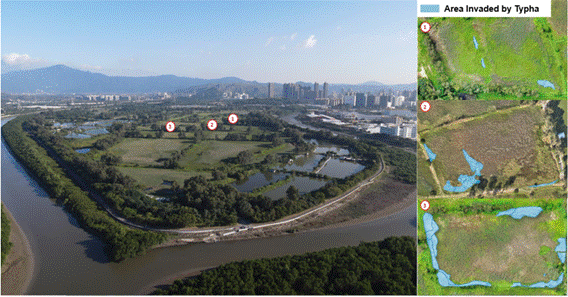
2.1.3 NSW largely consists of fishponds that are managed for fish farming and abandoned fishponds that have been undergone ecological succession through sedimentation and colonisation of vegetation which led to the establishment of the largest area of reedbed (a much rarer habitat than fishpond) in Hong Kong. However, this process is now at a point where the reedbed is drying out and being replaced by common non-wetland habitats of very limited ecological value. Furthermore, the reedbed is being invaded by Typha, an aggressive non-native herb that outcompetes and replaces the reeds, whilst other areas have become degraded by illegal dumping and poor fishpond management practices. Around the perimeter are areas of plantation and an area of grassland used by the public for leisure.
2.1.4 NSW is bounded by Shan Pui River and Kam Tin Main Drainage Channel River to the west and the east, and the Mai Po Inner Deep Bay Site of Special Scientific Interest (SSSI) which is within the Mai Po Inner Deep Bay Ramsar Site to the north. Yuen Long Industrial Estate is situated to the west of NSW across Shan Pui River while the Tung Tau industrial/ business area of Yuen Long Town, which is a mixture of village development and high-rise residential development, are located to the south.
2.1.5 LC is 55.4ha and is currently zoned as (SSSI(1)) under the approved Mai Po and Fairview Park Outline Zoning Plan No. S/YL-MP/8. LC falls within the Mai Po Inner Deep Bay Ramsar Site and is contained within the Mai Po Inner Deep Bay Ramsar Site Management Plan.
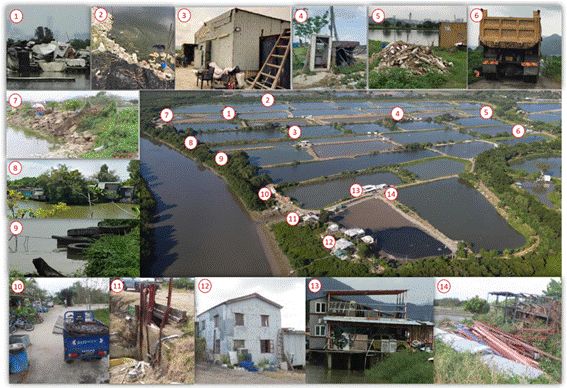
2.1.6 LC is largely used for commercial fish farming; the physical environment is generally poor due to improper management practices and unauthorized activities. These include the storage of materials unrelated to fisheries operation (notably abandoned houses and empty containers), illegal dumping of construction materials/waste and general waste, suction dredging of fishpond mud into adjacent creeks connected to Deep Bay, and the destruction of mangroves to expand fishponds. The latter is particularly destructive, and an analysis of aerial photographs has shown that between 2005 and May 2021, approximately 4.1ha of mangrove (some of which is within the Core Area of the Ramsar Site) have been destroyed. Such improper activities bring additional disturbance to wildlife and this is exacerbated by presence of large numbers of free-roaming dogs and cats, which could cause disturbance to bird using nearby fishponds.
|
Photos of Nam Sang Wai Existing Environment |
|
|
|
Photo taken in January 2024 |
|
|
|
Photos of Lut Chau Existing Environment |
|
|
|
Photo taken in January to April 2024 |
2.2.1 The Project comprises four key components: (i) a Nature Reserve (NR) and Wetland Enhancement Area (WEA), (ii) a public park cum visitor centre, (iii) a Development Site, and (iv) a proposed bridge. This section outlines the opportunities and constraints for the Project.
Conservation of Wetland Habitat
2.2.2 Since 2008, the number of migratory waterbirds in Inner Deep Bay has declined by half and the number has remained low in the past decade. One of the key factors of the decline in waterbirds is the deterioration of wetland habitats because of a lack of proper management and an increase in human disturbance. As echoed in the Strategic Feasibility Study on the Development of Wetland Conservation Parks System Under the Northern Metropolis Development Strategy (hereafter as WCP Feasibility Study Report) “the wetlands still face multiple challenges, including gradual degradation in their ecological value / function due to lack of conservation management, illegal development and fly tipping, etc.” (AFCD, 2024), there is an urgent need for wetland enhancement with long term management planning to conserve the wetland ecosystems in the Inner Deep Bay and Mai Po ecosystem. As elaborated in Section 2.1 above, the condition of the wetland in NSW and LC continues to deteriorate. There is an urgent need to implement the zoning intention of the OZPs to enhance the ecological value and function in these areas.
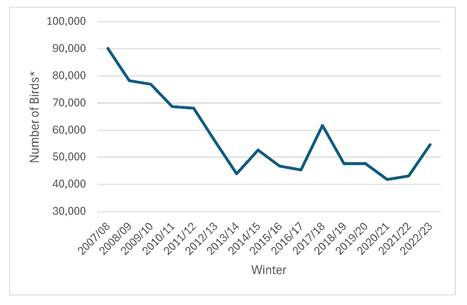
Peak waterbird number in Deep Bay, 2007/08 to 2022/23.
2.2.3 As shown in Table 2.1, it is notable that despite its being immediately adjacent to MPNR and hence its lying in the heart of the Ramsar Site, both the Literature Review and the Baseline Surveys undertaken for this EcolIA revealed that fewer bird species and bird species of conservation importance are present at LC than at NSW. Also, whilst the totals shown in Table 2.1 are not directly comparable, the much greater number of species seen at MPNR is a clear indication of the potential that might be realised at LC with appropriate conservation management in place. The Project thus provides a major opportunity to restore and enhance LC and allow it to fulfil its ecological potential after decades of neglect.
Table 2.1: Number of Bird Species Recorded at NSW, LC and MPNR
|
Avifauna |
NSW |
LC |
MPNR* |
||
|
Literature Review |
Baseline Survey |
Literature Review |
Baseline Survey |
||
|
Number of species of conservation importance |
57 |
55 |
38 |
37 |
248 |
|
Total number of species |
138 |
122 |
79 |
79 |
420 |
|
* The “Mai Po bird species list” (WWFHK, 2022) |
|||||
2.2.4 The WCP Feasibility Study Report also mentioned that “For the area of the Nam Sang Wai / Lut Chau project which is a potential project under the NNCP PPP Scheme that is identified as “Area for Potential Inclusion”, it is approximately 179ha, comprising mainly marsh habitats in Nam Sang Wai and fishpond habitats in Lut Chau. If the area of Nam Sang Wai / Lut Chau project is considered suitable / feasible for inclusion in the NSW WCP in future after further detailed study, the concerned area could be enhanced as ecological habitats and / or eco-friendly aquaculture.” (AFCD, 2024), the area of the NSW WEA and LCNR are demarcated as “Area for Potential Inclusion” in the boundary delineation of the Nam Sang Wai Wetland Conservation Park (NSW WCP), which will be an important element of the WCPs System, which is a crucial component of the Northern Metropolis Development Strategy. The WCPs System is proposed to “create environmental capacity for the development of the Northern Metropolis by enhancing natural habitats and other environmental conditions” (AFCD, 2024). The Project proposals have taken into consideration the possibility of future incorporation of the NSW WEA and LCNR into the NSW WCP.
2.2.5 As mentioned in S.1.1.3, the planning intention of the “OU(CDWEA1)” zone for NSW is to enhance the ecological value and function of the existing fishponds or wetland through development or redevelopment under the “private-public partnership (PPP) approach”. This offers an opportunity for providing long-term conservation and management of the NSW WEA and LCNR through the implementation of the Project.
2.2.6 Originally the Eucalyptus trees planted at NSW were chosen to demarcate the private landholding, but these trees unintentionally became the signature element of the NSW landscape character and a ‘heritage’ feature. They also now provide important roost trees for wintering Great Cormorants. However, they are now reaching the end of their limited life spans of about 60 years. Without the implementation of the proposed management and replanting plan, this important feature of the NSW will gradually be lost.
Promotion of Eco-tourism and Nature Conservation
2.2.7 NSW is frequently visited by the public for nature appreciation, and there are currently no amenities to serve the visitors. There is an opportunity to provide facilities including Nature Trails and Boardwalks, Bird Watching Hides and a Visitor Centre in the Project to cater for the visitors and promote eco-tourism as well as education on nature conservation. These proposals are compatible with the proposed theme of the NSW WCP as “An Eco-tourism Paradise”.
Support Accommodation for Elderly
2.2.8 The elderly population in Hong Kong continues to grow and there is an increasing demand for suitable care home accommodation. The Project is an opportunity to provide Residential Care Homes for the Elderly (RCHE) facilities to meet this need and play a part in promoting a more inclusive community.
Planning Intention of OU(CDWEA1)
2.2.9 The planning intention of NSW site requires that any new building be located farthest away from Deep Bay; accordingly the proposed Development Site is located in the southernmost portion of NSW which is the farthest away from Deep Bay.
Habitat Fragmentation
2.2.10 Bird usage is higher in contiguous and continuous ponds, and fragmentation or disturbance can reduce their habitat use and the number of birds present. To address this, the design of the NSW WEA and the LCNR needs to provide a large area of interconnected ponds, both to conserve the existing function of the ponds and maintain their continuity and contiguity. As well as avoiding the Eucalyptus clusters which are the roosting sites for the Great Cormorants, the Development Site is located where it will entirely avoid fragmentation as a result of interruption of flightlines used by the cormorants flying from the roosting sites to their feeding areas, as well as flightlines of other species such as egrets.
No-net-loss of Wetland Function
2.2.11 Any development impact must be compensated for by maintaining no net loss in wetland function. In this regard, the Project will result in no net loss in wetland function whilst the proposed NSW WEA and LCNR will achieve a level of wetland function that considerably greater than the existing condition.
Ecological Constraints
2.2.12 Within the Project Site, there are existing groups of Eucalyptus trees in NSW which form an important roosting site for Great Cormorants, while existing mangroves at NSW and LC also provide habitat for Mai Po Bent-winged Fireflies. Conservation of these roosting sites and habitats, as well as the need to avoid blocking the flightlines of the cormorants between their roosting sites and foraging areas and other flightlines of birds impose constraints on the Project’s layout and design.
No Net Increase in Pollution Load in Deep Bay
2.2.13 The Deep Bay catchment is recognised as being a highly sensitive ecological area with a requirement for ‘no net increase in pollution load’ from development activities. To meet this requirement, the Project will include design and operational measures to prevent pollution discharge into the surrounding rivers during the construction and operational phases. The sewerage facilities of the development will be connected to the Yuen Long Sewage Treatment Works at the north of Yuen Long Industrial Estate.
2.2.14 An ancestral hall of Shan Pui Village is located nearby, making it crucial for the Project to maintain a Fung Shui corridor for the village after the consultations with the villagers. The layout of the houses and apartment blocks will be designed in a way that minimizes the impact on the Fung Shui Corridor which runs in a north-south direction. This imposes another constraint in the planning of the development.
Conservation before Development
2.3.1 To minimise and compensate for the adverse environmental impacts of the Project and as a commitment of ecological enhancement, the Project is adopting conservation before construction approach. The construction works of wetland enhancement will be completed in advance of the commencement of construction of the residential portion, such that compensatory habitat will be available for fauna which may be displaced by loss or disturbance to habitats within or in vicinity to the Development Site. Thereafter the Project Proponent intends to adopt for the Additional Option under the New Nature Conservation Policy (NNCP) PPP Scheme regarding the long-term conservation of LCNR and NSW WEA. The requirements of the Additional Option under the NNCP PPP Scheme are that, inter alia, (i) a lump sum contribution be made to the Government, and (ii) the Conservation Portion be surrendered to the Government for management by the Government. In this instance the Conservation Portion shall comprise the LCNR and the NSW WEA, which will be handed over to the Government for long-term conservation works. This will provide a settled and stable environment in perpetuity for nature conservation and ensure no degradation in ecological value of the enhanced habitats.
2.3.2 LC will become a NR and the NSW WEA will also be a managed wetland reserve with some public access.
Enhancement of Biodiversity with Different Habitats Created
2.3.3 At LCNR, the establishment of new wetland habitats (including shallow tidal pond, lily pond and permanently wet reedbed) provide a more diverse mix of habitats and will create habitats suitable for a wider range of species. Conservation management of LCNR will contribute to enhancing ecological connectivity with the Mai Po and Inner Deep Bay wetland ecosystem.
Removal of Illegal Activities, Pollutions and Disturbance
2.3.4 Establishing the LCNR will end damaging and illegal practices there, including the destruction of mangrove in the Core Area of the Ramsar Site. Free-roaming dogs and cats will be removed ending predation and disturbance of wildlife. Despite being adjacent to MPNR, it is notable that Eurasian Otter has never been observed at LC. It is highly likely that this absence is related to high levels of disturbance and the presence of stray dogs (which are known to kill otters in Hong Kong). Provision of suitable conditions for Eurasian Otter will be a conservation priority in the LCNR.
Proper Long-term Management
2.3.5 The implementation of a plan for replacement of the Eucalyptus trees that are reaching the end of their biological life will secure the long-term integrity of the Great Cormorant roosting sites.
2.3.6 At NSW and LC, a Mangrove Management Plan will be formulated to ore and maintain native mangrove areas. Areas that have been filled and invasive exotic plants will be removed and replaced with native mangrove communities creating a habitat for the Mai Po Bent-winged Firefly, and other mangrove-dependent species.
Synergistic Effect on Conservation of Inner Deep Bay Wetland Ecosystem
2.3.7 Only 11.6ha of the Project Site will be developed. With the implementation of the Project, 154.4ha (99ha at NSW and 55.4ha at LC) of enhanced wetland will be made available in a few years’ time and added to the managed and protected wetland network in Inner Deep Bay. This equates to about 72% of the area of MPNR or about 45% of the proposed Sam Po Shue Wetland Conservation Park.
2.3.8 In para. 167 of its Decision on 31 December 2021, the TPAB quoted from the Appellant’s case that “It is considered that by a combination of fish pond enhancement and the creation of a more intensely managed reedbed and marshland area it is realistic to predict that at least a doubling in the carrying capacity of the current fish pond habitat can be achieved overall”, and stated “We accept that the statement (which referenced the LMC Environmental Impact Assessment) [is] objective and reasonable. There is no good practical reason why the extent of enhancement at the NSW and LC sites combined would not at least double (TPAB’s emphasis).
2.3.9 Indeed, as is referenced in para. 137 of its Decision, the LMC EEA achieved an enhancement factor of 5 times. With a much larger area and a location much closer to the key intertidal mudflats and MPNR area, there is a strong likelihood that the NSW WEA and the LCNR will achieve a similar degree of enhancement of wetland function. As found in the TPAB, the enhancement would be at least double, and up to some 5 times (para. 169 of its Decision). As this enhancement is higher than the levels of enhancement required to mitigate for the impacts of the Project, NSW WEA and the LCNP may potentially result in a significant contribution to ecological conservation and increasing the environmental capacity of the Inner Deep Bay wetland ecosystem in perpetuity.
Additional Conservation Initiatives
2.3.10 The peripheral bund at LCNR will be raised to create safe high tide roosting sites for shorebirds and other species using the intertidal mudflats of Deep Bay, considering storm surges and compensate for some of the impacts to the mudflat in Deep Bay Area from rising sea levels caused by climate change.
2.3.11 The LCNR will also create a permanent and safe site for egrets to roost and potentially breed, providing an island sanctuary for egrets and other bird species thereby contributing to their conservation.
2.3.12 Though Eurasian Otter was not found during the recent ecological survey, otter holts will be provided in the WEA as an additional conservation initiative in case they appear again in the future.
Promotion of Sustainable Fisheries
2.3.13 With the implementation of fishpond enhancement works and management measures, it is anticipated that the fishponds in LCNR and NSW WEA will be managed and operated in an environmentally sustainable manner. The overall aquaculture environment and quality of fisheries resources in both NSW WEA and LCNR will be significantly improved; in conjunction with the comprehensive wildlife management measures proposed in the CMP, the Project will result in a significant improvement in the overall environment of LC and NSW.
2.3.14 The existing public park to the west of NSW is popular for recreational activities including pre-wedding photo shoots, outdoor fitness training, informal sports activities, exercising dogs, and bird watching. This area will be retained as a public park that is separated from the NSW WEA, with improvement works designed to retain the existing character of the area while enhancing the user-friendliness and safety for enjoyment by the public.
2.3.15 The proposed visitor centre provided with small convenience shop and café to cater for the visitors and space for educational activities, group activities and bird watching will help to promote eco-tourism and education on nature conservation.
2.3.16 An elderly centre, a unique 6-storey building designed for RCHE use, is proposed at an exclusive location in the northern part of the Development Site, away from traffic noise and having a magnificent view of and adjacent to the wetland and public park. The elderly centre will provide quality accommodation for the elderly in a serene environment and contribute to easing the shortage of RCHE facilities.
2.3.17 The proposed Development Site will provide a total of 2,521 residential units, comprising dwellings of various sizes, to meet the long-term housing demand of Hong Kong.
2.3.18 The project proponent shall explore with relevant government departments to obtain agreement to access the government land within LCNR and NSW WEA for implementation of the wetland enhancement works. The Project Proponent will carry out the wetland enhancement work on the Conservation Portion of the Project Site before surrendering the private land and making a lump sum contribution to the Government adequately for the long-term management and maintenance of the Conservation Portion (i.e. LCNR and NSW WEA), subject to (i) the Government’s acceptance of the Project Proponent’s application/proposal for and (ii) the Project Proponent’s compliance with the requirements of the NNCP PPP Scheme.
2.3.19 The Project proposals will be in line with the objectives of the proposed NSW WCP as “An Eco-tourism Paradise” by providing facilities including Nature Trails and Boardwalks, Bird Watching Hides and a Visitor Centre to cater for the visitors and promote eco-tourism as well as education on nature conservation. The Project proposals also aim at enhancing the existing wetland ecological value and function by wetland creation for target species that will also benefit to other wetland fauna with long-term management plan in order to “create environmental capacity for the development of the Northern Metropolis” as is stated in AFCD’s WCP Feasibility Study Report.
2.4.1 It is anticipated that the situation of Project Site remains status quo without the implementation of the Project. The abandoned fishponds within the NSW will continue to degrade through sedimentation and colonisation of exotic vegetation. NSW ultimately will lose the wetland function and the important natural feature of the NSW site will be completely lost. Besides, as mentioned in S.2.1.6, the illegal activities, pollutions and disturbance at LC were observed and these are highly disturbing the habitats at LC and subsequently invading the mangrove habitat. The continuous lack of proper management and illegal acts (e.g., mangrove destruction) in the areas are expected to cause further environmental degradation, leading to decreasing in ecological value and biodiversity.
2.4.2 It is foreseeable that unless the Project Site be developed in a comprehensive manner with long-term wetland enhancement and management, the area will continue to undergo degradation and would not achieve the wetland conservation objectives and zoning intention.
2.5.1 During the planning stage, it was concluded that the Development Site should be located in the southern portion of the NSW site which is farthest away from the Inner Deep Bay area, which is the least ecologically sensitive part of the site. To further develop various alternative layout options, the Project Proponent has considered the environmental constraints and the relevant requirements under the OU(CDWEA1) zone in the OZP. In particular, the ecological impacts should be taken into consideration to avoid disturbance to the adjacent recognized conservation importance sites and important habitat areas during the construction and operation phases of the Project.
2.5.2 The consideration of development alternatives has focused on balancing ecological enhancement and housing provision. The scenarios of two alternative development options (i.e., Development Option A, Development Option A - Approved under the Town Planning Application, and Development Option B) have been considered.
● Development Option A comprises 154.4ha of managed wetland conservation area and 11.6ha of Development Site with total domestic gross floor area is about 306,581 m2. The Development Site is located within the NSW portion of the site and as far to the south as possible which is located furthest from Deep Bay and in a less ecologically sensitive location. This layout option has also considered the reconfiguration and re-profiling of ponds to provide larger wetlands to ensure no net loss of water surface area with minimum pond filling activities.
● Development Option B comprises 127.7ha of managed wetland conservation area and 40ha of Development Site with total domestic gross floor area is about 306,581 m2. The amount of wetland lost is approximately 8.5ha, this development option has addressed the wetland functionality by replacing the ecologically low-value lake within the Development Site, with an additional 9.2ha of high-value continuous reedbed in the wetland enhancement area.
2.5.3 The total area of the Project Site remains unchanged when considering alternatives, the area of the Development Site has reduced significantly from 40 ha in Development Option B to 11.6 ha in Development Option A and the area of the NSW WEA increased from 70.9ha to 99ha. During the planning application stage, the MLP of Development Option A has been reviewed and refined to incorporate mitigation measures on ecological impacts such as providing a greater buffer distance from residential towers to roosting sites of Great Cormorants and avoiding lights on the façade facing the firefly habitat through a series of single aspect buildings. Development Option A - Approved under the Town Planning Application is considered to be the best option for achieving the conservation objectives of the Project and resulting in the least environmental impact. Development Option A - Approved under the Town Planning Application has been selected as the preferred option and adopted in this EIA. Specific mitigation measures for further minimising environmental impacts to acceptable levels are provided in the respective Chapters.
2.5.4 Three alternative options for vehicular access to the Project Site were also considered.
● Option 1: Upgrading the existing NSW Road along the Kam Tin Main Drainage Channel (KTMDC), linking back to Castle Peak Road near the Au Tau interchange;
● Option 2: A bridge across the KTMDC to the northeast, joining Castle Peak Road near Wing Kei Tsuen; and
● Option 3: A bridge connecting directly across the Shan Pui River. Since the bridge alignment overlaps with the site boundary of a concurrent project (i.e., Yuen Long Barrage Scheme), the bridge alignment has been revised. The revised bridge alignment slightly differs from the bridge alignment in the planning submission.
2.5.5 Significant impacts on the channel and the wetland birds utilizing it are expected due to upgrading a long section of the existing NSW Road along the KTMDC for Option 1. For Option 2, footings on the river are required for the bridge, resulting in direct impacts on the KTMDC. Option 3 is the shortest route, providing a convenient connection to Yuen Long Town and the Long Ping MTR Station. This shorter route leads to a reduced construction period, resulting in less environmental and ecological impacts during the construction phase compared to the other two options.
2.5.6 Considering of the environmental and ecological impact, Option 3 has been selected as the preferred vehicular access option.
2.6.1 Major construction activities and methods involved will be generally in line with the residential development project with wetland restoration in the North West New Territories. The Project is expected to involve three key forms of construction, namely wetland enhancement, site formation, and building construction.
2.6.2 The construction/enhancement of NSW WEA and LCNR mainly consists of re-profiling the existing ponds and bund area. During the pond reprofiling, the pond needs to be dewatered before the reprofiling works, the water will be pumped to adjacent ponds for temporary storage within the Project Site and will not be discharged into surrounding rivers or Deep Bay to avoid water pollution.
2.6.3 The site formation is all conventional methods which include site clearance, excavation, and filling. Site formation work has been planned to be undertaken in three phases, with the northern portion to commence first. Considering the nature and distance of surrounding sensitive receptors, the potential of moist excavated material and the site area, open cut with temporary cut slopes is considered to be the preferrable method for excavation.
2.6.4 The Project will consist of a mix of low-rise houses and high-rise residential buildings. Mini-piles or box footing is considered to be adopted for the foundation of the 3-storey houses, elderly centre, clubhouses, commercial centre, and visitor centre. Due to the sensitivity of the surrounding environment, the foundation of the high-rise residential buildings is expected to be in the form of reinforced concrete columns (i.e., large diameter bored piles) instead of percussive piling to avoid significant noise impact.
2.6.5 The proposed bridge over the Shan Pui River will be constructed without pier structures within the river, it will be supported by abutments on both sides of the riverbank. Piling and modification works would be required on both sides of the riverbank to construct the bridge abutments. No piling or foundation works will be undertaken at the Shan Pui River to avoid direct disturbance of the riverbed.
2.7.1 To minimise and compensate for the adverse environmental impacts of the Project and as a commitment to ecological enhancement, the Project is adopting a conservation before construction approach. The construction works of wetland enhancement will be completed in advance of the commencement of construction of the residential portion, such that compensatory habitat will be available for fauna which may be displaced by loss or disturbance to habitats within or in the vicinity of the Development Site.
2.7.2 The works will begin with pond/wetland enhancement at LC. Once sufficient pond/wetland enhancement works are completed to achieve no-net-loss of ecological function throughout the construction phase of the Project, the construction of the proposed bridge, visitor centre and Phase I of the development at NSW will follow.
2.7.3 The construction of the Project is tentatively targeted for commencement in Q3 2025 and is expected to be completed by Q2 2036.
2.7.4 The population intake for phases 1, 2, and 3 of the Development Site is tentatively scheduled to occur after their respective constructions, specifically in 2030, 2033, and 2036.
2.7.5 The operation of the proposed bridge across the Shan Pui River will be in the first phase, as it will provide service and vehicular access for the first phase of the Development Site and more importantly, access for emergency vehicles.
3.1.1 The EIA process identifies, evaluates, and reports on the environmental impacts and benefits associated with the Project. Mitigation measures have been proposed, where necessary, to prevent certain potential environmental impacts or to minimize them to acceptable levels. Furthermore, environmental benefits have been integrated into the Project wherever feasible.
3.2.1 The air quality impact associated with the construction and operational phases of the Project has been assessed in accordance with the requirements under Clause 3.4.1 and Appendix B of the EIA Study Brief, and Annex 4 and Annex 12 of the Technical Memorandum on Environmental Impact Assessment Process (EIAO-TM).
3.2.2 Potential air quality impacts from the construction works of the Project would mainly be related to fugitive dust arising from site clearance, site formation and excavation works. With proper implementation of the recommended mitigation measures, no adverse air quality impacts at air sensitive receivers (ASRs) due to the Project are anticipated during the construction phase. Since limited diesel PMEs would be operated at the same time under normal operation, with proper maintenance, air quality emissions from such equipment would be limited. Regular site inspections as well as dust monitoring should be undertaken to inspect the construction activities and works area to ensure the recommended mitigation measures are properly implemented. While the potential odour impacts from the construction works would mainly be related to excavation works for fishponds and wetland. With proper implementation of the recommended mitigation measures, adverse construction odour impact would not be anticipated.
3.2.3 Vehicular emissions from road networks, existing bus depots, bus terminus, heavy goods vehicle and coach car parks, and chimney emissions from Yuen Long Industrial Estate, were identified as potential sources of air quality impact. Modelling results concluded that the predicted cumulative results for NO2, RSP, FSP and SO2 at all identified ASRs complied with their respective AQOs. Hence, no adverse air quality impacts arising from the operation of the Project are anticipated.
3.2.4 For the planned air-conditioned visitor centre, no air sensitive uses including openable window/ fresh air intakes of the ventilation system or recreational uses in open space (e.g. sitting area) and any other air-sensitive uses of the proposed development would be located within the 500m buffer from TOC, NH3, H2S, styrene, ethyl benzene and dibutyl phthalate related emission sources. Otherwise, further assessment will be conducted during detailed design stage to demonstrate no adverse air quality impact to the air sensitive use of the planned visitor centre or any other air-sensitive uses of the proposed development.
3.3.1 The ecological impact associated with the construction and operational phases of the Project has been assessed in accordance with the requirements under Clause 3.4.2 and Appendix C of the EIA Study Brief, and Annex 8 and Annex 16 of the EIAO-TM.
3.3.2 The constraints posed by existing ecologically important habitats and species have been carefully taken into account, and requirements of existing conservation-related zonings, including the WCA, the OU(CDWEA1) and SSSI zone have been followed in the Development Site layout and design to uphold the principles of the precautionary approach, no-net loss in wetland and avoidance of habitat fragmentation. With the implementation of the mitigation measures, no unacceptable ecological impacts are anticipated to arise from the Project.
3.3.3 On top of no-net-loss of wetland function the Project also brings the additional ecological function that may provide environmental capacity for the development of Northern Metropolis. Key ecological gains accruing from the Project will include:
· The establishment of new wetland habitats in the LCNR (reedbed, shallow tidal pond, lily pond and permanently wet reedbed) and enhancement of ecological connectivity with the adjoining Mai Po NR;
· Creation of a permanent and safe island sanctuary site for roosting and potentially breeding egrets and other disturbance-sensitive waterbirds in the LCNR;
· Raising of the peripheral bund at LC and provision of tidal mudflat habitat in the LCNR to provide a safe alternative roosting site for migrating shorebirds and other waterbirds, thus mitigating the reduction of the tidal mudflat area as a consequence of rising sea levels caused by global warming;
· Implementation of a mangrove management plan to remove exotic mangrove species at LC and promote the growth of native mangrove and associated plant species, enhancing the habitat quality for local wildlife, especially the Mai Po Bent-winged Firefly;
· Overall, the conserved, enhanced and newly created protected wetland habitats, together with active management, will provide a settled and stable environment for wildlife in perpetuity. This project ensures no degradation in the future by preventing risks to the ecology from fire, degradation through illegal dumping and disturbance, whilst encouraging managed public access and enjoyment of wildlife.
3.3.4 To enhance the conservation of ecologically important site, a Conservation and Management Plan (CMP) is formulated which details a wetland conservation and enhancement scheme, including a long-term maintenance and management plan, and monitoring and implementation mechanism.
3.4.1 The fisheries impact associated with the construction and operational phases of the Project has been assessed in accordance with the requirements under Clause 3.4.3 and Appendix D of the EIA Study Brief, and Annex 9 and Annex 17 of the EIAO-TM.
3.4.2 Fisheries baseline conditions of the Project Site and its 500m Assessment Area have been established from a literature review and supplemented with field verification and drone surveys conducted from January to July 2022. A total of 14.78ha (or 12.1%) of NSW Site and 35.33ha (or 63.7% of LC Site) were occupied by active fishponds. Common fish species were reared in polyculture in the Project Site. Some ponds were used for culture of shrimps.
3.4.3 From a purely wildlife management perspective, converting all the fishponds to conservation wetland and ending all culture fisheries is preferable; indeed, this is the approach adopted in application No. A/YL/NSW/242 which was approved, as noted above, by the TPAB with conditions on 31 December 2021. However, such an approach would have a considerable impact to culture fisheries. To mitigate for this potential loss the following fisheries mitigation measures are proposed:
· The retention of culture fisheries at NSW covering an area of 14.78ha;
· Culture fisheries operations will resume in 10.75ha of currently inactive/ abandoned ponds at NSW;
· Some of the active fishponds (10.28ha in total) in the eastern portion of LC will be retained for culture fisheries;
· The creation of a 5.11ha shallow tidal pond in LC to be operated as a gei wai during summer periods with associated culture fisheries operations.
3.4.4 Under the Proposed Scheme, about 20ha of active fishponds in LC will be converted into other managed wetlands in the future LCNR under the proposed scheme. The measures above result in a residual loss of 9.25ha of active fishponds, equivalent to 0.8% of total pond area in Hong Kong. The anticipated fisheries impact from loss of active fishpond areas is considered to be “Slight” in the Hong Kong context.
3.4.5 The Project is not expected to result in any temporary occupation or suspension of operation of fishponds outside the Project Site. All the access to existing fishponds outside the Project Site will be maintained throughout the construction and operation of the Project. With full implementation of mitigation measures and good site practices as addressed in the Water Quality Impact Assessment and Waste Management Chapters of this EIA, no significant direct and indirect fisheries impacts from potential degradation of aquaculture environments are anticipated.
3.4.6 In fact, in overall terms there will be a major improvement in the aquaculture environment, with the removal of materials unrelated to fisheries (abandoned houses, empty containers, construction materials, general waste), a cessation of dumping of construction waste, suction dredging of fishponds and dumping of sediment into adjacent creeks connected to Deep Bay, and the destruction of mangroves to expand fishponds.
3.5.1 The water quality impacts associated with the construction and operational phases of the Project has been assessed based on the criteria and guidelines as stipulated in Annexes 6 and 14 of the EIAO-TM and the requirements described in Section 3.4.4 and Appendix E of the EIA Study Brief.
3.5.2 The Project is located within the Deep Bay Water Control Zone and is surrounded by rivers, ponds, and wetland habitats. Existing water quality in the area is generally graded as ‘Bad’, primarily due to low dissolved oxygen and high ammonia-nitrogen. Construction and operation of the Project will involve alterations to existing ponds within NSW and LC and converting a portion of the existing ponds within NSW into residential development, including provision of associated infrastructure, drainage, sewerage, and the proposed bridge over Shan Pui River.
3.5.3 The main potential water quality impacts associated with construction activities include polluted runoff from the construction site, disturbance of waterbodies within the Project Site, accidental spillage and leakage, sewage effluent from construction workers and other general construction activities. The proposed pond reprofiling works within the LCNR and NSW WEA will be hydraulically isolated from surrounding ponds and will not be drained to surrounding rivers, while appropriate drainage and sedimentation measures will be adopted within the Development Site to contain and treat any polluted runoff. No direct disturbance or alterations to waterbodies outside of the Project Boundary is anticipated with the proposed construction method for the proposed bridge. Other potential water quality impacts associated with spills, sewage effluent and general construction activities will be mitigated through application of best practice measures for chemicals and chemical wastes, provision of portable toilets, training of construction workers and good housekeeping practices onsite. Application of the recommended mitigation measures will be adequate to prevent adverse water quality impacts during construction phase.
3.5.4 During operational phase, the main water quality concerns relate to potential discharges from normal operation of the managed LCNR and NSW WEA and the Development Site. As part of the future management regime of the LCNR and NSW WEA, direct discharge of drain down water from the ponds to the adjacent rivers will not be permitted to avoid affecting water quality offsite, while the Development Site will adopt an “On-site Detention” approach with measures to minimise runoff and provision of an underground retention tank to settle out pollutants before discharge. With these measures, the pollution loading due to surface runoff generated by the Development Site will be adequately controlled. Sewage generated from the development will be conveyed to the Yuen Long Sewage Treatment Plant through the government sewerage system. For the proposed private underground sewage pumping station, standby pumps and electricity supply will be provided to ensure continuous operation during maintenance or mechanical failure. A contingency plan will also be in place to respond effectively to unforeseen incidents.
3.6.1 The waste management implications associated with the construction and operational phases of the Project has been assessed based on the criteria and guidelines as stipulated in Annexes 7 and 15 of the EIAO-TM and the requirements described in Section 3.4.5 and Appendix F of the EIA Study Brief.
3.6.2 Potential waste management implications from the generation of waste during the construction phase have been evaluated. Waste types generated by the construction activities of the Project would include construction and demolition (C&D) materials, excavated pond mud and marine deposit, general refuse, and chemical waste.
3.6.3 C&D materials will be generated from site clearance, site formation and construction of infrastructures and new buildings, and pond/wetland enhancement at NSW Site and LC Site. At NSW Site, during site clearance, site formation, construction of infrastructures, and pond/ wetland enhancement, it is estimated that approximately 288,000 m3 inert C&D material and 52,200 m3 non-inert C&D material would be generated whilst it is estimated that approximately 68,200 m3 inert C&D material and 100 m3 of non-inert C&D material are anticipated during pond/wetland enhancement of construction phase at LC Site. During construction phase of new buildings at NSW Site, approximately 29,400 m3 inert C&D material and 2,600 m3 non-inert C&D material will be generated.
3.6.4 Excavated pond mud and marine deposit for basement construction and proposed bridge abutment constructions would need to be excavated. It is estimated that 159,700 m3 of excavated pond mud and marine deposit will be generated, and the whole quantity generated is proposed to be reused on-site after treatment.
3.6.5 Other waste materials, including general refuse (approximately less than 650 kg per day) from construction workforce and chemical waste (in the order of few hundred litres per month) from maintenance activities of plants and equipment will also be generated throughout construction. Provided that these identified wastes will be handled, transported, and disposed of using the recommended methods and that good practices would be strictly followed, adverse environmental impacts are not expected.
3.6.6 Measures, including the opportunity for on-site sorting, reusing C&D materials, reusing pond mud and marine deposit etc, have been explored to minimise the surplus materials to be disposed. Pre-cast construction method have been recommended for implementation by the Contractor during the construction period to minimise waste generation and off-site disposal. Measures for yard waste avoidance, recycling and reuse have been recommended to achieve yard waste minimization.
3.6.7 The types of waste that will be generated during the operational phase have been identified. The main waste types to be generated will be general refuse, chemical waste, and screenings. It is estimated that the municipal solid waste in around 15.0 tonne per day and chemical waste in a few hundred liters per month for Nam Sang Wai Site during Operational Phase would be generated. While for operation of the sewage pumping station, approximately 1.13 m3 screenings per month would be produced. Recommendations have been made to ensure proper treatment and disposal of these waste.
3.6.8 With the implementation of recommended mitigation measures, the storage, handling, transportation and disposal of waste during construction and operation of the Project is not anticipated to cause adverse environmental impact.
3.7.1 The land contamination assessment examined the potentially contaminated land uses in accordance with Section 3 (Potential Contaminated Land Issues) of Annex 19 “Guidelines for Assessment of Impact on Sites of Cultural Heritage and Other Impacts” of the EIAO-TM, and the requirements described in Clause 3.4.6 and Appendix G of the EIA Study Brief.
3.7.2 Site appraisal comprising site reconnaissance survey, review of historical aerial photographs, and review of historical spillage and leakage records was undertaken at the Assessment Area. Based on the findings from the site appraisal, no potentially contaminated area within the Assessment Area is identified. As no potential land contamination impact has been identified for the Project, no specific mitigation measure is recommended. No further site investigation works, or EM&A requirements are considered necessary for the Project.
3.8.1 The noise impact assessment has been conducted in accordance with the criteria and guidelines as stated in Annex 5 and Annex 13 of the EIAO-TM as well as the requirements given in Clause 3.4.7 and Appendix H of the EIA Study Brief.
3.8.2 Construction noise associated with the use of powered mechanical equipment for different phases of construction has been assessed. With the implementation of practical mitigation measures including good site management practices, adoption of quieter construction method/quality powered mechanical equipment, and use of movable noise barrier, construction noise impacts at all the neighbouring residential noise sensitive uses would be controlled to acceptable levels. With the recommended mitigation measures in place, construction noise impacts on all representative noise sensitive receivers (NSRs) would comply with the relevant criteria.
3.8.3 Road traffic noise impact on the representative existing and planned noise sensitive uses have been predicted. All representative NSRs would comply with the relevant criteria.
3.8.4 Fixed noise source impact assessment has been conducted for all existing and planned fixed noise sources. All representative NSRs would comply with the relevant criteria. Noise impact from planned fixed noise source under this Project (i.e., proposed private underground sewage treatment plant) could be effectively mitigated by implementing noise mitigation measure at source (e.g., enclosed with acoustic silencers). No adverse fixed noise impact is anticipated.
3.9.1 The landscape and visual impact assessment is conducted in accordance with the EIAO-TM Annex 10 and Annex 18, the EIA Study Brief Clause 3.4.8 and Appendix I, and the EIAO Guidance Note No. 8/2010. In the proposed development, there will be landscape and visual impacts as a result of the removal of existing vegetation, site formation and new building works, and the wetland enhancement work on the existing ponds and wetland in NSW and LC.
3.9.2 A tree survey has been carried out. It is anticipated that approximately 971 nos. trees would be felled, including 514 nos. of invasive species. 2184 nos. trees are proposed to be planted within the Project Boundary as compensation tree planting for the felling of an estimated 463 nos. of trees (including 353 living trees and 110 dead trees). A detailed Tree Felling Application process will be carried out at a later detailed design stage, to finalize tree treatment and allocate compensatory planting areas including open space, parks within the proposed development.
3.9.3 Within the Development Site, the landscape character of affected Landscape Character Areas (LCAs) will be changed, where a more urbanised character will be introduced into the rural context.
3.9.4 Outside the Development Site but within the Project Boundary, the existing NSW and LC wetland have a number of unmanaged ponds that are gradually colonised by reeds and Typha. Proposed wetland enhancement measures will involve unwanted Typha clearance and pond reprofiling so as to re-delineate wetland habitats for the benefit of ecology. Details of works are outlined in the CMP. This is expected to bring beneficial residual impacts to Landscape Resource areas and Landscape Character Areas within the Project Boundary.
3.9.5 Landscape and visual impacts brought by the proposed development will be mitigated during the construction and operational phases by various measures. During the construction phase, measures will include the proper preservation of existing healthy unaffected trees, advance tree planting, the appropriate screening of construction works, and the control of night-time lighting. During both the construction and operational phases, buffer tree planting is proposed along the Development Site periphery abutting the wetland. The buffer planting extends out of the proposed comprehensive development towards the WEA to form a wider buffer area, mitigating human activities’ disturbance on ecological activities on adjacent wetlands. A sectional illustration of the buffer planting treatment is shown in Figure 3.1. Together with proposed wetland enhancement measures (Briefly mentioned in the above paragraph and further elaborated in the Ecological Impact Assessment), the overall landscape amenity in the NSW and LC wetland areas are expected to be uplifted. Whereas for the visual impact, the proposed development will inevitably create new artificial building structures to the flat plain landscapes of Nam Sang Wai. Proposed tree planting works along the site Periphery are anticipated to slightly mitigate residual impact to some view points.
3.9.6 The assessment concluded that the residual landscape and visual impacts of the proposed development will be Acceptable with the mitigation measures during construction and operational phases.
3.10.1 The potential cultural heritage impacts associated with the construction and operation of the Project has been assessed in accordance with the requirements of Annex 10 and Annex 19 of EIAO-TM as well as the guidelines requirements set out under Clause 3.4.9 and Appendix J of the EIA Study Brief. The Assessment Area covers an area within 500m from the Project Boundary.
3.10.2 No Site of Archaeological Interest, declared or proposed monuments and Government historic sites identified by AMO are located within the Assessment Area.
3.10.3 The archaeological potential is anticipated be minimal at the flat land where Shan Pui and Shan Pui Hung Tin Tsuen are located. The proposed works of the Project are located on areas of man-made deposits like fishponds and wetlands of NSW which are of no archaeological potential. Besides, three Grade 3 historic buildings and twenty-eight other identified items are outside the Project Boundary with adequate separate distance. Cultural heritage impact is not anticipated due to construction and operational phases of the Project. No mitigation measure is required.
3.10.4 As a precautionary measure, pursuant to the Antiquities and Monuments Ordinance (Cap. 53), the project proponent is required to inform the Antiquities and Monuments Office (AMO) immediately in case of discovery of antiquities or supposed antiquities in the course of works, so that appropriate mitigation measures, if needed, can be timely formulated and implemented in agreement with and to the satisfaction of AMO.
3.11.1 The sewerage and sewage treatment implications associated with the construction and operational phases of the Project has been assessed based on the criteria and guidelines as stipulated in Section 6.5 in Annex 14 of the EIAO-TM and the requirements described in Clause 3.4.10 and Appendix K of the EIA Study Brief.
3.11.2 The sewage generated from the construction works in LC and NSW will be adequately collected and treated, therefore no adverse impact is anticipated from sewage and sewerage treatment implication perspective.
3.11.3 During the operational phase, a new sewerage system has been proposed to convey sewage generated from the Project to an existing manhole via a new twin rising main connected to the YLSTW/YLEPP, including a private underground sewage pumping station.
3.11.4 A detailed assessment has been conducted in the Sewerage and Sewage Treatment Implications on the impact of the proposed development on the existing sewerage system. The effect on sewerage pipes from the discharge point of the sewage generated by the proposed development to the YLSTW/YLEPP has been evaluated. Results show that the proposed development would increase pipe utilization by 8%, bringing maximum utilization to 98% to the assessed sewerage system after the project is completed. The existing YLSTW/YLEPP was also found to have sufficient capacity to handle the sewage generated by the proposed development.
3.11.5 As such, it is concluded that no adverse residual sewerage impact from the Project would be anticipated.
4.1.1 For the construction phase, environmental monitoring and audit (EM&A) requirements and regular site inspection and audits for air quality, ecological (terrestrial and aquatic), water quality, waste management implication, noise, landscape and visual, and cultural heritage impacts have been recommended to ensure that the recommended mitigation measures will be properly implemented.
4.1.2 For the operational phase, EM&A requirements for ecological (terrestrial and aquatic), water quality, and landscape and visual impacts have been recommended to ensure that the recommended mitigation measures will be properly implemented.
4.1.3 The details of the EM&A requirements for both the construction and operational phases are specified in the standalone EM&A Manual.
5.1.1 The EIA has provided an assessment of the potential environmental impacts associated with the construction and operational of the Project, based on the engineering design information available at this stage. The key outcomes are summarised in Table 5.1.
Table 5.1: Summary of Key Environmental Problems Avoided and Sensitive Areas Protected
|
Design Approaches |
Environmental Problems Avoided and Sensitive Areas Protected |
|
The Development Site has been designed to be furthest from the Deep Bay to avoid fragmentation impacts on MPNR, intertidal mudflat habitat, fishpond and reedbed habitats |
Protects the wetland habitats from fragmentation and minimises potential direct or indirect impacts to the wintering bird population. |
|
The eastern and southern boundaries of the Development Site are defined by 150m radius arcs from the Eucalyptus clusters which are roosting sites for the Great Cormorants. |
To avoid impacts on roosting Great Cormorants. |
|
The layout of the development has been designed to avoid egretry flight-lines and the Great Cormorant roost and flight-lines between the roost and their Deep Bay foraging areas |
Protects flight paths and minimises potential direct or indirect impacts on Great Cormorant roosts |
|
Spacing of towers has been designed to enhance the degree of visual permeability. |
To avoid causing a visual ‘wall’ effect and minimise visual impact |
|
Curtain wall will not be adopted for high buildings |
To avoid bird strike |
|
Buildings facing the mangrove habitat along Shan Pui River where the MPBWF is found will be designed as ‘single aspect’with no windows facing the mangrove habitat. Bamboo and shrubs will be planted along the edge of the development site boundary facing the mangrove habitat. Low level lighting pointing towards the buildings will be used in areas around the mangrove habitat. The vehicular bridge crossing the Shan Pui River will have high parapets with low level lighting at its sides. |
Avoids direct light impacts on the habitat of the MPBWF |
|
A CMP detailing wetland conservation and enhancement, including the design, long-term maintenance, and management, and monitoring and implementation mechanism is provided. In addition, access to the NSW WEA and LCNR will be restricted under the CMP to reduce disturbance to wildlife; |
Avoids further environmental degradation and destruction within NSW and LC through active management and enhances existing wetland habitats |
|
The alignment and location of the proposed bridge have been designed to avoid mangroves on the eastern bank |
Protects mangrove habitat from destruction |
|
The proposed bridge crossing the Shan Pui River will be constructed without the need for any pier structures located within the river boundary |
Avoids direct impediment of water flows and disturbance of riverbed sediments |
|
“On-site Detention”approach for stormwater runoff from the Development Site |
To control and minimise pollution loading due to surface runoff |
6.1.1 With the implementation of the Project, existing wetlands that have been abandoned without proper management will be enhanced, preventing from further degradation of ecological value at the Site of Special Scientific Interest, while new wetlands to be created will further enhance the ecological connectivity and provide positive synergetic effects to the overall Deep Bay ecosystems. Considering the existing ecosystem, ecological objectives in promoting biodiversity, and the wider environment, the habitats at the LCNR and NSW WEA have been selected and planned to the advantage of ecological enhancement. The Development Site footprint of the project has been restricted to 11.6ha. In return, the wetland enhancement covering an area of 154.4ha will contribute positively to the ecological habitat network and formation of a comprehensive system of wetlands. No environmental disbenefits would be envisaged from the proposed comprehensive development with wetland enhancement at NSW and LC.
6.1.2 The EIA Study provided information on the nature and extent of the environmental impacts likely to arise from the proposed comprehensive development and wetland enhancement project during the construction and operational phases. Where necessary, the EIA Study has suggested pollution control and mitigation measures to ensure compliance with the relevant environmental legislation, standards, and guidelines. The summary of the environmental impacts arising from the Project is presented in Table 6.1.
6.1.3 The EIA Report has included an implementation schedule of the proposed mitigation measures. An EM&A Programme has also been recommended to ensure the implementation of the proposed pollution control and mitigation measures are effective. With the implementation of the recommended pollution control and mitigation measures during the construction and operational phases of the Project, the EIA concluded that the Project would comply with the requirements of the EIA Study Brief and EIAO-TM.
6.1.4 As elaborated at Section 2.3.3 above, only 11.6 ha of the Project Site will be used for development. With the implementation of the Project, 154.4ha of enhanced wetland will be made available in a few years’ time. This equates to 72% of the area of MPNR and 45% of the proposed Sam Po Shue Wetland Conservation Park. Wetland enhancement is expected to provide at least double an up to five times the existing ecological value and function of the managed wetland for waterbirds. As this is higher than the levels of enhancement required to mitigate for the impacts of the Project, the NSW WEA and the LCNR may potentially result in a significant contribution to the ecological conservation and carrying capacity of the Inner Deep Bay wetland system, hence providing enormous environmental capacity for the development of the Northern Metropolis.
Table 6.1: Summary of Environmental Impacts / Benefits
|
Sensitive Receivers / Assessment Points |
Impact Prediction Results (Without Mitigation) |
Key Relevant Standards / Criteria |
Extents of Exceedance Predicted (Without Mitigation) |
Impact Avoidance Measures / Mitigation and Enhancement Measures |
Residual Impacts / Benefits (After Implementation of Mitigation or Enhancement Measures) |
|
Air Quality Impact |
|||||
|
Construction Impact |
|||||
|
· Representative existing residential, educational, and industrial developments within 500m from the boundary of the Project Site. · For Phase 2 and 3 of the Construction Phase, representative planned recreational and residential developments and the planned Elderly Centre are to be included. |
Air Quality Impact · Potential sources of air quality impact associated with construction works include excavation, material handling, temporary stockpiling and wind erosion, as well as construction activities of other concurrent projects within the 500m assessment area. |
Air Quality Objectives (AQO) RSP · 24-hr average conc.: 100 μg/m3 (Number of exceedances allowed: 9) · Annual average conc.: 50 μg/m3 FSP · 24-hr average conc.: 50 μg/m3 (Number of exceedances allowed: 35) · Annual average conc.: 25 μg/m3
|
· N/A |
· Good practices for dust control such as regular water spraying at all active work areas, site surfaces and unpaved roads and covering of stockpiles by impervious sheets. · Relevant dust control practices as stipulated in the Air Pollution Control (Construction Dust) Regulation should be adopted: · Good site management and housekeeping. · Hoarding at least 2.4m high from ground level along the works boundary. · Hoarding with a height of 3.5m (subject to site constraints) shall be erected for Phase 2 and Phase 3 construction works boundary. · Covering stockpiling area with impervious sheets and spraying all dusty material with water immediately prior to any load transfer operations. · Vehicles used for transporting dusty materials/spoils should be covered with tarpaulin or similar material. The cover should extend over the edges of the sides and tailboards. · Vehicle wheel washing facilities should be provided at each construction site exit. · The speed of the trucks within the site should be controlled to about 10 km/hour. · Provide power supply for on-site machinery. · Deploy electrified NRMMs as far as practicable. |
· No residual impact is anticipated |
|
|
Odour Impact · Odour Impact from excavation of fishponds and wetland. |
· 5 odour units based on an averaging time of 5 seconds. |
· N/A |
· Limit the number of ponds to be excavated at a time and the duration of works at each pond. · Proper disposal of fishpond/ wetland excavated materials. |
· No residual impact is anticipated |
|
Operational Impact |
|||||
|
· Representative existing residential, educational, industrial, and recreational developments and Elderly Centre within 500m from the boundary of the Project Site. |
Air Quality Impact Year 2030 RSP · 10th highest 24-hr average conc: 52.3 – 62.0 μg/m3 · Annual average: 19.9 – 26.6 μg/m3 FSP · 36th highest 24-hr average conc: 26.1 – 29.2 μg/m3 · Annual average: 12.2 – 14.7 μg/m3 NO2 · 19th highest 1-hr average conc.: 74.1 – 142.3 μg/m3 · Annual average conc.: 13.1 – 33.3 μg/m3 SO2 · 4th highest 10-min average conc.: 51.7 – 123.3 μg/m3 · 4th highest 24-hr average conc.: 8.4 – 24.8 μg/m3 |
AQO RSP · 24-hr average conc.: 100 μg/m3 (Number of exceedances allowed: 9) · Annual average conc.: 50 μg/m3 FSP · 24-hr average conc.: 50 μg/m3 (Number of exceedances allowed: 35) · Annual average conc.: 25 μg/m3 NO2 · 1-hr average conc.: 200 μg/m3 (Number of exceedances allowed: 18) · Annual average conc.: 40 μg/m3 SO2 · 10-min average conc.: 500 μg/m3 (Number of exceedances allowed: 3) · 24-hr average conc.: 50 μg/m3 (Number of exceedances allowed: 3)
|
· Exceedance zones were observed in the contour Figures 3.6A, 3.6B, 3.6E, 3.6G and 3.6H within the Yuen Long Industrial Estate. However, with reference to Appendix 3.12, no air sensitive uses including openable window/ fresh air intakes of the ventilation system or recreational uses in open space are situated within all the predicted exceedance zones. |
· For the planned air-conditioned visitor centre, no air sensitive uses including openable window/ fresh air intakes of the ventilation system or recreational uses in open space (e.g. sitting area) and any other air-sensitive uses of the proposed development would be located within the 500m buffer from TOC, NH3, H2S, styrene, ethyl benzene and dibutyl phthalate related emission sources. |
· No residual impact is anticipated |
|
Ecological Impact (Terrestrial and Aquatic) |
|||||
|
Construction Impact |
|||||
|
· Wetland Habitats (e.g. fishponds, marshes, reedbed, tidal watercourse) · Deep Bay Intertidal areas · Mammal species of conservation importance · Bird species of conservation importance · Great Cormorant Roost · Herpetofauna, odonates and butterflies · MPBWF
|
Direct Impacts · Loss of habitat due to development (Open Water, Reedbed, Brachiaria Marsh, Typha Marsh, Grassy Bund and Wooded Bund) · Loss of fishponds due to conversion of habitat · Sedimentation · Pollution impacts on wetland habitats · Mortality impacts on fauna
Indirect Impacts · Overall disturbance from the project · Light disturbance to fauna · Disturbance impact on Tidal Watercourse · Disturbance impact on Fishpond and Open Water · Disturbance impact on Reedbed · Disturbance impact on Marshes · Disturbance impact on Grassy Bund and Wooded Bund · Disturbance impact on Mangrove · Impact on MPBWF · Disturbance impact on Great Cormorant Roosts |
· Annexes 8 and 16 of the EIAO-TM · EIAO-GN 3/2010 · EIAO-GN 6/2010 · EIAO-GN 7/2023 · EIAO-GN 10/2023
|
· N/A
|
· Development Site footprint was restricted to 11.6ha, only 6.5% of the Project Site. · Following the Planning Intention of OU(CDWEA1), the Development Site is proposed at the southernmost of NSW, farthest away from the Deep Bay. · Light disturbance receivers to be avoided by appropriate design of external lighting and screening. · Bridge design will avoid impacts on the most importance linkage to the wetland habitats · Direct mortality of roosts/nests to be avoided by checking potential roost sites prior to site clearance (including buildings) and rescheduling if necessary. · Good site practice during construction to ensure no silty run-off enters watercourses. · Measures taken to avoid site runoff, including onsite sedimentation facility for treatment and onsite reuse. Stringent control of construction activities to avoid any accidental discharges. · Measures will be taken to reduce noise disturbance by use of quiet machinery. Piling will be conducted using bored piles with a shroud, hence will not be audible above existing background noise levels at the roost and will not be conducted from October to April between the hours of 16:00 and 09:00 when the roost is occupied. · Good site practice, noise management and use of quiet machines (including bored piling), minimising the number of machines working on site at one time and use of visual and noise barrier around works areas. Phasing of construction works to minimise magnitude and area of disturbance impacts. · Loss of 10.7ha wetland habitat due to development will be compensated by enhancement and active management for nature conservation of 154.4ha. · Loss of 9.7ha of Fishpond and 1.0ha Open Water due to conversion of habitat, will be compensated by enhancement of remaining 48.4ha of Fishpond and 1.6ha of Open Water, together with creation of 4.1ha of Lily Pond and 5.1ha of Shallow Tidal Pond. · Loss of 6.2ha Reedbed to be compensated by conversion of Fishpond to Reedbed. Net Reedbed area will be increased by 8.4ha. · Loss of 0.1ha Brachiaria Marsh will be compensated by enhancement of remaining 6.9ha Brachiaria Marsh. · Loss of 0.4ha of plantation will be compensated by planting of 0.2ha of trees and bamboos on an island to be formed at LCNR and 0.2ha of buffer plantation at the northwest of NSW. · 5.1ha of Shallow Tidal Pond habitat will be created at LCNR in advance of commencement of bridge construction to provide compensatory habitat for waterbirds that may be disturbed. · Additional area of 0.3ha of Mangrove will be formed at LCNR. Mangrove at NSW and Lut Chau will be enhanced/restored by removing dumped materials and invasive species. |
· No significant residual impacts. |
|
Operational Impact |
|
|
|
|
|
|
· Wetland Habitats (e.g. fishponds, marshes, reedbed, tidal watercourse) · Other terrestrial habitats (e.g. plantation, · Mammal species of conservation importance · Bird species of conservation importance · Great Cormorant Roost · Herpetofauna, odonates and butterflies · MPBWF
|
· Pollution impacts on wetland habitats · Mortality impacts on fauna · Overall disturbance from the project · Light disturbance to fauna · Disturbance impact on Tidal Watercourse · Disturbance impact on Fishpond and Open Water · Disturbance impact on Reedbed · Disturbance impact on Marshes · Disturbance impact on Grassy Bund and Wooded Bund · Disturbance impact on Mangrove · Impact on MPBWF · Disturbance impact on Great Cormorant Roosts |
· Annexes 8 and 16 of the EIAO-TM · EIAO-GN 3/2010 · EIAO-GN 6/2010 · EIAO-GN 7/2023 · EIAO-GN 10/2023
|
· N/A
|
· Development Site footprint was restricted to 11.6ha, only 6.5% of the Project Site. · Following the Planning Intention of OU(CDWEA1), the Development Site is proposed at the southernmost of NSW, farthest away from the Deep Bay. · Light disturbance receivers to be avoided by appropriate design of external lighting. · Bridge design will avoid impacts on the most importance linkage to the wetland habitats. · All sewage effluent generated in the Developed Site would be conveyed to the Project’s Private underground SPS, and then drained into the government sewer for discharge into the YLEPP. · Restriction of access will reduce the overall disturbance from human activity, compared to existing conditions. · Light disturbance receivers to be avoided by appropriate design of screening. · NSW WEA of 99.0ha and LCNR of 55.5ha (154.4ha in total), will complement the existing MPRN to increase the area of wetland in Deep Bay which is protected and actively managed for the benefit of wildlife. · In addition, a programme of eucalypt planting to ensure long term sustainability of the cormorant roost will be undertaken. |
· No significant residual impacts. Overall, the project is predicted to provide net ecological gain during operation. |
|
Fisheries Impact |
|||||
|
Construction Impact |
|
|
|
|
|
|
· Fishponds at LC and Nam Sang Wai · Adjacent fishponds outside Project site |
Direct Impacts · Loss of Aquaculture Ponds
Indirect Impacts · Degradation of aquaculture environment due to construction site runoff · Potential blockage of existing access during construction works · Dumping of construction waste or excavated materials |
· Water Pollution Control Ordinance (Cap. 358) · Technical Memorandum Standards for Effluents Discharged into Drainage and Sewerage Systems, Inland and Coastal Waters · ETWB TCW No. 34/2002 Management of Dredged / Excavated Sediment · ProPECC PN 2/23 Construction Site Drainage · ProPECC PN 1/23 Drainage Plans Subject to Comment by the Environmental Protection Department · Town Planning Board Guidelines No.12C · ETWB TCW No. 5/2005 Protection of Natural Streams/Rivers from Adverse Impacts arising from Construction Works |
· N/A |
· Minimization of loss of aquaculture ponds 1. Retention of culture fisheries at NSW covering an area of 14.78ha 2. Resumption of culture fisheries in 10.75ha in currently inactive/ abandoned ponds at NSW 3. Retention of 10.28ha culture fisheries in the eastern portion of LC site 4. Creation of a 5.11ha shallow tidal pond in LC to be operated as gei wai during summer periods · Implementation of good site management measures to control induced water quality impact to fishponds. · Maintain access to existing fishponds outside the Project site to ensure no adverse impacts to the logistics of fishpond operation outside the Project site throughout Project construction · Implementation of waste management measures to properly management construction waste disposal. · Removal of materials unrelated to fisheries (abandoned vehicles, containers, construction materials, general waste) and illegally dumped toxic materials, and a cessation of dumping of construction waste, the burning of waste, suction dredging of fishponds into adjacent creeks connected to Deep Bay, and the destruction of mangroves to expand fishponds. The removal of temporary structures, dogs and the reduction in overall levels of disturbance are also expected to be beneficial. |
· Slight impacts from overall loss of ~9.25ha active aquaculture ponds
· Overall aquaculture environment and quality of fisheries resources in both NSW WEA and LCNR will be significantly improved from implementation of the Project and CMP. |
|
Operational Impact |
|
|
|
|
|
|
· Fishponds at LC and Nam Sang Wai · Adjacent fishponds outside Project site |
· Potentially induced water quality impact to fishponds from sewage and runoff from the proposed Development Site · Potential blockage of access to existing fishpond outside the Project site during Project operation · Increased disturbance impacts from visitors to NSW WEA · Deterioration of aquaculture environment and fisheries resources |
· Water Pollution Control Ordinance (Cap. 358) · Technical Memorandum Standards for Effluents Discharged into Drainage and Sewerage Systems, Inland and Coastal Waters · ETWB TCW No. 34/2002 Management of Dredged / Excavated Sediment · ProPECC PN 1/23 Drainage Plans Subject to Comment by the Environmental Protection Department · Town Planning Board Guidelines No.12C |
· N/A |
· Implementation of mitigation measures to control water quality impacts during Project operation. · Maintain access to existing fishponds outside the Project site to ensure no adverse impacts to the logistics of off-site fishpond operation · Public access to NSW WEA and LCNR will be tightly controlled, and boardwalks will be constructed at suitable locations to facilitate visitor access at NSW. · Good site management measures issued in AFCD’s Good Aquaculture Practices Series shall be followed to ensure site hygiene and prevent deterioration of water environment. · Quality fish feed and effective measures will be implemented to manage fish stocking to ensure healthy fry are stocked and maintain good quality of fish production |
· No deterioration of aquaculture environment is anticipated during Project operation.
· Overall aquaculture environment and quality of fisheries resources in both NSW WEA and LCNR will be significantly improved. |
|
Water Quality Impact |
|||||
|
Construction Impact |
|||||
|
· Shan Pui River · Kam Tin River · Mai Po Nature Reserve · Inner Deep Bay Estuary / Mudflats · Nam Sang Wai Wetlands · Intertidal Ponds in Shan Pui River · Fishponds at Lut Chau, Tai Sang Wai, Fung Lok Wai and Nam Sang Wai · Drainage Channels in Tsai Sang Wai and around Lut Chau |
· Construction site runoff containing high loads of suspended solids and other pollutants can adversely affect water quality. · Direct disturbance of waterbodies causing agitation of settled sediments and disruptions to existing flow patterns leading to changes in erosion and sedimentation. · Accidental spillage and/or leakage of chemicals, fuels and oils may contaminate the ground and get washed into adjacent drainage channels or ponds. · Untreated sewage discharge into waterbodies causing odour and deterioration in water quality. · Windblown refuse and litter into adjacent waterbodies. · Vehicles entering and leaving construction sites tracking mud and dirt onto public roads. |
· Water Pollution Control Ordinance (Cap. 358) · Technical Memorandum Standards for Effluents Discharged into Drainage and Sewerage Systems, Inland and Coastal Waters · ETWB TCW No. 34/2002 Management of Dredged / Excavated Sediment · ProPECC PN 2/23 Construction Site Drainage · ProPECC PN 1/23 Drainage Plans Subject to Comment by the Environmental Protection Department · Town Planning Board Guidelines No.12C · ETWB TCW No. 5/2005 Protection of Natural Streams/Rivers from Adverse Impacts arising from Construction Works |
· N/A |
· During pond reprofiling and bund removal / reprovisioning works, the affected ponds will be hydraulically isolated from surrounding ponds · Good site management measures including those specified in ProPECC PN2/23 will be adopted to hydraulically isolate the construction works sites and prevent ingress of runoff from outside the construction sites as well as egress of construction site runoff to surrounding areas. · Measures will be taken to minimise the generation of wastewater onsite and an emergency response plan will be developed to minimise potential water quality impacts under emergency or severe inclement weather conditions. · Avoid direct disturbance or alterations to waterbodies outside the Project Boundary as no structures are proposed to be erected within any waterbody surrounding the Project Boundary. · The proposed bridge over the Shan Pui River will be constructed without the need for any pier structures located within the river boundary. · Onsite storage of chemicals, fuels and oils will be prohibited within the LCNR and NSW WEA areas, while within the Development Site, best practice measures on labelling, handling, storage, use, transport and disposal will be implemented to minimise the risk of accidental spills and leaks. · Adequate numbers of portable toilets will be provided onsite and a licensed waste collector will be employed to transport the sewage effluent to a suitable government sewage treatment facility offsite. · Good housekeeping practices at the construction site will be implemented. Stockpiles of materials will be secured and covered; refuse bins will be provided and emptied regularly; wheel washing facilities will be provided at each site entrance / exit to ensure the wheels and body of the vehicles are free from mud and dirt before leaving the construction site. |
· No residual impact is anticipated |
|
Operational Impact |
|||||
|
· Shan Pui River · Kam Tin River · Mai Po Nature Reserve · Inner Deep Bay Estuary / Mudflats · Nam Sang Wai Wetlands · Intertidal Ponds in Shan Pui River · Fishponds at Lut Chau, Tai Sang Wai, Fung Lok Wai and Nam Sang Wai · Drainage Channels in Tsai Sang Wai and around Lut Chau |
· Any discharge from the freshwater ponds into the surrounding rivers during pond drain down can have an impact on the water quality of the rivers. · Non-point source pollution associated with surface runoff from roads and paved areas will get washed into nearby drains and rivers, causing increased turbidity and water quality deterioration over time. · Sewage effluent from operation of the Project will cause deterioration in water quality if discharged directly into the surrounding environment. |
· Water Pollution Control Ordinance (Cap. 358) · Technical Memorandum Standards for Effluents Discharged into Drainage and Sewerage Systems, Inland and Coastal Waters · ETWB TCW No. 34/2002 Management of Dredged / Excavated Sediment · ProPECC PN 1/23 Drainage Plans Subject to Comment by the Environmental Protection Department · Town Planning Board Guidelines No.12C |
· N/A |
· For all freshwater ponds, no discharge of drain down water will be permitted into the adjacent rivers. · Sediment from desilting of ponds will either be reused onsite or disposed to landfill or other licensed waste facility offsite. · Within the Development Site, an “On-site Detention” approach will be adopted, including underground detention tank, bioswales and permeable paving. · All sewage generated by the Project will be collected by the internal sewerage network and pumped to the existing public sewers that will convey the sewage to the existing Yuen Long Sewage Treatment Works. · Swimming pool drain down water will be discharged to the underground stormwater detention tank. · Standby pumps and electricity supply will be provided for the sewage pumping station to ensure continuous operation during maintenance or mechanical failure. No overflow will be permitted. A contingency plan will also be implemented. · No piers will be erected within the river, hence no impediment of water flows or flow regimes within Shan Pui River. |
· No residual impact is anticipated |
|
Waste Management Implications |
|||||
|
Construction Impact |
|
|
|
|
|
|
· N/A |
· C&D materials will be generated from site clearance, site formation and construction of infrastructures and new buildings, and pond/wetland enhancement at NSW Site and LC Site. At NSW Site, around 288,000 m3 inert C&D material and 52,200 m3 non-inert C&D material would be generated from site clearance, site formation, construction of infrastructures, and pond/ wetland enhancement. At LC Site, around 68,200 m3 inert C&D material and 100 m3 of non-inert C&D material would be generated from pond/wetland enhancement. While for construction of new buildings and structures at NSW Site, approximately 29,400 m3 inert C&D material and 2,600 m3 non-inert C&D material will be generated. · Approximately 159,700 m3 of excavated pond mud and marine deposit will be generated, and the whole quantity generated is proposed to be reused on-site after treatment. · Chemical wastes will be generated from maintenance and servicing of construction plant and equipment at a few hundred litres per month. · Approximately less than 650 kg per day of general refuse will be generated from workers. |
· Annexes 7 and 15 of the EIAO-TM · Waste Disposal Ordinance (Cap. 354) · Waste Disposal (Chemical Waste) (General) Regulation (Cap. 354C) · Waste Disposal (Charges for Disposal of Construction Waste) Regulation (Cap. 354N) · Land (Miscellaneous Provisions) Ordinance (Cap. 28) · Public Health and Municipal Services Ordinance – Public Cleansing and Prevention of Nuisances Regulation (Cap. 132BK)
|
· N/A |
· Implementation of good site practices, waste reduction measures and proper storage, collection and transport of waste. · Careful design, planning and good site management to reduce generation of C&D materials. · Monitoring of disposal of C&D waste with trip-ticket system and the dump trucks engaged on-site should be equipped with GPS or equivalent automatic system for real time tracking and monitoring of their travel routings and parking locations. |
· No residual impact is anticipated |
|
Operational Impact |
|
|
|
|
|
|
· N/A |
· Chemical wastes in the order of a few hundred liters per month will be generated from maintenance activities on the road networks and the sewage pumping station. · Around 15.0 tonnes per day of municipal solid waste would be generated. · About 1.13 m3/month of screening will be generated from the sewage pumping station. |
· Annexes 7 and 15 of the EIAO-TM · Waste Disposal Ordinance (Cap. 354) · Waste Disposal (Chemical Waste) (General) Regulation (Cap. 354C) · Public Health and Municipal Services Ordinance – Public Cleansing and Prevention of Nuisances Regulation (Cap. 132BK) |
· N/A |
· Implementation of waste reduction measures and proper storage, collection and transport of waste |
· No residual impact is anticipated |
|
Land Contamination |
|||||
|
· On-site Construction Workers and future occupants |
· Based on the findings from the site appraisal, no potentially contaminated area within the Assessment Area is identified. |
· Annex 19 of the EIAO-TM · Guidance Note for Contaminated Land Assessment and Remediation · Guidance Manual for Use of Risk-Based Remediation Goals for Contaminated Land Management (RBRGs Guidance Manual) · Practice Guide for Investigation and Remediation of Contaminated Land |
· N/A |
· Not necessary |
· No residual impact is anticipated |
|
Noise Impact |
|||||
|
Construction Impact |
|||||
|
· Representative existing residential uses and education institution within 300m from the boundary of the Project Site. · For phase 1, representative planned elderly home within 300m from the boundary of the Project Site |
· 71 – 86 dB(A) |
· Annexes 5 and 13 of the EIAO-TM · EIAO-GN 9/2023 · Leq(30 min) 75dB(A) at 1m from the façade of all domestic premises · Leq(30 min) 70dB(A) at 1m from the façade of educational institutions and 65 dB(A) during examinations |
· Exceedance of the noise criteria by up to 11 dB(A) |
· Adoption of good site practices to limit noise emissions at the sources · Use of quiet construction method / quality powered mechanical equipment (QPME) · Use of at-source mitigation measures (e.g., movable noise barrier) to screen noise from construction plant
|
· No residual impact is anticipated
|
|
Operational Impact |
|||||
|
· Representative residential uses, education institution, and home for the elderly within 300m from the boundary of the Project Site |
Road Traffic Noise Impact · Predicted overall noise levels: up to 67 dB(A) · Predicted road traffic noise levels of the Project roads: up to 68 dB(A)
|
· Annexes 5 and 13 of the EIAO-TM · EIAO-GN 12/2023 · L10 (1hour) 70dB(A) at 1m from the façade of all domestic premises, offices · L10 (1hour) 65dB(A) at 1m from the façade of educational institutions and 65 dB(A) during examinations · L10 (1hour) 55dB(A) at 1m from the façade of homes for the aged |
· N/A
|
· N/A
|
· No residual impact is anticipated
|
|
|
Fixed Noise Sources Impact · Predicted noise level: 47 – 61 dB(A) |
· Annexes 5 and 13 of the EIAO-TM · Appropriate ANL -5 dB(A) as shown in Table 2 of IND-TM or the prevailing background noise level
|
· N/A
|
· N/A
|
· No residual impact is anticipated
|
|
Landscape and Visual Impacts |
|||||
|
Construction Impact |
|||||
|
· Landscape Resources (LRs) |
Residual impacts significance and respective number of LRs · Beneficial: 1 nos · Substantial: 3 nos · Moderate/ Substantial: 2 nos · Moderate: 5 nos · Slight/ Moderate: 4 nos · Insubstantial: 10 nos |
· Annexes 10 and 18 of the EIAO-TM · EIAO-GN 8/2010 |
· N/A |
· Preservation of existing vegetation · Minimizing construction area and temporary works area · Construction of visually complementary screen hoarding around construction works · Advance planting of screen/ buffer planting along development site boundary · Management of construction activities and facilities · Compensatory planting include species with high amenity value and species matching with NSW local flora · Tree and shrub planting within the proposed development in accordance to Landscape Master Plan · Landscape mitigation measures proposed to align with, and enhance ecological measures for wetland areas
|
Residual impacts significance and respective number of LRs · Beneficial: 1 nos · Substantial: 3 nos · Moderate/ Substantial: 2 nos · Moderate: 5 nos · Slight/ Moderate: 4 nos · Insubstantial: 10 nos |
|
· Landscape Character Areas (LCAs) |
Residual impacts significance and respective number of LCAs · Substantial: 1 nos. · Moderate/ Substantial: 2 nos · Moderate: 3 nos · Slight/ Moderate: 2 nos · Insubstantial: 4 nos |
· Annexes 10 and 18 of the EIAO-TM · EIAO-GN 8/2010 |
· N/A |
· Preservation of existing vegetation · Minimizing construction area and temporary works area · Construction of visually complementary screen hoarding around construction works · Advance planting of screen/ buffer planting along development site boundary · Management of construction activities and facilities · Compensatory planting include species with high amenity value and species matching with NSW local flora · Tree and shrub planting within the proposed development in accordance to Landscape Master Plan · Landscape mitigation measures proposed to align with, and enhance ecological measures for wetland areas |
Residual impacts significance and respective number of LCAs · Substantial: 1 nos · Moderate/ Substantial: 2 nos · Moderate: 3 nos · Slight/ Moderate: 2 nos · Insubstantial: 4 nos |
|
· Visually Sensitive Receivers (VSRs) |
Residual impacts significance and respective number of VSRs · Substantial: 1 nos. · Moderate/ Substantial: 1 nos · Moderate: 2 nos · Slight/ Moderate: 4 nos · Slight: 2 nos · Insubstantial: 4 nos |
· Annexes 10 and 18 of the EIAO-TM · EIAO-GN 8/2010 |
· N/A |
· Preservation of existing vegetation · Minimizing construction area and temporary works area · Construction of visually complementary screen hoarding around construction works · Advance planting of screen/ buffer planting along development site boundary · Management of construction activities and facilities · Compensatory planting include species with high amenity value and species matching with NSW local flora · Tree and shrub planting within the proposed development in accordance to Landscape Master Plan · Landscape mitigation measures proposed to align with, and enhance ecological measures for wetland areas
|
Residual impacts significance and respective number of VSRs · Substantial: 1 nos. · Moderate/ Substantial: 1 nos · Moderate: 2 nos · Slight/ Moderate: 4 nos · Slight: 2 nos · Insubstantial: 4 nos |
|
Operational Impact |
|||||
|
· Landscape Resources (LRs) |
Residual impacts significance and respective number of LRs · Beneficial: 8 nos · Substantial: 3 nos · Moderate/ Substantial: 1 nos · Moderate: 1 nos · Slight/ Moderate: 2 nos · Insubstantial: 10 nos |
· Annexes 10 and 18 of the EIAO-TM · EIAO-GN 8/2010 |
· N/A |
· Preservation of existing vegetation · Minimizing construction area and temporary works area · Construction of visually complementary screen hoarding around construction works · Advance planting of screen/ buffer planting along development site boundary · Management of construction activities and facilities · Compensatory planting include species with high amenity value and species matching with NSW local flora · Tree and shrub planting within the proposed development in accordance to Landscape Master Plan · Landscape mitigation measures proposed to align with, and enhance ecological measures for wetland areas |
Residual impacts significance and respective number of LRs at Year 10: · Beneficial: 13 nos · Slight/ Moderate: 2 nos · Insubstantial: 10 nos |
|
· Landscape Character Areas (LCAs) |
Residual impacts significance and respective number of LCAs · Beneficial: 4 nos · Substantial: 1 nos · Moderate/ Substantial: 1 nos · Slight/ Moderate: 2 nos · Insubstantial: 4 nos |
· Annexes 10 and 18 of the EIAO-TM · EIAO-GN 8/2010 |
· N/A |
· Preservation of existing vegetation · Minimizing construction area and temporary works area · Construction of visually complementary screen hoarding around construction works · Advance planting of screen/ buffer planting along development site boundary · Management of construction activities and facilities · Compensatory planting include species with high amenity value and species matching with NSW local flora · Tree and shrub planting within the proposed development in accordance to Landscape Master Plan · Landscape mitigation measures proposed to align with, and enhance ecological measures for wetland areas |
Residual impacts significance and respective number of LCAs at Year 10: · Beneficial: 6 nos · Slight: 2 nos · Insubstantial: 4 nos |
|
· Visually Sensitive Receivers (VSRs) |
Residual impacts significance and respective number of VSRs · Substantial: 1 nos · Moderate/ Substantial: 1 nos · Moderate: 2 nos · Slight/ Moderate: 4 nos · Slight: 2 nos · Insubstantial: 4 nos |
· Annexes 10 and 18 of the EIAO-TM · EIAO-GN 8/2010 |
· N/A |
· Preservation of existing vegetation · Minimizing construction area and temporary works area · Construction of visually complementary screen hoarding around construction works · Advance planting of screen/ buffer planting along development site boundary · Management of construction activities and facilities · Compensatory planting include species with high amenity value and species matching with NSW local flora · Tree and shrub planting within the proposed development in accordance to Landscape Master Plan · Landscape mitigation measures proposed to align with, and enhance ecological measures for wetland areas |
Residual impacts significance and respective number of VSRs at Year 10: · Moderate/ Substantial: 1 nos · Moderate: 2 nos · Slight/ Moderate: 4 nos · Slight: 3 nos · Insubstantial: 4 nos |
|
Cultural Heritage Impact |
|||||
|
Construction Impact |
|||||
|
· Cultural heritage and other identified items |
· For archaeology, no SAIs were identified within CHAA and the proposed works of the Project are located on areas of man-made deposits like fishponds and wetlands of Nam Sang Wai without archaeological potential. · Thus, no archaeological impact is anticipated. · For built heritage, no declared or proposed monuments and Government historic sites identified by AMO are located within the Assessment Area. · Although three Grade 3 historic buildings and twenty-eight other identified items were located within the Assessment Area, they are outside the Project Boundary with adequate separate distance. Cultural heritage impact is not anticipated due to construction and operational phases of the Project. |
· EIAO-TM Annexes 10 and 19 · Guidelines for Cultural Heritage Impact Assessment · Antiquities and Monuments Ordinance (Cap.53)
|
· N/A |
· As a precautionary measure, pursuant to the Antiquities and Monuments Ordinance (Cap. 53), the project proponent is required to inform the Antiquities and Monuments Office (AMO) immediately in case of discovery of antiquities or supposed antiquities in the course of works, so that appropriate mitigation measures, if needed, can be timely formulated and implemented in agreement with and to the satisfaction of AMO. |
· No residual impact is anticipated |
|
Operational Impact |
|||||
|
· Cultural heritage and other identified items |
· Cultural heritage impact is not anticipated in the operational phase of the Project. |
· EIAO-TM Annexes 10 and 19 · Guidelines for Cultural Heritage Impact Assessment · Antiquities and Monuments Ordinance (Cap.53)
|
· N/A |
· No mitigation measure would be required |
· No residual impact is anticipated |
|
Sewerage and Sewage Treatment Implications |
|||||
|
Construction Impact |
|||||
|
· Existing Sewerage System and Sewage Treatment Plant |
· Sewage generation from the workforce |
· Water Pollution Control Ordinance (Cap. 358) · Technical Memorandum Standards for Effluents Discharged into Drainage and Sewerage Systems, Inland and Coastal Waters · ProPECC PN 2/23 Construction Site Drainage
|
· None |
· The sewage generated will be collected by suitable collector. |
· No residual impact is anticipated. |
|
Operational Impact |
|||||
|
· Existing and planned sewerage system, sewage treatment and disposal facilities |
· Increase in sewage discharge arising from the population |
· EPD Report No. EPD/TP 1/05 Guidelines for Estimating Sewage Flows (GESF) for Sewerage Infrastructure Planning Version 1.0 · DSD Sewage Manual Part 1 (Key Planning Issues and Gravity Collection System) · Annex 14 of EIAO-TM
|
None |
· Twin rising main will be used to convey the sewage generated from the proposed development to the public sewerage system. The existing sewerage system is found to be adequate to handle the additional sewage generated from the proposed development. |
· No residual impact is anticipated. |