TABLE OF CONTENTS
12.2 Hazard to Life Assessment Risk Criteria
12.3 Study Objectives and Methodology
12.7 Consequence and Impact Analysis
12.9 Conclusions and Recommendations
List of Plates
Plate 12.1 Locations of PHIs and Project Layout
Plate 12.2 Blasting Extents and On-site Transport Route of Explosives
Plate 12.3 Societal Risk Guidelines
Plate 12.4 Cumulative Individual Risk Contours for Chevron Terminal and STYI
List of Appendices
Appendix 12.1 Hazard to Life Assessment for Chevron Terminal
Appendix 12.2 Hazard to Life Assessment for Shell Tsing Yi Installations (STYI)
Appendix 12.3 Hazard to Life Assessment for Use of Explosives
12.
Hazard to Life
12.1
Background
12.1.1.1 This section of
the EIA presents the analysis and findings of the Hazard to Life Assessment
undertaken for the Project.
12.1.1.2 In accordance
with Section 3.4.13 of the EIA Study Brief (ESB-359/2023), a hazard to life
assessment should be conducted to evaluate the risks associated with two
Potentially Hazardous Installations, namely Chevron Terminal and Shell Tsing Yi
Installations (STYI) and the use of explosives during both construction and
operational phases of the Project.
Chevron Terminal and STYI
12.1.1.3 Chevron Hong Kong
Limited Tsing Yi Terminal (Chevron Terminal) and STYI are classified as
Potentially Hazardous Installations (PHIs) since their stored quantities of
hazardous materials exceed the threshold quantity as stated in Chapter 12 of
the Hong Kong Planning Standards and Guidelines (HKPSG). A Consultation
Zone (CZ) of 1000 m radius, centred at the liquified petroleum gas (LPG) store,
is established around each of the terminal. Portion of the Tsing Yi – Lantau
Link (TYLL) encroaches into the CZ of both terminals. Consultation Zones
are established around PHIs to control developments in the vicinity and prevent
population accumulating to the point where societal risks may become
unacceptable. Any new development within the CZ of a PHI that may lead to
an increase in population requires a hazard assessment to be conducted to
ensure that the societal risks remain acceptable. The terminal location
and its associated CZ for Chevron Terminal and STYI, as well as the project layout
at Tsing Yi side is shown in Plate
12.1.
Explosives
12.1.1.4
Based on the current construction method, drill-and-blast method would
be proposed for tunnel construction, and surface blasting would be proposed for
the site formation for the anchorage construction in North Lantau.
Explosives will be transported directly from the Kau Shat Wan Government
Explosives Depot to the works area on a daily basis by the Mines Division,
therefore no overnight storage of explosives is anticipated. There may be
potential hazards associated with the use and on-site transport of explosives[1]. Hazard assessment would be
required to assess the associated hazards during construction phase of the
Project. The locations of the proposed blasting sites and on-site
transport route of explosives are shown in Plate 12.2 and Figure
12.1 of Appendix 12.3.
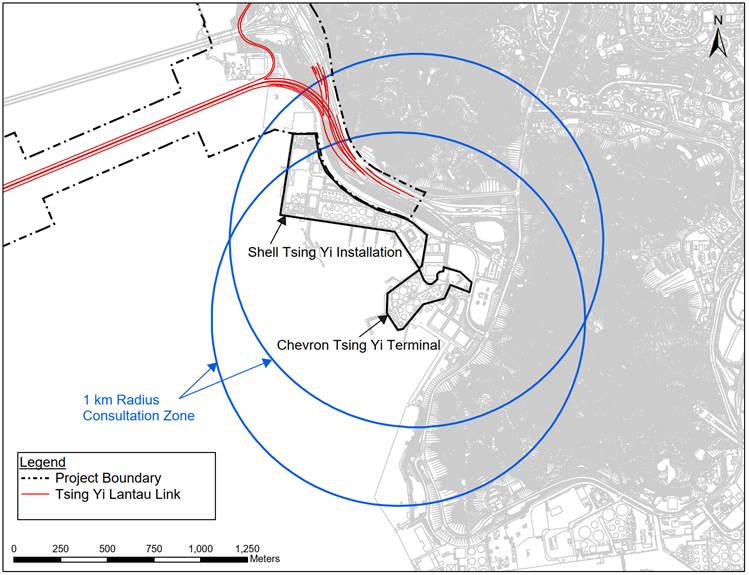
Plate 12.1 Locations of PHIs and Project Layout
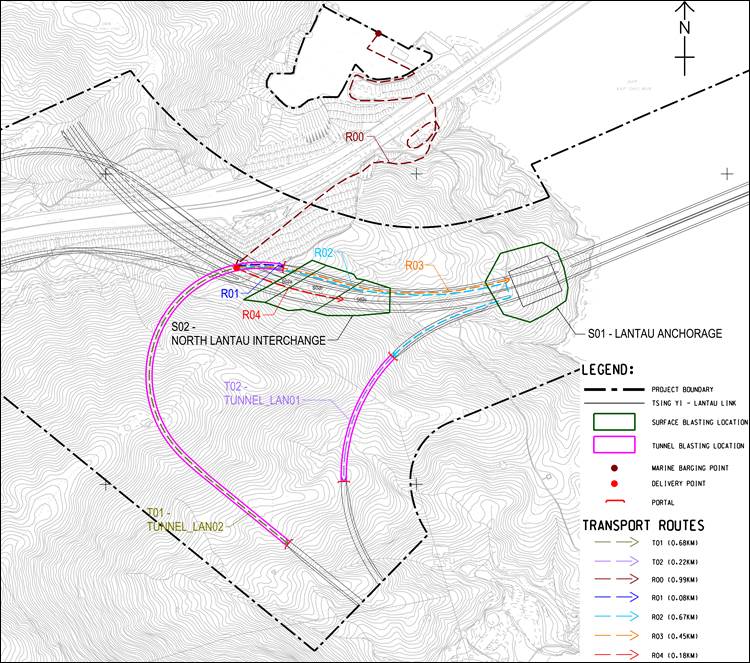
Plate 12.2 Blasting Extents and On-site Transport Route of Explosives
12.1.1.5
Details of the Hazard to Life Assessment for the Project are presented
in the following appendices:
(a) Appendix 12.1: Hazard to Life Assessment in association with Chevron Terminal;
(b) Appendix 12.2: Hazard to Life Assessment in association with Shell Tsing Yi Installations (STYI); and
(c) Appendix 12.3: Hazard to Life Assessment in association with the use of explosives.
12.2
Hazard to Life
Assessment Risk Criteria
12.2.1.1
Annex 4 of the EIAO-TM specifies the Individual and Societal Risk
Guidelines. The Hong Kong Government Risk Guidelines (HKRG) per the EIAO-TM
Annex 4 states that the individual risk is the predicted increase in the chance
of fatality per year to an individual due to a potential hazard. The
individual risk guidelines require that the maximum level of off-site
individual risk should not exceed 1 in 100,000 per year i.e. 1×10⁻⁵
per year. Societal risk expresses the risks to the whole off-site population.
It is expressed in terms of lines plotting the cumulative frequency (F)
of N or more deaths in the population from incidents at the installation.
Two F-N risk lines are used in the HKRG that demark “Acceptable” or
“Unacceptable” societal risks. To avoid major disasters, there is a
vertical cut-off line at the 1,000 fatality level extending down to a frequency
of 1 in a billion years. The intermediate region indicates the
acceptability of societal risk is borderline and should be reduced to a level
which is “as low as reasonably practicable” (ALARP). It seeks to ensure
that all practicable and cost-effective measures that can reduce risk are
considered. The HKRG is presented graphically in Plate 12.3.
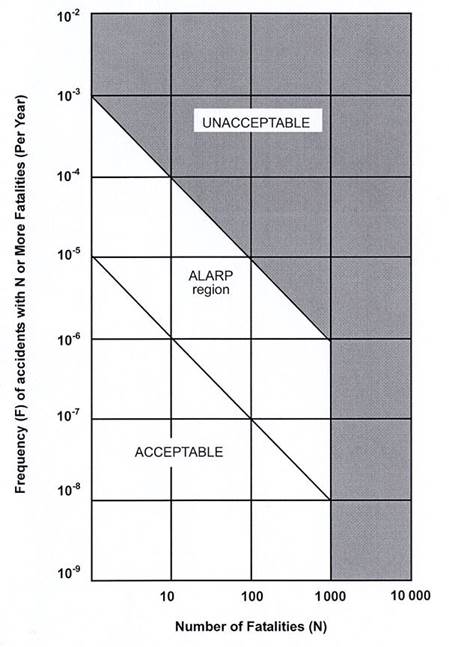
Plate 12.3 Societal Risk Guidelines
12.3
Study Objectives
and Methodology
12.3.1.1 The Hazard to Life
Assessment requirements for the PHIs and explosives as detailed in Appendix K
of the EIA Study Brief are shown below:
(a) Identify hazardous scenarios and then determine a set of relevant scenarios to be included in a Quantitative Risk Assessment (QRA);
i. For PHIs: Hazard scenarios associated with the on-site transport, storage and use of dangerous goods in the PHIs
ii. For Explosives: Hazardous scenarios associated with the use, transport and overnight storage of the explosives
(b) Execute a QRA of the set of hazardous scenarios determined in (a), expressing population risks in both individual and societal terms;
(c) Compare individual and societal risks with the criteria for evaluating hazard to life as stipulated in Annex 4 of the TM; and
(d) Identify and assess practicable and cost-effective risk mitigation measures to demonstrate the compliance with the Risk Guidelines.
12.3.1.2
This assessment consists of the following six main tasks:
a) Data / Information Collection and Update: collect relevant data / information that is essential for the hazard assessment;
b) Hazard Identification: identify credible set of hazardous scenarios associated with the operation of the PHIs / explosives;
c) Frequency Estimation: estimate the frequencies of the identified hazardous scenarios by using Fault Tree and Event Tree Analysis;
d) Consequence Analysis: analyse the consequences of the identified hazardous scenarios by using the well-established and widely accepted model, e.g. SAFETI, ESTC;
e) Risk Assessment and Evaluation: evaluate the risks associated with the identified hazardous scenarios. The evaluated risks will be compared with HKRG to determine their acceptability. Where necessary, risk mitigation measures will be identified and assessed to comply with the ALARP principle used in the HKRG; and
f) Identification of Mitigation Measures: review the recommended risk mitigation measures from previous studies, practicable and cost-effective risk mitigation measures will be identified and assessed as necessary. The risk outcomes of the mitigated case will then be reassessed to determine the level of risk reduction.
12.3.1.3 The hazard
assessments covered the following two scenarios:
· Year 2031 (Construction phase) – The risk imposed by the terminals’ operation (i.e. Chevron Terminal and STYI) and use of explosives to the existing, committed and planned population in 2031. This scenario took into account the presence of the construction workers and any potential impacts associated with the construction activities undertaken for TYLL and its associated works.
· Year 2033 (Operational phase) – The risk imposed by the terminals’ operation (i.e. Chevron Terminal and STYI) to the existing, committed and planned population in 2033 upon completion of the Project. This scenario took into account all the road users induced by the Project.
12.4
Population Data
12.4.1.1 The land /
building population as well as road population were estimated based on the
information collected from the following sources:
(a) Desktop study and site survey;
(b) Task Force Planning Dataset (TFPD);
(c) Latest Annual Traffic Census (ATC) from Transport Department;
(d) Traffic Impact Assessment (TIA) report of this Assignment; and
(e) Previous reports of similar studies.
12.4.1.2 The population
data adopted in the hazard assessments are detailed in Appendices 12.1 to 12.3.
12.5
Hazard
Identification
12.5.1.1
The hazards associated with the hazardous installations and use of
explosives were identified by reviewing the past incidents (e.g. EIDAS
(Explosives Incidents Database Advisory Service) database), existing conditions
of the hazardous installations and previous studies. The hazard scenarios
include the loss of containment from Chervon terminal and STYI leading to fire
and explosion, and accidental detonation of explosives leading to explosion and
overpressure, as detailed in Appendices
12.1 to 12.3.
12.6
Frequency
Analysis
12.6.1.1 With the
potential hazards identified, the likelihood of each hazardous scenario was
determined. The majority of the occurrence frequencies were adopted
directly from previous studies and were supplemented by statistics from
historical data if necessary. In some cases, event tree analysis was
adopted to derive the frequencies of the hazardous scenarios. Appendices 12.1 to 12.3
provide the details of the frequency assessment in each hazard assessment.
12.7
Consequence and
Impact Analysis
12.7.1.1 The consequence
assessment estimates the impact of each outcome in the area of concern.
It includes discharge rate modelling, dispersion modelling and fire and
explosion modelling. The details of the consequence assessment are
presented in Appendices 12.1
to 12.3.
12.8
Risk Evaluation
12.8.1 Introduction
12.8.1.1 By combining the results
of frequency estimation and consequence analysis, risk levels of the assessment
scenarios were characterised in terms of individual risk (presented in
individual risk contours plot) and societal risk (presented in FN curves and
Potential Loss of Life).
12.8.2 Chevron
Terminal and STYI
Individual Risk
12.8.2.1 The predicted
individual risk contours for the Chevron Terminal and STYI are detailed in Appendix 12.1 and Appendix 12.2
respectively. The associated risk levels were based on 100% occupancy
with no allowance made for shelter or escape, as specified in the user manual
of Phast Risk.
12.8.2.2 Based on the
operation details taken from TYLL Feasibility Study and information provided by
DSG Energy Limited, the maximum individual risk level of 1×10⁻⁵ per
year was observed due to operation of Chevron Terminal and STYI. Whilst
the 1×10⁻⁵ per year contour extends beyond the terminals’ boundary
towards the sea for both terminals, it does not encroach to nearby land
population. Since such area of the sea is within 100 m “operation area”
of the terminals, off-site population is not envisaged as other vessels
entering the “operation area” will normally be warned off and expelled.
Thus, the individual risk level is considered to be in compliance with
HKRG.
Societal Risk
12.8.2.3 The societal risks
of the Chevron Terminal and STYI during both construction and operational
phases of the Project, are presented in Appendix
12.1 and Appendix 12.2
respectively.
12.8.2.4 As shown in the
FN plots, the societal risks for both Chevron Terminal and STYI fall within the
“ALARP” region in both assessment years. The total Potential Loss of Life
(PLL) associated with the operation of Chevron Terminal in Year 2031 and 2033 was
found to be 6.23×10⁻⁴ per year and 6.33×10⁻⁴ per year
respectively; while the total PLL associated with the operation of STYI in Year
2031 and 2033 was found to be 4.23×10⁻⁴ per year and 5.32×10⁻⁴
per year respectively. The proposed works areas of the Project account
for 9.45×10⁻⁷ per year (<1% of total PLL) for Chevron Terminal
and 9.96×10⁻⁶ per year (~2% of total PLL) for STYI during
construction phase, while the proposed TYLL accounted for 3.35×10⁻⁶
per year (<1% of total PLL) for Chevron Terminal and 9.89×10⁻⁵
per year (~18% of total PLL) for STYI during operational phase. Thus, the PLL
contribution from the proposed works areas of the Project/ proposed TYLL as
compared with the overall risk level was considered insignificant.
12.8.2.5 As the societal
risks for both terminals fall within the “ALARP” region, risk mitigation
measures i.e. installation of gas detectors during construction phase and
provision of a physical barrier during operational phase were proposed
following the ALARP principle. Based on the cost-benefit analysis, the
proposed mitigation measure to install gas detectors with PLL reduction of 9.45×10⁻⁷ per year for Chevron Terminal and
9.96×10⁻⁶ per year for STYI during the construction phase was
considered economically unviable since the Implied Cost of Averting Fatality
(ICAF) (i.e. HK$1.76×10¹⁰ for Chevron Terminal and
HK$1.67×10⁹ for STYI) was found to be significantly larger than the
adjusted Value of Life (i.e. HK$660M). Meanwhile, the proposed mitigation
measure for provision of a physical barrier with PLL reduction of 3.35×10⁻⁶
per year for Chevron Terminal and 9.89×10⁻⁵ per year for STYI
during the operational phase was considered economically unviable since ICAF
(i.e. HK$2.69×10¹² for Chevron Terminal and HK$9.10×10¹⁰ for STYI) was found to
be significantly larger than the adjusted Value of Life (i.e. HK$660M).
12.8.3 Explosives
Individual Risk
12.8.3.1 The predicted
individual risk contours for the on-site transport and use of explosives are
detailed in Appendix 12.3.
12.8.3.2 The maximum
individual risk level of 1×10⁻⁵ per year for indoor populations
confined with the Project site boundary. On this basis, the level of individual
risk associated with the on-site transport and use of explosives should be
acceptable since it meets the HKRG.
Societal Risk
12.8.3.3 The societal
risks for on-site transport and use of explosives are detailed in Appendix 12.3.
As shown in the FN plot, the societal risks associated with the
on-site transport and use of explosives falls within the “Acceptable” region.
12.8.4 Cumulative
Impact
12.8.4.1 Cumulative impact
from the Chevron terminal and STYI is considered owing to the proximity of the
two PHIs but excludes the risks associated with the use of explosives as the
blasting locations are over 3.5 km away from both PHIs.
12.8.4.2 The cumulative
individual risk contours for the two facilities are presented in Plate 12.4. As observed, the 1×10⁻⁵ per year
contour marginally encroaches to the Tsing Tim Street and Sai Tso Wan Road,
located adjacent to the LPG facilities under STYI and the neighbouring Yiu Lian
Dockyard located adjacent to the Chevron terminal.
12.8.4.3 The calculated
individual risk (IR) contour assumes an individual is located at a specific
location 24 hours a day and 365 days per year, however the actual IR is
expected to be lower. This risk posed by the two facilities to road users on
Tsing Tim Street is estimated as 3.8×10⁻⁶ per year by applying a
presence factor of 0.33 to the maximum IR of 1.13×10⁻⁵ per year at
STYI boundary near the Tsing Tim Street. The presence factor is conservatively
estimated by assuming road occupants will be present 8 hours per day for 365
days per year for truck loading operation.
12.8.4.4 The risk posed by
the two facilities to road users on Sai Tso Wan Road is estimated as 4.9×10⁻⁹
per year by applying a presence factor of 2.9×10⁻⁴ to the maximum IR
of 1.68×10⁻⁵ per year at STYI boundary near this road. The presence
factor is conservatively estimated by assuming commuters of this road will be
present 0.42 minutes per day for 365 days per year (i.e. 50 km/hr for 176 m for
a return journey).
12.8.4.5 The risk posed by
the two facilities to workers in Yiu Lian Dockyard is estimated as 5.7×10⁻⁶
per year by applying a presence factor of
0.3 to the maximum IR of
1.92×10⁻⁵ per year at Chevron terminal boundary near the
dockyard. The presence factor is conservatively estimated by assuming workers
will be present 50 hours a week for 365 days per year.
12.8.4.6
In view that the actual IR for the road occupants and workers are found
to be lower than 1×10⁻⁵ per year, the individual risk level is
considered to be acceptable.
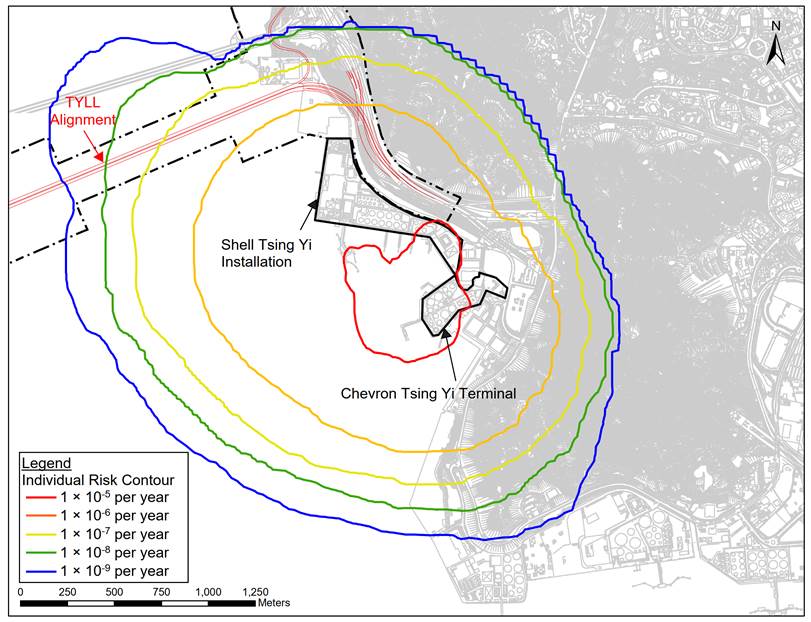
Plate 12.4 Cumulative Individual Risk Contours for Chevron Terminal and STYI
12.8.4.7 Regarding the on-site transport and use of
explosives on the North Lantau, a review of the individual risk contours
associated with the use of explosives for the construction of anchorages of
Tsing Lung Bridge, North Lantau under Route 11 was conducted, and it is
concluded that no cumulative risk impact between the 2 projects is anticipated.
12.9
Conclusions and
Recommendations
12.9.1.1 Hazard assessments
were conducted to assess the risks associated with the terminals’ operation
(i.e. Chevron Terminal and STYI) during the construction and operational phases
of the Project as well as use of explosives during the construction phase of
the Project.
Chevron Terminal
and STYI
12.9.1.2 For both
terminals, the individual risks and societal risks results taking into account
the population induced by the Project, were found to be in compliance with the
risk criteria stipulated in Annex 4 of the EIAO-TM and risk mitigation measures
are therefore not required. The PLL contribution from the proposed works
areas of the Project/ proposed TYLL as compared with the overall risk level was
considered insignificant (i.e. 9.45×10⁻⁷ per year (<1% of total
PLL) for Chevron Terminal and 9.96×10⁻⁶ per year (~2% of total PLL)
for STYI during construction phase; and 3.35×10⁻⁶ per year (<1%
of total PLL) for Chevron Terminal and 9.89×10⁻⁵ per year (~18% of
total PLL) for STYI during operational phase). Based on the cost-benefit
analysis, the proposed mitigation measure to install gas detectors during
construction phase was considered economically unviable since ICAF (i.e.
HK$1.76×10¹⁰ for Chevron Terminal and HK$1.67×10⁹
for STYI) was found to be significantly larger than the adjusted Value of Life
(i.e. HK$660M). Meanwhile, the proposed mitigation measure for provision
of a physical barrier during the operational phase was considered economically
unviable since ICAF (i.e. HK$2.69×10¹² for Chevron Terminal
and HK$9.10×10¹⁰ for STYI) was found to be significantly larger than
the adjusted Value of Life (i.e. HK$660M).
12.9.1.3 Although the proposed
mitigation measure to install gas detectors was considered economically
unviable for PLL reduction during construction phase, the following “Good
Practices” are proposed for implementation during construction phase of the
Project to limit the number of causalities and/or fatalities:
· Establishment of emergency response/ evacuation plans;
· Safety/ emergency response training and drills for all personnel; and
· Maintain the number of construction workers on-site to a minimum.
Explosives
12.9.1.4 For the risk
related to on-site transport and use of explosives including tunnel blasting
and surface blasting, the geotechnical features near the tunnel section and
surface blasting of the Project, as well as the populations near the blasting
sites and transport route have been assessed. The assessment results show
that the societal risk lies within the “Acceptable” region. The risks of
the on-site transport and use of explosives comply with both the individual
risk and societal risk criteria outlined in Annex 4 of the EIAO-TM.
12.9.1.5 Nevertheless,
there are some recommendations specific to the on-site transport and use of
explosives during construction of the Project to further minimise the risks
with best practices.
12.9.1.6 The following
recommendations should be implemented for the on-site transport of explosives:
• Emergency plan should be developed to address uncontrolled fire during transport. Case of fire near an explosive carrying vehicle in jammed traffic should be included in the plan. Activation of fuel and battery isolation switches on vehicle when fire breaks out should also be included in the emergency plan to reduce likelihood of prolonged fire leading to explosion;
• Working guideline should be developed to define procedure for explosives transport during adverse weather such as thunderstorm;
• Detonators should be transported separately from other Class 1 explosives. Separation of vehicles should also be maintained through the trip;
• Develop procedure to ensure the availability of parking space on site for the explosives carrying vehicle. Delivery should not be commenced if parking space on site is not secured;
• Hot work should be suspended during passage of the diesel vehicle truck and bulk emulsion truck in the tunnels;
• Speed limit for the diesel vehicle truck and bulk emulsion truck in the tunnels should be imposed. The truck may be escorted while underground to ensure route is clear from hazards and obstructions;
• Fire screen should be used between cabin and the load on the vehicle;
• Lining should be provided within the transportation box on the vehicle;
• Ensure packaging of detonators remains intact until handed over at blasting site;
• Ensure that cartridged emulsion packages are not damaged before every trip; and
• Use experienced driver with good safety record.
12.9.1.7 The following
recommendations should be implemented for the safe use of explosives:
• Blast Charge Weight should be within maximum MIC as specified for the given blast face;
• Temporary mitigation measures such as blast doors or heavy duty blast curtains should be installed at the portals at suitable locations underground to prevent flyrock and control the air overpressure;
• Secure refuge areas should be identified to workers within the construction areas since a complete evacuation of the construction areas is not intended during blasting;
• A Chief Shotfirer and a Blasting Engineer shall be employed in addition to the normal blasting personnel to ensure that the works are safe and coordinated between blasting areas;
• Shotfirer to be provided with a lightning detector, and appropriate control measures should be in place;
• A boulder survey should be undertaken based on the likely peak particle velocity (PPV) values that would result from the blasting process. Those boulders subject to the vibration higher than the allowable limit should be strengthened, removed, or constructed with boulder fence, prior to the commencement of blasting.
• Establishment of no-blast zones for areas of high sensitivity/risk;
• The surface blasting benches will be covered with blasting cages, blast mats and blasting screens to limit flyrock potential;
• All hiking paths/ footpaths located within the 200m assessment area (Figure 12.2 of Appendix 12.3 refer) will be temporarily closed during blasting/ explosives delivery from the barging point to the blasting sites;
• Drill bits larger than 64mm should not be brought to the sites to avoid drilling a larger blasthole by accident; and
• The Contractor will place warning signs at the concerned area (i.e. Yi Chuen) to let the residents know the blasting schedule at the surface blasting site S01 so that they have to be evacuated or stay indoor away from windows. Before the commencement of blasting, the contractor will also strike a gong to alert the residents and notify the residents in person to ensure all potentially affected personnel are fully aware of the surface blasting.
[1] Although part of the explosives transport route between marine barging point and explosives delivery point (i.e. R00) is outside the Project boundary, it will be established as a temporary project access route intended specifically for the explosive transport during the construction phase of the Project when required. As such, this routing is regarded as on-site transport route in this assessment.