TABLE OF CONTENTS
14.2 Environmental Legislation, Standards and Guidelines
14.3 Description of Environment
14.5 Identification of Landfill Gas Generation, Characteristics, Hazards and Migration
14.6 Qualitative Assessment of Potential Risk
List of tables
Table 14.1 Classification of Risk Category
Table 14.2 Summary of General Categorization of Risk
Table 14.3 Generic Protection Measures for Planning Stage Categorization
Table 14.4 Definition of Control Terms
Table 14.6 Groundwater Elevation Measured from the Top of the Well
Table 14.7 Source-Pathway-Target Analysis
LIST OF FIGURES
|
Location of Ngau Tam Mei Landfill and Project Site Boundary |
|
|
Geological Map in the Vicinity of Ngau Tam Mei Landfill |
|
|
Locations of Landfill Gas and Groundwater Monitoring Wells at Ngau Tam Mei Landfill |
LIST OF APPENDIX
|
Landfill Gas Monitoring Data |
14 LANDFILL GAS HAZARD
14.1 Introduction
14.1.1 This section evaluates and assesses the potential landfill gas (LFG) hazard on any development under the Project within the consultation zone (CZ) of the Ngau Tam Mei Landfill (NTML) during the construction and operation of the Project. The LFG hazard assessment (LFGHA) has been conducted in accordance with the requirement in Annexes 7 and 19 of the Technical Memorandum on Environmental Impact Assessment Ordinance (EIAO-TM) and the requirements in Section 3.4.14 and Appendix M of the EIA Study Brief (ESB-363/2023).
14.2 Environmental Legislation, Standards and Guidelines
14.2.1 Relevant legislation and associated guidance notes applicable to LFGHA include:
· Annex 7 and Annex 19 of the EIAO-TM;
· Landfill Gas Hazard Assessment for Development Adjacent to Landfills (ProPECC PN 3/96); and
· Landfill Gas Hazard Assessment Guidance Note (2022) (Guidance Note).
Landfill Gas Hazard Assessment for Development Adjacent to Landfills (ProPECC PN 3/96) and Landfill Gas Hazard Assessment Guidance Note (2022)
14.2.2 ProPECC PN 3/96 and the Guidance Note provide an assessment framework to be followed when evaluating the risks related to developments described under Section 6.5, Chapter 9 of the Hong Kong Planning Standards and Guidelines. ProPECC PN 3/96 and the Guidance Note apply to all developments proposed within a landfill consultation zone, which is the area of land surrounding the landfill boundary as defined by a line running parallel to and 250 m away from the edge of the waste if this can be identified or, if not, the recognised landfill site boundary.
14.3 Description of Environment
14.3.1 Where a proposed development or elements of a development are of higher sensitivity, a LFGHA is required to provide preliminary technical input for formulating and evaluating development options by ascertaining the risk acceptability for development within or in close proximity to a landfill site.
14.3.2 According to the Recommended Outline Development Plan, the closed and restored NTML is located to the northwest of the Project (Figure 14.1 refers) with a small portion of the planned road development (approximately 0.4 ha) lying within the CZ of NTML.
14.3.3 A phased approach has been adopted to qualitatively assess potential LFG hazard and outline a range of possible mitigation measures for consideration in the design of the proposed road to afford an appropriate level of protection dependent upon the calculated risk.
14.4 Assessment Methodology
14.4.1 In accordance with aforementioned framework (Section 14.2 refers), the following tasks have been undertaken to assess potential LFG hazard associated with the NTML to potentially sensitive elements of the Project situated within its CZ:
· A review of background information (including LFG monitoring data) and studies related to NTML including Section 14 (LFGHA) and Section 15 (Impacts on the Restored NTML) of the approved EIA report of the Hong Kong Section of Guangzhou - Shenzhen - Hong Kong Express Rail Link (Register No.: AEIAR-143/2009);
· Identification of the nature and extent of the source, including the likely concentrations and/or amounts of hazardous emissions with potential to impact the Project;
· Identification of possible subsurface pathways and the nature of these pathways through which hazardous emissions must traverse if they are to reach the development of the Project;
· Identification of potentially sensitive receivers/elements of the Project that maybe susceptible to LFG ingress/accumulation;
· Qualitative assessment of the degree of risk which hazardous emissions may pose to aspects of the Project taking account of each source-pathway-target combination; and
· Recommendation of precautionary and/or protection measures required, as well as monitoring/maintenance requirements during the construction and operation of the Project.
Criteria
14.4.2 In accordance with the Guidance Note, risk associated with LFG may be evaluated by assessment of the following three criteria:
· Source – location, nature and likely quantities/concentrations of LFG with potential to affect the development;
· Pathway – the ground and groundwater conditions through which LFG must pass in order to reach the development; and
· Target – elements of a development that may be sensitive to the effects of LFG.
Source
14.4.3 The classification of the Source (i.e. NTML) is undertaken as follows:
|
Minor |
Landfill sites at which gas controls have been installed and proven to be effective by comprehensive monitoring which has demonstrated that there is no migration of gas beyond the landfill boundary (or any specific control measures) and at which control of gas does not rely solely on an active gas extraction system or any other single control measure which is vulnerable to failure; or
Old landfill sites where the maximum concentration of methane within the waste, as measured at several locations across the landfill and on at least four occasions over a period of at least 3 months (preferably longer), is less than 5% by volume (v/v). |
|
Medium |
Landfill site at which some form of gas control has been installed (e.g. lined site or one where vents or barriers have been retrospectively installed) but where there are only limited monitoring data to demonstrate its efficacy to prevent migration of gas; or
Landfill site where comprehensive monitoring has demonstrated that there is no migration of gas beyond the landfill boundary but where the control of gas relies solely on an active gas extraction system or any other single control system which is vulnerable to failure.
|
|
Major |
Recently filled landfill site at which there is little or no control to prevent migration of gas or at which the efficacy of the gas control measures has not been assessed; or
Any landfill site at which monitoring has demonstrated that there is significant migration of gas beyond the site boundary.
|
14.4.4 The 'significance' of migration should be assessed by reference to the concentration, frequency and location at which gas is detected. For guidance, it should be assumed that any concentration of methane or carbon dioxide greater than 5% v/v above background levels in any monitoring well outside the landfill boundary indicates significant migration in accordance with the Guidance Note. Lower concentrations may still be 'significant' if they are observed in more than one monitoring well, on several occasions or in monitoring wells located some distance from the site boundary. In general, concentrations of greater than 1% v/v methane or 1.5% v/v carbon dioxide (above background levels in each case) indicate less than adequate control of the gas at source.
14.4.5 In classifying the source term, account needs to be taken of the likelihood and probable effect of a failure of the gas controls. Thus, if it has been demonstrated that there is no migration of gas and there is little danger of the gas controls failing (e.g. if these comprise solely of passive measures such as a liner) it can be assumed that the site is a "Minor" Source. Where there is no gas migration, but this may be as a result of a single, "vulnerable" control measure (e.g. an active extraction system with no warning of failure), the site should be regarded as a "Medium" or even a "Major" Source depending on the other factors (e.g. size of site and age of waste).
14.4.6 Where the effectiveness of the gas controls has not been proven by off-site monitoring or if there is some doubt as to the adequacy of the monitoring, this should be considered when considering the impact of the control measures on the Source term. Assessments should always err on the side of caution and, in general, if the effectiveness cannot be demonstrated the assessment should be undertaken on the same basis as if the controls were not in place.
14.4.7 The reliability of the monitoring, for determining the efficacy of the gas controls, needs to take account of the design, number and location of the monitoring points together with the frequency and duration over which monitoring has been undertaken. Monitoring should have been undertaken under different weather conditions including, in particular, periods of low or falling atmospheric pressure.
Pathway
14.4.8 A broad classification is as follows:
|
Very short / direct |
Path length <50 m for unsaturated permeable strata and fissured rock or <100 m for man-made conduits
|
|
Moderately short / direct |
Path length of 50 - 100 m for unsaturated permeable soil or fissured rock or 100 - 250 m for man-made conduits
|
|
Long / indirect |
Path length of 100 - 250 m for unsaturated permeable soils and fissured rock
|
14.4.9 In classifying the pathway, adjustment to the above general guidelines will often be required to take account of other factors which will affect the extent of gas migration including the following:
· Particular permeability of the soils;
· Spacing, tightness and direction of the fissures/joints;
· Topography;
· Depth and thickness of the medium through which the gas may migrate (which may be affected by groundwater level);
· The nature of the strata over the potential pathway;
· The number of different media involved; and
· Depth to groundwater table and flow patterns.
14.4.10 Thus, although there may be permeable soil between the landfill site and a proposed development, if the soil layer is very shallow and thin with its upper surface exposed to the atmosphere, then it will be appropriate to consider this as a long/indirect pathway. This could alter if the land between the landfill site and the development was paved over or altered which reduced the potential for gas release. Similarly, if the land is flat, the surface may be prone to water logging which will also effectively seal it at times of heavy rain. In general, a conservative approach should be adopted, and it should be assumed that any such permeable surface soils may become less permeable in the future.
14.4.11 If it is known that a conduit (man-made or natural feature such as a fault plane) leads directly from the landfill to the development area, it should be regarded as a "direct/short" pathway even if it is longer than 100 m.
Target
14.4.12 Target sensitivities are classified as follows:
|
High sensitivity |
Buildings or structures with ground level or below ground rooms/voids or into which services enter directly from the ground and to which members of the general public have unrestricted access or which contain sources of ignition. This would include any developments where there is a possibility of additional structures being erected directly on the ground on an ad hoc basis and thereby without due regard to the potential risks.
|
|
Medium sensitivity |
Buildings, structures or service voids where there is access only by authorised, well trained personnel, such as the staff of utility companies, who have been briefed on the potential hazards relating to landfill gas and the specific safety procedures to be followed or deep excavations.
|
|
Low sensitivity |
Buildings/structures which are less prone to gas ingress by virtue of their design (such as those with a raised floor slab). Excavations or developments which involve outdoor activities but where evolution of gas could pose potential problems.
|
Risk Categorisation
14.4.13 Having determined the categories of source, pathway and target, qualitative assessment of overall risk has been made by reference to Table 14.1. The potential implications associated with the various qualitative risk categories are summarised in Table 14.2.
Table 14.1 Classification of Risk Category
|
Source |
Pathway |
Target Sensitivity |
Risk Category |
|
Major |
Very short / direct |
High |
Very High |
|
Medium |
High |
||
|
Low |
Medium |
||
|
Moderately short / direct |
High |
High |
|
|
Medium |
Medium |
||
|
Low |
Low |
||
|
Long / indirect |
High |
High |
|
|
Medium |
Medium |
||
|
Low |
Low |
||
|
Medium |
Very short / direct |
High |
High |
|
Medium |
Medium |
||
|
Low |
Low |
||
|
Moderately short / direct |
High |
High |
|
|
Medium |
Medium |
||
|
Low |
Low |
||
|
Long / indirect |
High |
Medium |
|
|
Medium |
Low |
||
|
Low |
Very Low |
||
|
Minor |
Very short / direct |
High |
High |
|
Medium |
Medium |
||
|
Low |
Low |
||
|
Moderately short / direct |
High |
Medium |
|
|
Medium |
Low |
||
|
Low |
Very Low |
||
|
Long / indirect |
High |
Medium |
|
|
Medium |
Low |
||
|
Low |
Very Low |
Table 14.2 Summary of General Categorization of Risk
|
Category |
Level of Risk |
Implication |
|
A |
Very High (Undesirable) |
The type of development being proposed is very undesirable and a less sensitive form of development should be considered. At the very least, extensive engineering measures, alarm systems and emergency action plans are likely to be required. |
|
B |
High |
Significant engineering measures will be required to protect the planned development. |
|
C |
Medium |
Engineering measures will be required to protect the proposed development. |
|
D |
Low |
Some precautionary measures will be required to ensure that the planned development is safe. |
|
E |
Very Low (Insignificant) |
The risk is so low that no precautionary measures are required. |
14.4.14 Five generic forms of protection will be considered for mitigation of hazards to development where necessary. These correspond to the risk categories set out in Table 14.3 with the terms used defined in Table 14.4.
Table 14.3 Generic Protection Measures for Planning Stage Categorization
|
Category |
Generic Protection Measures |
|
A |
Active control of gas, supported by barriers and detection systems for the planned development. Another, less sensitive form of development should also be considered. |
|
B |
Active control of gas, including barriers and detection systems(1) |
|
C |
Use of 'semi active' or enhanced passive gas controls. Detection systems in some situations. |
|
D |
Passive control of gas only. |
|
E |
No precautionary measures required. |
Note:
(1) The gas protection measures required to allow the safe development of a Category A risk development will need to be more extensive than those for a Category B risk development.
Table 14.4 Definition of Control Terms
|
Terms |
Definition |
|
Active |
Control of gas by mechanical means (e.g. ventilation of spaces with air to dilute gas, or extraction of gas from the development site using fans or blowers). |
|
Semi- active |
Use of wind driven cowls and other devices which assist in the ventilation of gas but do not rely on electrically powered fans. |
|
Passive |
Provision of barriers to the movement of gas (e.g. membranes in floors or walls, or in trenches, coupled with high permeability vents such as no-fines gravel in trenches or voids/permeable layers below structures, vents such as gravel in trenches or a clear void/permeable layer below structures). |
|
Detection |
Electronic systems based upon, for example, catalytic oxidation or infra-red measurement principles, which can detect low concentrations of gas in the atmosphere and can be linked to alarms and/or telemetry systems. |
14.5 Identification of Landfill Gas Generation, Characteristics, Hazards and Migration
Landfill Gas Generation
14.5.1 Infiltration of water into a landfill causes gases to be generated as decomposition of organic materials occurs. Once biodegradation has started, the oxygen is soon exhausted and as no replenishment of the free oxygen is available, the waste mass becomes anaerobic. During anaerobic fermentation, methanogens generate methane and carbon dioxide, the primary constituents of LFG.
14.5.2 A typical composition of LFG is about 60% by volume of methane and 40% by volume of carbon dioxide, although these percentages can vary widely depending on the site conditions. There is also presence of trace quantities of hydrogen sulphide, nitrogen and gaseous hydrocarbons.
14.5.3 Due to the high variability in the settings of biodegradation, waste composition, and individual site characteristics, the rate of degradation and the volume of LFG produced per unit of waste can vary greatly. The generation of LFG is dependent on numerous environmental conditions including temperature, pH, substrate availability, moisture content and oxygen content.
Landfill Gas Characteristics
14.5.4 Whilst methane has relatively low solubility in water, it is colourless and odourless, and generally of little influence in groundwater quality. It occurs in gaseous form in the unsaturated zone. The gas, which is also an asphyxiant, is highly flammable and can be explosive when all the following conditions exist at the same time:
· Its concentration in air is between 5% of the Lower Explosive Limit and 15% of the Upper Explosive Limit;
· The gas is in a confined space; and
· A source of ignition exists.
14.5.5 The relationship between methane and oxygen where flammable mixtures can occur is shown in Plate 14.1 (from 30 CFR § 57.22003, MSHA Illustration 27).
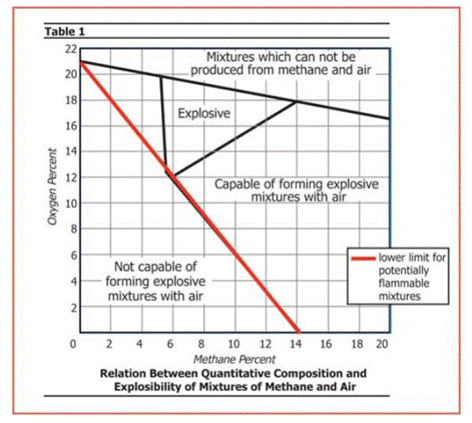
Plate 14.1 Flammability Levels of Methane and Oxygen
14.5.6 Carbon dioxide, the other major component of LFG, is an asphyxiating gas and causes adverse health effects at relatively low concentrations. The long-term Occupational Exposure Limit is 0.5% v/v. Like methane, it is odourless and colourless and its presence (or absence) can only be confirmed by using appropriately calibrated portable detectors.
14.5.7 Methane is lighter than air whereas carbon dioxide is heavier than air. Typical mixtures of LFG are likely to have a density close to or equal to that of air. However, site conditions may vary the ratio of methane to carbon dioxide which may make the gas mixture lighter or heavier than air. As a result, LFG may accumulate in either the base or top of any voids or confined spaces.
Landfill Gas Hazard
14.5.8 Given the potentially flammability, asphyxiant properties and gaseous density of LFG, potential hazard arises in the event that LFG is able to migrate from the landfill and accumulate in confined spaces such as excavations, buried utility corridors and maintenance chambers etc. For the same reason, temporary structures such as site huts and any other unventilated enclosures to be erected during construction stage may also be exposed to LFG hazards.
Landfill Gas Migration
14.5.9 Methane will migrate along pressure gradients from areas where it is present at higher pressures to areas where it is present at lower pressures. The primary mechanism for significant methane migration in subsurface of unsaturated soils is pressure-driven flow. Diffusion also occurs but at rates too low to result in unacceptable indoor air /confined space concentrations under reasonably likely scenarios.
14.5.10 The ability for LFG to migrate beyond the waste boundary varies according to the type of landfill construction details, presence of gas, leachate control measures, restoration details and permeability of the ground through which gas must travel. Factors such as changes in atmospheric pressure can also encourage gas migration.
14.5.11 If gas is able to intercept any buried service routes especially where the utility has been laid in an open conduit or the trench excavation has been backfilled around the utility line with coarse gravel. These may also be susceptible to potential hazards and/or they may act as preferential gas migration pathways.
14.6 Qualitative Assessment of Potential Risk
Source
14.6.1 NTML occupies approximately 1.7 ha and was formed in a natural stream valley generally oriented northeast to southwest. A review of information suggests that waste disposal occurred on an informal basis as early as 1963, with more formal waste placement occurring between 1973 and 1975 resulting in approximately 90,000 m3 of waste disposed of prior to landfill closure.
14.6.2 The landfill was configured as two platforms; an upper platform between +32 mPD and +36 mPD which gently slopes from northeast to southwest while the lower platform is between elevations +24 mPD and +26 mPD, with a slightly steeper slope towards the southwest. The toe of the landfill is approximately +16 mPD.
14.6.3 Landfill restoration works in 1999 consisted of placement of a “high integrity” capping system over the two platforms, minor modifications to the existing leachate management system to provide for collection and transport to an off-site treatment facility, installation of a passive LFG ventilation system, and on-going monitoring of groundwater, leachate levels and LFG. The leachate management system consists of a simple piping network installed at the base of the landfill, and a concrete chamber near the toe of the lower slope. The LFG management system consists of nine vertical passive vent pipes (VV-1 to VV-9) installed to depths to 3.0 - 9.0 m across the upper platform and horizontal pipes installed in relatively shallow trenches with vertical passive vent risers aligned around the perimeter of the upper platform, along the toe of the upper slope and diagonally across and down the lower slope. The network of passive horizontal trenches and vertical risers around the perimeter of the upper platform likely have a limited depth of waste beneath.
14.6.4 The passive venting system acts as the primary control will minimise build-up of LFG pressure within the landfill and hence reduce the potential for sub-surface off-site migration. Under the North-west New Territories Landfills and Gin Drinkers Bay Landfill Restoration Contract No. EP/SP/30/95A LFG, a monitoring programme is in place which acts as a secondary control to monitor the effectiveness of the passive venting system and provide an early warning of any off-site migration of LFG. The locations of LFG and groundwater monitoring wells are presented in Figure 14.3.
14.6.5 According to the LFG monitoring data for the period between July 2021 and June 2023 provided by Environmental Protection Department (EPD), no methane was detected in any of the monitoring wells. Relevant monitoring points between the landfill and the Project are located to the southwest of the landfill (namely monitoring wells A454, A457A, A458 and A459). A summary of the monitoring data is provided in Table 14.5, while full monitoring data is presented in Appendix 14.1.
Table 14.5 Summarised Methane and Carbon Dioxide Concentrations Measured in A454, A457A, A458 and A459 from July 2021 to June 2023
|
Well |
% Range & Average |
% Average |
% Range |
|
Methane (CH4) |
Carbon Dioxide (CO2) |
||
|
A454 |
<0.1% |
9.15% |
1.6-17.3% |
|
A457A |
<0.1% |
<0.1% |
<0.1% |
|
A458 |
<0.1% |
4.40% |
0.2-10.9% |
|
A459 |
<0.1% |
1.12% |
0.1-2.1% |
14.6.6 As shown in the monitoring data, there is no evidence of accumulation of methane in any of the monitoring wells, suggesting that methane production within the waste mass is extremely low and that pressure heads are insufficient to drive any lateral migration of gas beyond the waste mass. Elevated carbon dioxide concentrations were occasionally recorded. In the absence of background soil gas concentrations for reference, a conservative assumption is that the potential for off-site migration of LFG cannot be eliminated.
14.6.7 Typical LFG production phases are shown in Plate 14.2. The phase duration will vary according to specific landfill conditions such as composition of the waste, the restoration of the landfill, and the provision of LFG and leachate management systems (Crawford and Smith 1985).
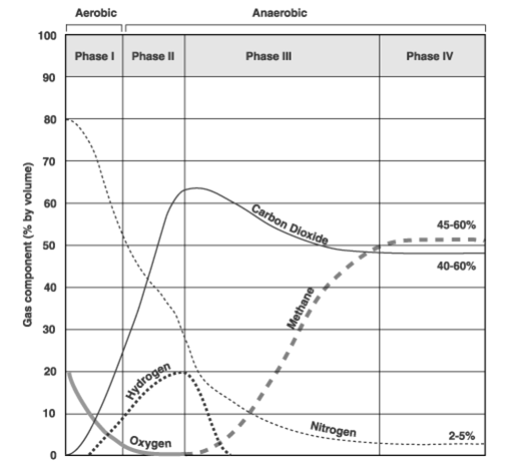
Plate 14.2 Production Phases of Typical Landfill Gas (USEPA 1997)
14.6.8 Based on the timeline of historic operations alone, gas production at NTML (Table 14.5 refers) is likely in the latter stages of Phase IV or beyond with end of methane production if the majority of the organic matter has been degraded.
Classification of Source
14.6.9 NTML can be considered an ‘old’ landfill site where the maximum concentration of methane within the waste, as measured at (ongoing) monthly intervals as indicated in the monitoring data is <0.1% by volume.
14.6.10 Whilst detections of carbon dioxide greater than 5% v/v have occasionally been measured in wells to the southwest of waste boundary but within the landfill boundary, given the age of the landfill and likely phase of gas production, volumes of gas evolution resulting in a pressure gradient and lateral migration of gas are not anticipated to be significant especially as passive venting creates a preferential vertical gas migration pathway from the landfill.
14.6.11 With reference to Section 3.9 of the Guidance Note, for landfill sites at which some form of gas control has been installed (e.g. where vents have been retrospectively installed) but where there are only limited monitoring data to demonstrate its efficacy to prevent migration of gas; or where comprehensive monitoring has demonstrated that there is no migration of gas beyond the landfill boundary but where the control of gas relies solely on an active gas extraction system or any other single control system which is vulnerable then the source may be classified as ‘Medium Source’, however the assessment suggests that there is no serious LFG migration problem, and therefore the restored NTML can be classified as a “Minor” Source.
Pathways
14.6.12 Potential pathways through which LFG may migrate include transmission along natural pathways such as unsaturated granular soil, fissures or joints in rock, man-made pathways such as through permeable backfill in utilities trenches, or a combination of both.
14.6.13 No utility runs or other man-made pathways are identified between the landfill and the Project Site.
14.6.14 Groundwater monitoring data at the three wells nearest to the Project Site for the period between August 2022 and May 2023 as provided by EPD indicates the likely thickness of the unsaturated zone of the subsurface through which gas may migrate. A summary of the monitoring data is provided in Table 14.6.
Table 14.6 Groundwater Elevation Measured from the Top of the Well
|
Well |
Level of Top of Well(1) (mPD) |
Level of Top of Well(2) (mPD) |
Groundwater Elevation (mPD) |
|||
|
23 Aug 2022(1) |
29 Nov 2022(1) |
16 Feb 2023(1) |
25 May 2023(2) |
|||
|
A458 |
16.089 |
16.088 |
13.458 |
9.169 |
8.199 |
9.578 |
|
DH404A |
20.259 |
20.258 |
12.898 |
8.629 |
7.219 |
7.088 |
|
DH405 |
16.658 |
16.657 |
11.197 |
9.308 |
8.638 |
8.807 |
Notes:
(1) Top level of monitoring well re-surveyed on 12 Apr 2022 for the calculation of groundwater elevation in Aug and Nov 2022, and Feb 2023.
(2) Top level of monitoring well re-surveyed on 14 Apr 2023 for the calculation of groundwater elevation in May 2023.
14.6.15 Assuming wells heads are flush with ground level, gauged depths to groundwater suggest that the unsaturated zone thickness at the above well locations range from approximately 2.5 m to 13 m. However, as topography between these wells and the Project Site slopes down to a floodplain, where groundwater is anticipated to reside within a few meters of the surface and only a few meters above mean sea level, the thickness of the unsaturated zone to be able to transmit gas is likely to significantly decrease towards the Project Site.
14.6.16 Mapped information identifies unconsolidated superficial alluvial clay-silt deposits (Qam) above the rock at the location where the Project Site Boundary encroaches the CZ of NTML. The fine grained-clayey nature of unsaturated superficial deposits is anticipated to be poorly gas permeable. Furthermore, any significant gas transport would need a pressure head to drive advective movement through the ground which is generally unpaved between the landfill and the Project.
14.6.17 A review of the geological situation shows that the majority of NTML is underlain by coarse ash crystal tuff that is slightly metamorphosed. No faults or fissures are identified below the landfill. Gas permeability of the rock mass is negligible and will be controlled by the fracture / fissure pattern. Therefore, the rate of movement of gas will be slow and any build-up of gas could only occur over a long period of time.
14.6.18 Based upon the above lines of evidence, natural migration pathways are classified as “Long and Indirect”. Figure 14.2 illustrates superficial geology in the vicinity of NTML.
Targets
Construction Phase
14.6.19 Development within the CZ of NTML comprises construction of road connections to and from the existing San Tin Highway and road works on the San Tin Highway. Landfill restoration facilities within NTML will remain unaffected. Minor extent of excavation works is anticipated and this might create temporary confined spaces within trenches where risk of exposure of LFG could increase. However, the construction works within the CZ of NTML would be undertaken by trained workers applying risk assessments, safety supervision (including periodic monitoring), implementation of safe construction methodologies and action in the event that monitoring triggers action in response to identified risk.
14.6.20 As the construction works would mainly be undertaken in an outdoor environment, the sensitivity of this target group is classified as “Low”.
Operational Phase
14.6.21 To facilitate further assessment of hazards, the Guidance Note suggests consideration of the intended use and contents, provision and reliability of ventilation, and frequency of use of each at risk area. Based on the outdoor setting of the proposed roads of the Project and existing San Tin Highway, no LFG hazard would exist for the general public using the roads. Future utility maintenance would also be undertaken by trained operatives. As such, operational target sensitivity is classified as “Low”.
Source-Pathway-Target Analysis
14.6.22 On the basis of the source, pathways and targets identified above, a source-pathway-target analysis has been undertaken according to EPD’s assessment framework and is presented in Table 14.7.
14.6.23 This classifies both the construction and operational phases as ‘Very Low Risk’ such that no precautionary measures are necessary.
Table 14.7 Source-Pathway-Target Analysis
|
Minor Source |
Long / Indirect Pathway |
Target Sensitivity – Low for Construction Phase / Low for Operational Phase |
Risk Category |
NTML can be considered an ‘old’ landfill site where the maximum concentrations of methane in wells between the landfill and potentially affected areas of the Project are <0.1% by volume based on the monitoring data from July 2021 to June 2023. Whilst detections of carbon dioxide greater than 5% v/v were occasionally measured, given the age of the landfill and likely phase of gas production, volumes of gas evolution resulting in a pressure gradient and lateral migration of gas are not anticipated to be significant especially as passive venting creates a preferential vertical gas migration pathway from the landfill.Assessment suggests that there is no serious LFG migration problem therefore the restored NTML can be classified as a “Minor” Source. |
The majority of NTML is underlain by coarse ash crystal tuff that is slightly metamorphosed. No faults or fissures are identified below the landfill. Gas permeability of the rock mass is negligible. The nature of the unconsolidated superficial cover between the Project and the landfill is anticipated to be more gas permeable.Natural migration pathways are classified as “Long and Indirect”.No man-made pathways are identified between the landfill and the Project. |
Construction PhaseWhilst road and utility construction may entail minor excavation works which might create confined spaces where risk of exposure of LFG could increase; given the pathway assessment, risk is considered negligible. Furthermore, construction works would be undertaken by trained workers with risk assessment, safety supervision and implementation of safe construction methodologies to mitigate identified risks.Construction phase target sensitivity is classified as “Low’. |
Source Pathway Receptor linkages classify the overall risk during the construction phase to be “Very Low”. |
Operational PhaseThe planned roads under the Project are open-air features as such no LFG hazard would exist for the general public using the roads. Potentially sensitive elements of the Project may include constructed utilities such as electrical conduits for highway lighting and signage and surface water drainage conduits. These facilities are not publicly accessible, and maintenance would be undertaken by trained workers with risk assessment, safety supervision and implementation of safe working practice.Based on these assumptions, the target sensitivity during operational phase is classified as “Low”. |
Source Pathway Receptor linkages classify the overall risk during the operational phase to be “Very Low”. |