TABLE OF CONTENTS
6 Sewerage and Sewage Treatment Implications
6.2 Population and Employment Data
6.3 Methodology of Sewerage Impact Assessment
6.4 Existing and Planned Sewerage Infrastructure
6.5 Estimation of Sewage Discharge
6.9 Potential Impacts by the Proposed Sewerage System
6.10 Recommended Mitigation Measures
List of tables
Table 6.1........ Population Summary of the Project in Recommended Outline Development Plan
Table 6.2........ Unit Flow Factors for Residential and Commercial Population from GESF
Table 6.3........ Peaking Factors for Various Population Ranges
Table 6.4........ Summary of Estimated Sewage Discharge from the Project
Table 6.5........ Summary of Estimated Sewage Discharge
Table 6.6........ Build Up of the Sewage Flow within NTMA
Table 6.7........ Summary of Sewage Peak Flow designed for the Proposed SPS
Table 6.8........ Wet Well Arrangement
Table 6.9........ Preliminary Hydraulic Assessment of Rising Main
LIST OF EXHIBIT
|
Exhibit 6-1 Proposed Location of SPS and Emergency Bypass Alignment
|
|
6
Sewerage and Sewage Treatment Implications
6.1 Introduction
6.1.1 This section presents the assessment on the potential sewerage and sewage treatment implications associated with the construction and operation of the Project. The sewerage and sewage treatment implications have been assessed in accordance with the criteria and guidelines on Annexes 6 and 14 of the Environmental Impact Assessment Process, the requirements of WPCO and the requirements in Section 3.4.6 and Appendix E of the EIA Study Brief (ESB-363/2023).
6.2 Population and Employment Data
Sewage Catchments in North-East New Territories
6.2.1 There is no existing sewerage system near the Development Area. According to the approved EIA report for San Tin Technopole (STT) (Register No.: AEIAR-261/2024), San Tin Effluent Polishing Plant (EPP) is planned under the project. The expected commissioning year of the planned San Tin EPP is in 2031. Sewage generated by the Project would be pumped from the proposed on-site sewage pumping station (SPS) to the San Tin EPP for treatment.
6.2.2 As advised by the Sewerage Infrastructure Group of EPD (EPD/SIG), a total sewage flow of about 15,000 m3/day discharged from the existing adjacent villages should be collected by the proposed sewerage system under the Project, subject to further review in later stage. In the initial stage, a capacity of 4,000 m3/day will be reserved in the proposed SPS of the Project for adjacent existing villages and the capacity for adjacent existing villages would ultimately be increased to 15,000 m3/day after a potential upgrading works at Site G.1 when such need arises.
Population and Employment for Estimation of Sewage Flow
6.2.3 For technical assessments under the Study, a 0% home space enhancement (i.e. 50 m2 for public housing and 75 m2 for private housing) was adopted as a more conservative approach. The approximate population of the Project adopted in this assessment is summarised in Table 6.1.
Table 6.1 Population Summary of the Project in Recommended Outline Development Plan
|
|
Population |
|
|
Base Case |
Sensitivity Test Scenario |
|
|
Residential |
38,500 |
42,200 |
|
Employment |
26,000 |
35,700 |
6.3 Methodology of Sewerage Impact Assessment
Unit Flow Factors
6.3.1 The sewage flows are estimated using unit flow factor (UFF) in Tables T-1 and T-2 of EPD’s Guidelines for Estimating Sewage Flows for Sewerage Infrastructure Planning Version 1.0 (GESF). With reference to the GESF, commercial flows comprise flows due to commercial activities and employees. The total UFF is the sum of UFF for employee plus various commercial activities, i.e. J2 to J12 as defined in Table T-2 of GESF. The unit flows factors that were used to estimate the sewage flows from the Project are listed in Table 6.2 below.
Table 6.2 Unit Flow Factors for Residential and Commercial Population from GESF
|
Description |
Type |
Unit |
UFF per Employee (m3/day) |
UFF for Commercial Activities (m3/day) |
Total Unit Flow Factors (UFF) (m3/day) |
|
Domestic Flows |
|||||
|
Dedicated Rehousing Estate |
Private Housing (R2) |
Person |
/ |
/ |
0.27 |
|
Private Housing/ Staff Quarter/ Residential Social Welfare Facilities |
Private Housing (R2) |
Person |
/ |
/ |
0.27 |
|
Student, Hospital and Commercial Flows |
|||||
|
Student |
- |
Person |
/ |
/ |
0.04 |
|
Hospital Bed |
- |
Person |
/ |
/ |
1.25(1) |
|
Wet Lab Staff |
J2 |
Employee |
0.08 |
0.25 |
0.33 |
|
Wet Lab Admin Staff |
J6 |
Employee |
0.08 |
/ |
0.08 |
|
Dry Lab Staff |
General |
Employee |
0.08 |
0.20 |
0.28 |
|
Dry Lab Admin Staff |
J6 |
Employee |
0.08 |
/ |
0.08 |
|
General Employee |
General |
Employee |
0.08 |
0.20 |
0.28 |
Note:
(1) Referenced from Appendix I of GESF issued by EPD.
Catchment Inflow Factors
6.3.2 The Catchment Inflow Factors (Pcif) cater for the net overall ingress of water or wastewater to the sewage system. They are catchment-dependent and applicable to major sewage facilities of a catchment. They are not applicable to new catchments which are deemed to be free from misconnections and pipe defects. Therefore, the Pcif are not applicable in estimating the total flows from the new development area.
Peaking Factors
6.3.3 Peaking factors cater for seasonal/diurnal fluctuation and normal amount of infiltration and inflow. The peaking factors shall be in accordance with Table T-5 of EPD’s GESF.
6.3.4 Under normal condition, peaking factors (excluding stormwater allowance) are applicable to planning sewage facilities receiving flow from new upstream sewage systems which essentially have no misconnections and defects for infiltration. If the service conditions of the upstream sewage systems for the planning horizons under considerations are unclear, peaking factors (including stormwater allowance) shall be used.
6.3.5 Table 6.3 below shows the peaking factors for various population range (including and excluding stormwater allowance) for design of sewer and sewage treatment works.
Table 6.3 Peaking Factors for Various Population Ranges
|
Population Range |
Peaking Factor (including stormwater allowance) for facility with existing upstream sewerage |
Peaking Factor (excluding stormwater allowance) for facility with new upstream sewerage |
|
Sewers |
||
|
<1000 |
8 |
6 |
|
1,100 – 5,000 |
6 |
5 |
|
5,000 – 10,000 |
5 |
4 |
|
10,000 – 50,000 |
4 |
3 |
|
>50,000 |
Max (7.3/N0.15, 2.4) |
Max (6/N0.175, 1.6) |
Sewage Treatment Works, Preliminary Treatment Works and Pumping Stations |
||
|
<10,000 |
4 |
3 |
|
10,000 – 25,000 |
3.5 |
2.5 |
|
25,000 – 50,000 |
3 |
2 |
|
>50,000 |
Max (3.9/N0.065, 2.4) |
Max (2.6/N0.065, 1.6) |
Note:
(1) N = Contributing population in
thousands
Contributing population = Calculated total average flow (m3/day) /
0.27 (m3/person/day)
6.3.6 The peaking factors (excluding stormwater allowance) should be adopted for the gravity sewer, sewage pumping station and sewage rising mains because the proposed sewerage facilities of the Project will only receive flow from new upstream sewer systems which should have no misconnections and defects for infiltration.
6.4 Existing and Planned Sewerage Infrastructure
Existing and Planned Sewerage Infrastructure
6.4.1 There is no existing sewerage system near the Development Area. Sewage generated by the Project would be pumped from the proposed on-site SPS to the planned San Tin EPP for treatment.
Interface with Planned Sewerage System
6.4.2 Planned sewerage network for the future Ngau Tam Mei (NTM) Station and its associated railway facility (i.e. Ngau Tam Mei Depot (NTD)) under Northern Link (NOL) Main Line (by MTRCL) is anticipated. In the sewerage network design under the Project, it has been planned that the sewage discharged from the operation of NTM Station and NTD will be collected by sewerage under the Project.
6.5 Estimation of Sewage Discharge
Estimated Sewage Discharge from the Development Area
6.5.1 Based on the design parameters and assumptions discussed in Section 6.3, the estimated sewage discharge from the Project is summarised in Table 6.4.
Table 6.4 Summary of Estimated Sewage Discharge from the Project
|
Land Use |
Total Unit Flow Factor(1) (m3/head/day) |
Population/ Employment(4) |
Total Average Dry Weather Flow (ADWF) (m3/day) |
|
Dedicated Rehousing Estate (R1) |
0.27 |
2,352 |
635 |
|
Private Housing (R2) |
0.27 |
38,491 |
10,393 |
|
Staff Quarters(5) (R2) |
0.27 |
1,331 |
359 |
|
Post-Secondary Hostel Place(6) (R2) |
0.27 |
28,196 |
7,613 |
|
Student(7) |
0.04 |
49,892 |
1,996 |
|
Wet Lab Staff (J2) |
0.33 |
1,760 |
581 |
|
Wet Lab Admin Staff (J6) |
0.08 |
440 |
35 |
|
Dry Lab Staff (General) |
0.28 |
3,520 |
986 |
|
Dry Lab Admin Staff (J6) |
0.08 |
880 |
70 |
|
Hospital Bed |
1.25 |
3,030 |
3,788 |
|
General Employee |
0.28 |
29,088 |
8,145 |
|
Centralised Cooling Systems for UniTown and Integrated Hospital |
/ |
/ |
2,101(2) |
|
NOL Development |
/ |
/ |
459(3) |
|
Sub-total |
37,159(8) |
||
|
Total ADWF (with 10% contingency) (m3/day) |
40,875 |
||
Notes:
(1) Total UFF refers to Table 6.2.
(2) The predicted daily wastewater discharge is based on its water consumption.
(3) According to the approved NOL EIA report (Register No.: AEIAR-259/2024), the total ADWF of railway facilities within the Development Area (i.e. NTM Station and NTD) under normal operation is 459 m3/day.
(4) Population/employment figure adopted in this table is based on the sensitive test scenario.
(5) “Staff Quarter” refers to staff quarter to be provided at Site G.5.
(6) “Post-Secondary Hostel Place” refers to staff quarter and student hostel place to be provided by UniTown.
(7) “Student” refers to students studying in UniTown, proposed kindergarten, and proposed primary and secondary schools.
(8) Value may not be exactly sum up due to the round-off of ADWF in each land use.
6.5.2 With addition of sewage discharge from existing adjacent villages as mentioned in Section 6.2.2, the sewage generated within the Development Area will reach approximately 44,875 m3/day (Table 6.5 refers). Taking into account the additional sewage flow from the existing adjacent villages (i.e. 11,000 m3/day), the total sewage generated from the entire Ngau Tam Mei Area (NTMA) will be 55,875 m3/day in the long term. A buildup of the sewage flow with reference to the population intake based on the Recommended Outline Development Plan (RODP) is shown in Table 6.6.
Table 6.5 Summary of Estimated Sewage Discharge
|
Description |
Total ADWF (m3/day) |
|
Total Sewage Flow from the Project (with 10% contingency) |
40,875 |
|
Sewage Flow from Existing Adjacent Villages (Initial Stage) |
4,000 |
|
Sub-total |
44,875 |
|
Additional Sewage Flow from Existing Adjacent Villages (Long Term) |
11,000 |
|
Total |
55,875 |
Table 6.6 Build Up of the Sewage Flow within NTMA (1)
|
Population Intake Year |
Cumulative ADWF (m3/day) (2) |
|
2034 |
11,013 |
|
2036 |
40,875 |
Note:
(1) With reference to Section 2, the first population intake of the Project will be in Year 2033 for the Dedicated Rehousing Estate (DRE) site within where temporary sewerage arrangement (i.e. septic tank) will be provided. The DRE site will be permanently connected to the proposed sewerage system of the Project in Year 2034.
(2) 10% contingency is added in ADWF for sewerage design.
6.6 Proposed Sewerage Scheme
6.6.1 Sewage collected within the sewerage system under the Project will be conveyed to the proposed on-site SPS with a capacity of 44,875 m3/day, equivalent to peak flow of 0.97 m3/s, and to be discharged to San Tin EPP for treatment. Space has been reserved for potential upgrade to 55,875 m3/day to cater the additional sewage flow from adjacent existing villages in the long term.
6.6.2 The land requirement for the proposed on-site SPS with centrifugal pumps differs significantly from wet well type and wet/dry well type installations. For land reservation purposes, the required land should be estimated from the existing SPSs of similar capacity. Table 6.7 and Table 6.8 below are derived from the land uptake of some existing SPSs. The land required for the proposed SPS will be approximately 0.14 ha. The proposed SPS will be located at Site G.1 which is of 0.37 ha. Location of the proposed SPS is shown in Exhibit 6-1.
Table 6.7 Summary of Sewage Peak Flow designed for the Proposed SPS
|
Area (m2) |
|
|
Not exceeding 0.15 |
400 |
|
0.15 – 0.35 |
400 – 900 |
|
0.35 – 1.00 |
900 – 1400 |
|
1.00 – 4.50 |
1400 – 2500 |
|
4.50 – 7.50 |
2500 – 4000 |
Table 6.8 Wet Well Arrangement
|
Area (m2) |
|
|
Not exceeding 0.15 |
300 |
|
0.15 – 0.35 |
300 – 800 |
|
0.35 – 1.00 |
800 – 1200 |
6.6.3 The sewage from the proposed SPS will be pumped to San Tin EPP directly via a twin rising mains to be laid across underneath existing roads (e.g. San Tin Highways, cycle track of Castle Peak Road – Mai Po or San Tam Road) and end at San Tin EPP. The connection level of the rising mains at San Tin EPP is subject to further coordination with Drainage Services Department (DSD). A preliminary hydraulic assessment is provided in Table 6.9.
Table 6.9 Preliminary Hydraulic Assessment of Rising Main
|
ADWF (m3/day) |
Peaking Factor |
Peak Flow (m3/s) |
Pipe Size(1) |
Flow Velocity (m3/s) |
|
44,875 |
1.86 |
0.97 |
680 |
1.33 |
Note:
(1) Internal pipe diameter is subjected to change of actual soil cover for the rising main, standard dimension ratio of 13.6 is used for conservative design purpose
6.6.4 Based on the approved EIA report for San Tin Technopole (STT) (Register No.: AEIAR-261/2024), the sewage generated by STT would be approximately 98,700 m3/day. Taking into the consideration of the sewage from the Project as well as sewage from other nearby projects, there would be potential shortfall of design capacity of San Tin EPP (i.e. larger than 125,000 m3/day), and thus the sewage from the Project that could be delivered to San Tin EPP would be subject to the residual capacity of the San Tin EPP. Subject to the detailed design stage of the Project, in the event that the estimated sewage generation from the Project exceeds San Tin EPP’s design capacity, other possible mitigation measures as mentioned below should be considered.
6.6.5 Possible measures in mitigating the potential shortfall in the long term could include the provision of another sewerage network to allow sewage from the proposed on-site SPS to be diverted to the existing Nam Sang Wai (NSW) SPS and ultimately to Yuen Long EPP, subject to detailed design stage. Relevant technical studies for the associated sewerage network will be reviewed in detailed design stage during which more design/development information is available, and agreement will be sought on the sewage quantity that needs to be diverted to NSW SPS.
6.6.6 As mentioned in Section 6.2.2, the sewage discharge from nearby existing villages would be increased from 4,000 m3/day to ultimately 15,000 m3/day, subject to further review in later stage. Therefore, the capacity of the proposed on-site SPS will be potentially upgraded from 44,875 m3/day to 55,875 m3/day, when the sewerage network is ready in future for diverting the sewage generated from the nearby existing villages to the proposed SPS. On top of 0.14 ha allowed for the proposed SPS mentioned in Section 6.6.2, an additional land of 0.07 ha would be required for the potential upgrade of capacity. The RODP has allowed 0.37 ha at Site G.1 to serve sufficient flexibility for future upgrade to cater the sewage discharge from the existing nearby villages.
6.6.7 The preliminary list of responsible parties of the proposed sewerage and sewage treatment facilities is shown in Table 6.10.
Table 6.10 Preliminary List of Responsible Parties of the Proposed Sewerage and Sewage Treatment Facilities
|
Sewerage/Sewage Treatment Facilities |
Parties Responsible for Construction |
Parties Responsible for Maintenance |
|
SPS and twin rising mains |
CEDD (subject to review during detailed design stage) |
DSD (subject to review during detailed design stage) |
6.7 Proposed Emergency Bypass
6.7.1 There will also be an emergency bypass discharged to NTM Drainage Channel, and ultimately discharged to Deep Bay control zone. Location of the proposed on-site SPS and the routing of emergency bypass are shown in Exhibit 6-1.
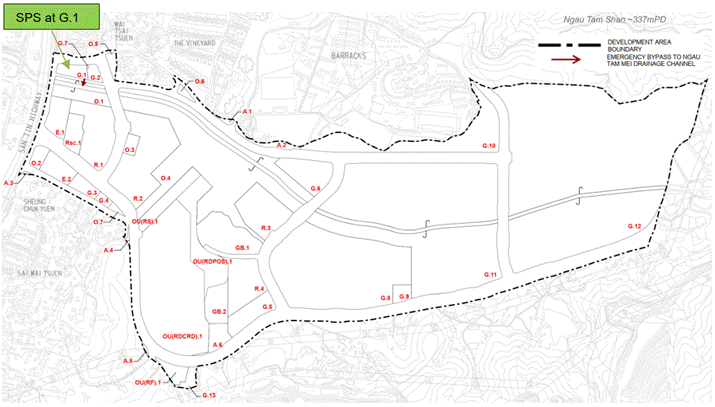
Exhibit 6-1 Proposed Location of SPS and Emergency Bypass Alignment