9 Ecological implication (Terrestrial and aquatic)
9.2 Environmental Legislation, Standards and Assessment Criteria
9.4 Description of the Environment
9.5 Ecological Baseline Information (Literature Review)
9.6 Ecological Baseline Information (Baseline Survey Findings)
9.7 Evaluation of Ecological Values of Recorded Habitats
9.8 Identification of Potential Ecological Impact
9.9 Evaluation of Potential Environmental Impacts
9.10 Cumulative Ecological Impacts
9.11 Mitigation Measures for Adverse Environmental Impacts
9.12 Evaluation of Residual Impacts
9.13 Environmental Monitoring and Audit
9.14 Environmental Acceptability of Schedule 2 Designated Projects
LIST OF TABLES
Table 9.1............. Baseline Information on Ecological Resources in the Assessment Area
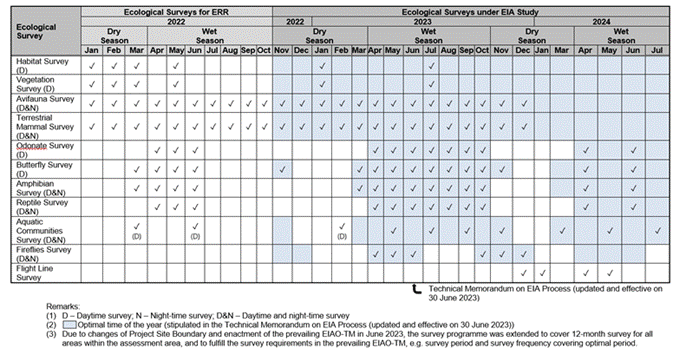
Table 9.2............. Ecological Survey Programme
Table 9.3............. Summary of Habitats Recorded within the Project Site and Assessment Area
Table 9.4............. Ecological Evaluation of Marsh/Reed within the Assessment Area
Table 9.5............. Ecological Evaluation of Ponds within the Assessment Area
Table 9.6............. Ecological Evaluation of Modified Watercourses within the Assessment Area
Table 9.7............. Ecological Evaluation of Natural Watercourses within the Assessment Area
Table 9.8............. Ecological Evaluation of Semi-natural Watercourses within the Assessment Area
Table 9.11.......... Ecological Evaluation of Shrubland and Grassland within the Assessment Area
Table 9.13.......... Summary of Ecological Values of Habitats within the Assessment Area
Table 9.15.......... Direct Loss of Terrestrial Habitats within Project Site
Table 9.16.......... Evaluation of Potential Ecological Impacts to Marsh/Reed
Table 9.17.......... Evaluation of Potential Ecological Impacts to Ponds
Table 9.18.......... Evaluation of Potential Ecological Impacts to Modified Watercourses
Table 9.19.......... Evaluation of Potential Ecological Impacts to Natural Watercourses
Table 9.20.......... Evaluation of Potential Ecological Impacts to Semi-natural Watercourses
Table 9.21.......... Evaluation of Potential Ecological Impacts to Agricultural Land
Table 9.22.......... Evaluation of Potential Ecological Impacts to Woodland and Mixed Woodland
Table 9.23.......... Evaluation of Potential Ecological Impacts to Plantation
Table 9.24.......... Evaluation of Potential Ecological Impacts to Shrubland and Grassland
Table 9.26.......... Summary of Potential Ecological Impacts
LIST OF FIGURES
|
|
Ecological Survey Locations |
|
Assessment Area for Ecology, Sites of Conservation Importance and Other Ecologically Sensitive Resources/Areas |
|
|
Locations of Species of Conservation Importance from Literature Review (Key Plan) |
|
|
Locations of Species of Conservation Importance from Literature Review (Sheet 1 of 6) |
|
|
Locations of Species of Conservation Importance from Literature Review (Sheet 2 of 6) |
|
|
Locations of Species of Conservation Importance from Literature Review (Sheet 3 of 6) |
|
|
Locations of Species of Conservation Importance from Literature Review (Sheet 4 of 6) |
|
|
Locations of Species of Conservation Importance from Literature Review (Sheet 5 of 6) |
|
|
Locations of Species of Conservation Importance from Literature Review (Sheet 6 of 6) |
|
|
Habitat Map and Locations of Species of Conservation Importance from Recent Survey (Key Plan) |
|
|
Habitat Map and Locations of Species of Conservation Importance from Recent Survey (Sheet 1 of 7) |
|
|
Habitat Map and Locations of Species of Conservation Importance from Recent Survey (Sheet 2 of 7) |
|
|
Habitat Map and Locations of Species of Conservation Importance from Recent Survey (Sheet 3 of 7) |
|
|
Habitat Map and Locations of Species of Conservation Importance from Recent Survey (Sheet 4 of 7) |
|
|
Habitat Map and Locations of Species of Conservation Importance from Recent Survey (Sheet 5 of 7) |
|
|
Habitat Map and Locations of Species of Conservation Importance from Recent Survey (Sheet 6 of 7) |
|
|
Habitat Map and Locations of Species of Conservation Importance from Recent Survey (Sheet 7 of 7) |
|
|
Flight Lines of Ardeids and Other Waterbirds |
|
|
Habitat Map Overlaid with Recommended Outline Development Plan |
|
|
Potential Location for Wetland Compensation |
|
|
Potential Location of Wildlife Corridor Design |
LIST OF APPENDICES
|
Representative Photographs of Habitat Types within the Assessment Area |
|
|
Flora Species Recorded in Assessment Area |
|
|
Fauna Species Recorded in Assessment Area |
|
|
Results of Flight Line Survey within the Assessment Area |
|
|
Representative Photographs of the Species of Conservation Importance Recorded within the Assessment Area |
|
|
Draft Habitat Creation and Management Plan |
9
Ecological implication
(Terrestrial and aquatic)
9.1
Introduction
9.1.1
This section presents the baseline ecological profile
within the assessment area, and the assessment on the potential ecological
impacts associated with the construction and operation of the Project.
The ecological impact assessment has been conducted in accordance with the
requirement in Annexes 8 and 16 of the Technical Memorandum on Environmental
Impact Assessment Process (EIAO-TM) and the requirements in Section 3.4.9 and
Appendix H of the EIA Study Brief (ESB-363/2023).
9.2
Environmental Legislation, Standards and Assessment
Criteria
9.2.1
Reference was made to the following HKSAR Government
ordinances, regulations, standards, guidelines and documents when identifying
ecological importance of habitats and species, and evaluating and assessing
potential impacts of the Project on the ecological resources:
· Country Parks Ordinance (Cap. 208) and its subsidiary legislation;
· Forests and Countryside Ordinance (Cap. 96) and its subsidiary legislation, the Forestry Regulations (Cap. 96A);
· Wild Animals Protection Ordinance (Cap. 170);
· Protection of Endangered Species of Animals and Plants Ordinance (Cap. 586) and its subsidiary legislation;
· Chapter 10 of the Hong Kong Planning Standards and Guidelines;
· Environmental Impact Assessment Ordinance (Cap. 499) and relevant Annexes 8 and 16 of the associated EIAO-TM;
· EIAO Guidance Note No. 3/2010 – Flexibility and Enforceability of Mitigation Measures Proposed in an Environmental Impact Assessment Report;
· EIAO Guidance Note No. 6/2010 – Some Observations on Ecological Assessment from the Environmental Impact Assessment Ordinance Perspective;
· EIAO Guidance Note No. 7/2023 – Ecological Baseline Survey for Ecological Assessment;
· EIAO Guidance Note No. 10/2023 – Methodologies for Terrestrial and Freshwater Ecological Baseline Surveys;
· Drainage Services Department Practice Note No. 3/2021 – Guidelines on Design for Revitalisation of River Channel;
· Environment, Transport and Works Bureau Technical Circular (Works) (ETWB TC(W)) No. 5/2005 – Protection of Natural Streams/Rivers from Adverse Impacts Arising from Construction Works;
· New Nature Conservation Policy;
· List of Wild Animals under State Protection; and
· List of Wild Plants under State Protection.
9.2.2
This assessment also made reference
to the following international conventions and national legislation:
·
The
International Union for Conservation of Nature (IUCN) Red List of Threatened Species;
·
The
List of Wild Plants and Wild Animals Under Special State Protection under the
Law of the People’s Republic of China on the Protection of Wildlife; and
· The Convention on Biological Diversity (the CBD), and an associated city-level Biodiversity Strategy and Action Plan (BSAP) developed by Agriculture, Fisheries and Conservation Department (AFCD) under the CBD.
9.3
Assessment Methodology
Assessment Area
9.3.1
In accordance with EIA Study Brief No. ESB-363/2023,
the assessment area for the purpose of the terrestrial and aquatic ecological
impact assessment includes areas within 500 m distance from the boundary of the
Project Site which includes associated works of the proposed development.
Ecological Survey Methodology
9.3.2 Relevant reports, studies, books, scientific papers and available information regarding the ecological characteristics of the assessment were collated and reviewed (Table 9.1 refers). The information collected was evaluated to identify any information gaps relating to the assessment of potential ecological impacts.
Table 9.1 Baseline Information on Ecological Resources in the Assessment Area
|
Relevant Literature |
Habitat and Vegetation |
Avifauna |
Mammal |
Herpetofauna |
Butterfly and Odonate |
Freshwater Community |
|
EIA Report for Proposed Residential Cum Passive Recreation Development within "Recreation" Zone and "Residential (Group C)" Zone at Various Lots in DD 104, Yuen Long, N.T (Register No.: AEIAR-182/2014) (Capital Chance Limited, 2013[7]) |
✓ |
✓ |
✓ |
✓ |
✓ |
✓ |
|
EIA Report for Comprehensive Development and Wetland Protection near Yau Mei San Tsuen (Register No.: AEIAR-189/2015) (Asia King Development Limited, 2015[5]) |
✓ |
✓ |
✓ |
✓ |
✓ |
✓ |
|
EIA Report for Proposed Low-rise and Low-density Residential Development at Various Lots and their Adjoining Government Land in D.D. 104, East of Kam Pok Road, Mai Po, Yuen Long. New Territories (Register No.: AEIAR-205/2017) (Glory Queen Limited, 2016[19]) |
✓ |
✓ |
✓ |
✓ |
✓ |
✓ |
|
EIA Report for Proposed Interim Sewage Treatment Plant and Effluent Reuse Facility at Wo Shang Wai, Yuen Long (Register No.: AEIAR-217/2018) (Profit Point Enterprises Ltd, 2018[36]) |
✓ |
✓ |
✓ |
✓ |
✓ |
✓ |
|
Draft Ecological Baseline Survey Report – Study on Phase One Development of the New Territories North – San Tin/Lok Ma Chau Development Node (STLMC DN) – Feasibility Study – Additional Services for Expanded Ecological Survey (CEDD & PlanD, 2021[12]) |
✓ |
✓ |
✓ |
✓ |
✓ |
✓ |
|
EIA Report for Northern Link Main Line (Register No.: AEIAR-259/2024) (MTRCL, 2023[35]) |
✓ |
✓ |
✓ |
✓ |
✓ |
✓ |
|
Project Profile for Light Public Housing at Yau Pok Road, Yuen Long (Application No.: DIR-296/2023) (ArchSD, 2023[4]) |
✓ |
✓ |
✓ |
✓ |
✓ |
✓ |
|
Agriculture, Fisheries and Conservation Department (AFCD). Hong Kong Biodiversity Newsletter Issue No. 26 - Territory-wide Study on Roosting Sites of Ardeids in Winter 2019/20 (AFCD, 2020[3]) |
|
✓ |
|
|
|
|
|
EIA Report for Ngau Tam Mei Water Treatment Works Extension (Register No.: AEIAR-262/2024) (WSD, 2024[43]) |
✓ |
✓ |
✓ |
✓ |
✓ |
✓ |
|
EIA Report for First Phase Development of The New Territories North – San Tin/Lok Ma Chau Development Node – Investigation (Register No.: AEIAR-261/2024) (CEDD, 2024[13]) |
✓ |
✓ |
✓ |
✓ |
✓ |
✓ |
|
Project Profile for Ground Investigation Works for Northern Link within Lam Tsuen Country Park and Conservation Area (DIR-302/2024) (MTRCL, 2024[34]) |
✓ |
✓ |
✓ |
✓ |
✓ |
|
9.3.3 The purposes of the ecological surveys are to fill in the information gap, collect up-to-date ecological baseline information, as well as verify the information from literature review for subsequent assessment including evaluation of ecological values and potential ecological impacts arising from the proposed development, and formulate appropriate mitigation measures. The walk transects and sampling points for ecological surveys are shown in Figure 9.1. Where coverage by walk-transects were not possible (e.g. inaccessible areas within private areas, open storage, barrack areas where access is not allowed, and hillside areas with limited accessibility and safety concern), high-power binoculars were used at a location as close as possible to determine the habitat structure and general vegetation composition.
9.3.4
The ecological surveys covered flora, fauna and any
other habitats/species of conservation importance. The survey methodology had
referred to the EIAO Guidance Notes (No. 7/2023 and No. 10/2023) and Annex 16
of EIAO-TM to cover the active seasons of each faunal group. All field surveys
were carried out in such ways that would not cause any unnecessary stress or
damage to the existing habitats and wildlife.
Habitat Mapping and Vegetation Survey
9.3.5
Terrestrial habitats within the assessment area were
identified, sized and mapped. Ecological characteristics of each habitat type,
including size, vegetation type, species present, dominant species found,
species diversity and abundance, community structure, ecological value and
inter-dependence of the habitats and species, and presence of any features of
ecological importance were defined and characterised. Representative
photographs of the habitat types and/or any important ecological features
identified were taken. A habitat map of suitable scale (i.e. 1:5000) showing
types and locations of terrestrial habitats within the Project Site was
prepared from aerial photographs. The habitat map was checked during ground
truthing.
9.3.6
Vegetation surveys were conducted by direct
observation to record diversity and dominance of plant species present in
different habitat types. Locations of plant species of conservation
importance were recorded. Identification of flora species and status in
Hong Kong referred to Xing et al. (2000)[46],
Hu et al. (2003)[26], Lai
et al. (2008)[29], Hong
Kong Herbarium (2012)[21], and
Hong Kong Herbarium and South China Botanical Gardens (2007; 2008; 2009; 2011)[22,23,24,25].
Avifauna Survey
9.3.7
The presence and abundance of avifauna species at
various habitats within the assessment area were recorded visually and aurally.
Avifauna within the assessment area was surveyed quantitatively using transect
count method, covering early morning, dusk and night-time. The location
of avifauna species of conservation importance encountered was recorded, along
with notable behaviour (e.g. breeding behaviour such as nesting and presence of
recently fledged juveniles, roosting, and feeding activities), if any.
Ornithological nomenclature follows Carey et al. (2001)[8], Viney et al. (2005)[42] and the most recently
updated list from the Hong Kong Bird Watching Society.
Flight Line Survey
9.3.8
Bird flight line surveys were conducted to confirm any
major bird flight lines within the assessment area, typically for ardeids and
other waterbirds such as Black-faced Spoonbill (Platalea
minor) and Mandarin Duck (Aix galericulata).
The surveys were conducted from December 2023 to January 2024 and April 2024 to
May 2024 covering both dry and wet seasons at vantage points VP1 and VP2 (Figure 9.5 refers) close to Ngau Tam Mei
Drainage Channel (NTMDC). The flight lines of ardeids and other
waterbirds between the Project Site and Deep Bay wetlands were observed and
recorded, if any. The surveys started 30 minutes before sunrise and lasted two
hours. The time of sunrise on the date of survey made
reference to the Hong Kong Observatory. Flight direction and
flight height of ardeid and other waterbird individuals were recorded. The landing locations of
the observed birds within the assessment area were also recorded, wherever
possible.
Terrestrial Mammal Survey
9.3.9
Surveys for terrestrial mammals were conducted in areas
which might potentially be utilised by terrestrial mammals, covering daytime
for diurnal species, dusk for bats and night-time for nocturnal species in both
dry and wet seasons. The surveys focused on searching for field signs
such as droppings, footprints, diggings or burrows left by larger terrestrial
mammals. Mammal identification was made as accurately as possible from
the field signs encountered. In addition, any mammal directly observed were
also identified. A total of 10 camera traps were deployed at secure and
appropriate locations where would have potential mammal usage. Based on the
site situation, CT1 was adjusted to location CT1a starting from March 2023 (Figure 9.1 refers).
9.3.10
Bat surveys were undertaken by surveyor(s) equipped
with ultrasonic bat detector at potential roosting, commuting, foraging and
drinking sites. The bat species were located upon the detection location
of echolocation calls and from direct observation. The acoustic information was
recorded for later analysis and supplemented with other direct observation for species
identification. Nomenclature of mammal follows Shek (2006)[39].
Butterfly and Odonate Survey
9.3.11
Butterflies and odonates
(i.e. dragonflies and damselflies) within the assessment area were surveyed along survey transects during
daytime. Attention was given to their potential habitats. Relative
abundance of butterflies, dragonflies and damselflies was recorded, while
larvae and pupae encountered were also recorded. Nomenclature of
butterfly follows Lo & Hui (2010)[31]
and odonate on Tam et al. (2011)[41] and Reels (2019)[38].
Herpetofauna (Amphibian and Reptile) Survey
9.3.12
Herpetofauna within the assessment area were surveyed along survey transects covering daytime
and night-time. Potential microhabitats (e.g. leaf litter, underneath of rotten
logs) were searched. All reptiles and amphibians sighted were recorded.
9.3.13
Amphibian surveys were conducted whenever possible on
evening following or during periods of rainfall, focusing on areas suitable for
amphibians (e.g. shrublands, grasslands, watercourses, catchwaters, ponds and
marshes). Records of calling amphibians formed the bulk of the data were
collected. Visual observation of eggs, tadpoles, frogs and toads were
also conducted and supplemented in the data collected.
9.3.14
During reptile surveys, careful searches of
appropriate microhabitats and refugia (e.g. stones, pond bunds, crevices, leaf
litter/debris and rotten log) were undertaken. All reptiles observed were
identified. In addition to active searching, observation of exposed, basking or
foraging reptiles were also recorded.
9.3.15
Nomenclature of amphibian and reptile follows Chan et
al. (2005)[10] and Chan et
al. (2006) [11], respectively.
Aquatic Communities Survey
9.3.16
Freshwater invertebrates and fish surveys were
surveyed through active searching and/or direct observation at representative
aquatic sampling locations (i.e. FS1 to FS15) within the assessment area (Figure 9.1 refers). Freshwater invertebrates
surveys were conducted during daytime while freshwater fish surveys were
conducted during daytime for diurnal species and night-time for nocturnal
species. To avoid driving organisms (e.g. fish and shrimps) away, and avoid
disturbing the bottom substrate, direct observation from a suitable distance
were conducted before active searching and kick sampling. Boulders within
the watercourse were turned over to locate any aquatic animals beneath.
Hand net was used to collect organisms along the watercourse. Organisms
encountered were recorded and identified to the lowest possible taxon level.
9.3.17
Nomenclature of aquatic fish and invertebrate
communities follows Lee et al. (2004)[30]
and Dudgeon (2003)[14],
respectively.
Firefly Survey
9.3.18
Fireflies within the assessment area was surveyed
along survey transects. Day, dusk and night-time surveys were conducted
monthly. Potential habitats for fireflies and locations with less artificial
lighting were prioritised with particular attention paid during the firefly
surveys. Where site situation permits, lighting devices were switched off or at
sufficient intervals to allow detection of fireflies before progressing along
the transect. During the surveys, adult and larva firefly observed were
identified to the species level, where possible. The abundance and distribution
of fireflies were recorded. Any sighting of mass occurrence and/or breeding
behaviour of fireflies and the associated locations and habitats were recorded.
Diurnal fireflies found during other day-time surveys were also recorded if
observed.
Ecological Survey Programme
9.3.19
In the beginning of Ngau Tam Mei (NTM) Land Use Review
Study (the Study) which commenced in November 2021, a baseline ecological survey was conducted between January 2022
and October 2022 to establish the ecological conditions for preparation of environmental review report (ERR) under the Study. Following the
initiation of this EIA study, ecological surveys covering the 500 m assessment
area commenced in November 2022. Survey findings recorded during the ecological survey between January 2022 and October 2022 have also been taken
into account in this ecological assessment given the high relevance and
recentness of the survey findings. The detailed ecological survey
programme is presented in Table 9.2 below.
Table 9.2 Ecological Survey Programme
Assessment Approach
9.3.20
The criteria and guidelines in Annexes 8 and 16 of the
EIAO-TM were followed for evaluating and assessing ecological impact arising
from the construction and operation of the Project. Potential
direct/indirect, on-site/off-site, primary, secondary, cumulative and residual
ecological impacts arising from the construction and operation of the Project
were identified and evaluated. Mitigation measures and monitoring and
audit programme were recommended, where necessary.
9.4
Description of the Environment
9.4.1
The following sections provide a review of existing
ecological baseline conditions based on relevant available recent EIA studies,
together with books, scientific papers and available information regarding the
ecological characteristics of the assessment area.
Recognised Sites of Conservation Importance
Lam Tsuen Country
Park
9.4.2
Lam Tsuen Country Park (LTCP) is located approximately
190 m to the south of the Project Site (Figure 9.2 refers). Designated in 1979, the LTCP commands
a total area of 1,520 ha that spans over Tai Po, Fanling
and Yuen Long (AFCD, 2024[2]).
9.4.3
Fauna species of conservation importance recorded in
the LTCP include East Asian Porcupine (Hystrix brachyura),
Chinese Ferret Badger (Melogale moschata),
Chinese Pangolin (Manis pentadactyla) and
Chinese Leopard Cat (Felis bengalensis). Other birds and butterflies
commonly found in the LTCP include Chinese Bulbul (Pycnonotus sinensis),
Crested Bulbul (Pycnonotus jocosus), Common
Mormon (Papilio polytes), Red Helen (Papilio
helenus) and Peacock Pansy (Junonia
almana almana).
Woodlands in the LTCP also support a diversity of dragonflies and insects.
According to a recent EIA study (WSD, 2024[43]) and Project Profile
(MTRCL, 2024[34]), flora species of conservation importance
including Aquilaria sinensis and Brainea
insignis were recorded in the LTCP within the assessment area.
Conservation Area
9.4.4 Three Conservation Areas (CAs) are identified outside the Project Site. The two CAs under Ngau Tam Mei Outline Zoning Plan (OZP) No. S/YL-NTM/14 and Kam Tin North OZP No. S/YL-KTN/11 are situated at approximately 20 m to the east of the Project Site near NTMWTW and 120 m to the south of the Project Site respectively. One CA under Mai Po and Fairview Park OZP No. S/YL-MP/8 is situated at approximately 400 m from the Project Site.
9.4.5 The CAs gazetted in Ngau Tam Mei OZP and Kam Tin North OZP intend to protect and retain the existing natural landscape, ecological or topographical features of the area for conservation, educational and research purposes and to separate sensitive natural environment such as country park from the adverse effects of development. There is a general presumption against development in this zone. In general, only developments that are needed to support the conservation of the existing natural landscape or scenic quality of the area or are essential infrastructure projects with overriding public interest may be permitted. For the CA gazetted in Mai Po and Fairview Park OZP, it intends to conserve the ecological value of wetland and fishponds which formed an integral part of the wetland ecosystem in the Deep Bay Area. The “no-net-loss in wetland” principle is adopted in Mai Po and Fairview Park OZP for any change in use within the zone. The primary intention is to discourage new development unless it is required to support the conservation of the ecological integrity of the wetland ecosystem or the development is an essential infrastructure project with overriding public interest.
Wetland
Conservation Area
9.4.6 Wetland Conservation Area (WCA) is situated outside the Project Site, at approximately 260 m and 80 m from the Development Area and the proposed cycle track in Yau Mei San Tsuen area, respectively (Figure 9.2 refers). The WCA comprises the existing and contiguous, active or abandoned fishponds in the Deep Bay Area, which should all be conserved. According to Town Planning Board Guidelines for Application for Developments within Deep Bay Area under Section 16 of the Town Planning Ordinance (TPB PG-NO. 12C), the planning intention of WCA is to conserve the ecological value of the fishponds which form an integral part of the wetland ecosystem in the Deep Bay Area. Any development within the WCA should be supported by an ecological impact assessment to demonstrate that the development would not result in a net loss in wetland function and negative disturbance impact.
Wetland Buffer Area
9.4.7 The Wetland Buffer Area (WBA) is located along the landward periphery of the WCA. According to Town Planning Board Guidelines for Application for Developments within Deep Bay Area under Section 16 of the Town Planning Ordinance (TPB PG-NO. 12C), WBA is a buffer generally comprises the strip of land of about 500 m wide along the landward side of the WCA, which is intended to protect the ecological integrity of the fishponds and wetland within the WCA and prevent development that would have a negative off-site disturbance impact on the ecological value of fishponds. A small portion of the proposed cycle track and the associated connection would be located within the WBA in Yau Mei San Tsuen area (Figure 9.2 refers), subject to detailed design stage.
Priority Site for
Enhanced Conservation - Deep Bay Wetland outside Ramsar Site
9.4.8 An extensive area of fishponds adjacent to the Ramsar Site and along Shenzhen River was identified as a Priority Site for Enhanced Conservation with target on the waterbirds and other wildlife utilising the fishpond habitat. A small area of the Deep Bay Wetland outside Ramsar Site is located at approximately 450 m and 250 m to the northwest of the Development Area and the proposed cycle track in Yau Mei San Tsuen area, respectively (Figure 9.2 refers).
Other Ecologically
Sensitive Resources
Pond Areas
9.4.9 According to the survey and desktop research on the latest digital aerial photographs, patches of ponds were found on both sides of the NTMDC and some of the ponds near NTMWTW were also within the Project Site. Outside the Project Site, apart from the ponds near NTMWTW, ponds were mostly found to the west of San Tin Highway, including to the north of Pok Wai and near Yau Mei San Tsuen.
Other Specified
Uses (Comprehensive Development and Wetland Protection Area)
9.4.10 A plot of land zoned as “Other Specified Uses (Comprehensive Development and Wetland Protection Area)” (“OU(CDWPA)”) is located outside the Project Site, at approximately 295 m northwest from the Development Area and about 80 m from the proposed cycle track in Yau Mei San Tsuen. This area is covered by Mai Po and Fairview Park OZP and is also located within the WBA and partially within the WCA. The planning intention allows the consideration of comprehensive low-density residential development or redevelopment provided that all the existing continuous and contiguous fishponds within the zone are protected and conserved. The “no-net-loss in wetland” principle is adopted for any change in use within this zone. Development or redevelopment within this zone should involve no pond filling and no decline in wetland function of fishponds. Any new development should be located on the formed land and as far away from the existing fishpond within the development site.
9.4.11 Avifauna species of conservation importance/wetland-dependent species such as Collared Crow (Corvus torquatus), Common Kestrel (Falco tinnunculus), Eastern Cattle Egret (Bubulcus coromandus), were previously recorded in this area (Asia King Development Limited, 2017[6]; Capital Chance Limited, 2013[7]; Glory Queen Limited, 2016 [19]).
Other Specified Uses
(Wetland Conservation Park)
9.4.12 A plot of land zoned as “Other Specified Uses (Wetland Conservation Park)” (“OU(WCP)”) under Mai Po and Fairview Park OZP is located outside the Project Site, at about 220 m and 20 m northwest of the Development Area and the proposed cycle track of the Project Site respectively. This zone is located within the WCA and WBA. The OU(WCP) is intended primarily for the development of a Wetland Conservation Park (Sam Po Shue Wetland Conservation Park) by the Government to conserve the wetlands with ecological conservation values and safeguard the integrity of the wetland system; compensate for the impact on ecological and fisheries resources arising from the development of the San Tin/Lok Ma Chau area of the San Tin Technopole, thereby achieving ‘co-existence of development and conservation’; provide eco-education and eco-recreation facilities for the public; and promote scientific research on aquaculture and develop modernised aquaculture industry.
9.5
Ecological Baseline Information (Literature Review)
General Description of Habitats within Project Site
9.5.1 The northwest, eastern and southern parts of the Project Site were covered by previous EIA/environmental studies (Capital Chance Limited, 2013[7]; Asia King Development Limited, 2015[5]; Glory Queen Limited, 2016[19]; ArchSD, 2023[4]; WSD, 2024[43]). Habitats such as developed area/wasteland, pond, village/orchard, grassland/shrubland, grassland, marsh/reed, agricultural land, plantation, drainage channel and watercourse were previously recorded in the northwest part of the Project Site, and most of the recorded habitats were of very low to low-moderate ecological values, except NTMDC (ibid.). NTMDC was recorded with moderate ecological value with relatively higher number of ardeids foraging in the channel but in low bird species diversity (Asia King Development Limited, 2015[5]; ArchSD, 2023[4]).
9.5.2 On the other hand, the northeast part of the Project Site was covered in the studies conducted by CEDD & PlanD (2021)[12] and CEDD (2024)[13]. Habitats such as grassland, shrubland, pond, plantation, village/orchard, developed area/wasteland, agricultural land and semi-natural watercourse were identified at the northeast part of the assessment area (CEDD & PlanD, 2021[12]; CEDD, 2024[13]).
9.5.3 The eastern and southern parts of the Project Site were covered by a recent EIA study (WSD, 2024[43]). Habitats such as watercourse, pond, grassland, shrubland, woodland, plantation and developed area were recorded in the eastern the southern parts of the Project Site (WSD, 2024[43]).
9.5.4 Over half of the western part of the Project Site and the proposed road connection to/from San Tin Technopole (STT) at Ngau Tam Shan at the north of the Project Site were covered by recent EIA studies (CEDD, 2024[13]; MTRCL, 2023[35]). Habitats, including grassland, shrubland, pond, plantation, village/orchard, developed area/wasteland, watercourse, agricultural land, marsh/reed, mixed woodland and woodland, were recorded in this part of the Project Site (MTRCL, 2023[35]).
Habitat and
Vegetation
9.5.5 A total of 16 habitat types were previously identified within the 500 m assessment area, including marsh/reed, pond, watercourse, modified watercourse, semi-natural watercourse, drainage channel, agricultural land, woodland, mixed woodland, plantation, shrubland, grassland, grassland/shrubland, seasonally wet grassland, village/orchard and developed area/wasteland (Capital Chance Limited, 2013[7]; Asia King Development Limited, 2015[5]; Glory Queen Limited, 2016[19]; CEDD & PlanD, 2021[12]; ArchSD, 2023[4]; MTRCL, 2023[35]; WSD, 2024[43], CEDD, 2024[13] and MTRCL, 2024[34]). Most of these recorded habitats were also identified within the Project Site, dominated by developed area/wasteland habitat and village/orchard. Flora species of conservation importance recorded from previous studies are presented in Table 9.14 and Figure 9.3.1 to Figure 9.3.6.
9.5.6 Landscape planting areas located along the northern bank of the NTMDC and in Pok Wai were provided under EP Condition No. 2.5 of Environmental Permit No. VEP-002/1999/A/EP-003 and AEP-089/2001 respectively, and are both being managed by AFCD. These landscape planting areas are landscaping soft works, as revegetation and planting within the works boundaries of the Main Drainage Channels for Ngau Tam Mei and Pok Wai Drainage Channel.
Fauna
9.5.7 A number of previous studies have been reviewed to establish the general ecological profile of the assessment area (Table 9.2 refers). The recorded species of conservation importance were mostly recorded at the west of San Tin Highway, along Ching Yau Road, near San Wai Tsuen and at Ngau Tam Shan. Within the Project Site, avifauna species were recorded mostly along the NTMDC. Other species of conservation importance, including butterflies, odonates, mammals and herpetofauna species were scattered across the southern and western part of the Project Site. Habitats and locations of fauna species of conservation importance recorded from previous studies, where available, are presented in Table 9.14 and Figure 9.3.1 to Figure 9.3.6 respectively.
Avifauna
9.5.8 The avifauna community previously recorded in the vicinity of the assessment area were mainly waterbirds and wetland-dependent species recorded along NTMDC and wetland habitats to the west of San Tin Highway. In addition, no breeding site was recorded from the literatures. A total of 39 avifauna species of conservation importance were recorded within the assessment area from previous studies (Capital Chance Limited, 2013[7]; Asia King Development Limited, 2015[5]; Glory Queen Limited, 2016[19]; ArchSD, 2023[4]; MTRCL, 2023[35]; WSD, 2024[43]; CEDD, 2024[13]). Among these recorded species of conservation importance, 9 of them, namely Chinese Pond Heron (Ardeola bacchus), Collared Crow, Common Greenshank (Tringa nebularia), Great Egret (Ardea alba), Greater Coucal (Centropus sinensis), Grey Heron (Ardea cinerea), Little Egret (Egretta Garzetta), Northern Shoveler (Spatula clypeata) and Wood Sandpiper (Tringa glareola), were recorded within the Project Site in marsh/reed, modified watercourse, pond, agricultural land, grassland, village/orchard and developed area/wasteland habitats. However, exact locations of some recorded avifauna species were not available from previous studies (Capital Chance Limited, 2013[7]; Asia King Development Limited, 2015[5]; ArchSD, 2023[4]).
Flight Line of
Avifauna
9.5.9 Flight lines of avifauna in Yau Mei San Tsuen area were surveyed during October and November 2009 and from April to June 2011 in a previous EIA study (Asia King Development Limited, 2015[5]). According to this study, it was observed that the lower course of NTMDC was significant for non-breeding ardeids and provided linkages between the NTMDC and the wider Deep Bay wetlands through Fairview Park, Palm Springs and Yau Mei San Tsuen area. Moreover, from the vantage point at Yau Mei San Tsuen, most of the ardeids flew over Fairview Park without deterred by the presence of Fairview Park to forage in the lower course of NTMDC along Kam Pok Road (Asia King Development Limited, 2015[5]).
Mammal
9.5.10 Mammal species previously recorded within the assessment area include bats and non-flying terrestrial mammal species, and most of them were species of conservation importance. Bat species were recorded in a diversity of habitats including pond, modified watercourse, agricultural land, plantation, mixed woodland, village/orchard and developed area/wasteland, while other non-flying mammal species of conservation importance were recorded in woodland, mixed woodland and plantation habitats. A total of 7 flying mammal species and 5 non-flying mammal species were recorded within the assessment area (MTRCL, 2023[35]; CEDD, 2024[13]; WSD, 2024[43]). Among these mammal species of conservation importance, 5 bat species, including Japanese Pipistrelle (Pipistrellus abramus), Lesser Bamboo Bat (Tylonycteris fulvida), Chinese Noctule (Nyctalus plancyi), Unknown Vespertilionidae Sp. 1 and Unknown Vespertilionidae Sp. 2, and 1 non-flying mammal species, namely Pallas’s Squirrel (Callosciurus erythraeus), were recorded in different habitats (modified watercourse, mixed woodland, plantation, agricultural land, village/orchard and developed area/wasteland) within the Project Site.
Butterfly
9.5.11 Previous records of butterfly species within the assessment area were mainly near hillside vegetated habitats, e.g. mixed woodland, plantation and grassland, to the north of the Project Site while some were also recorded in modified watercourse, shrubland, agricultural land, village/orchard and developed area/wasteland habitats. A total of 14 species of conservation importance were recorded within the assessment area (Capital Chance Limited, 2013[7]; Asia King Development Limited, 2015[5]; CEDD& PlanD, 2021[12]; MTRCL, 2023[35]; CEDD, 2024[13]). Two species of conservation importance were recorded within the Project Site including Small Cabbage White (Pieris rapae) and Swallowtail (Papilio xuthus). These butterfly species of conservation importance were recorded in village/orchard habitat within the Project Site.
Odonate
9.5.12 A total of 4 odonate species of conservation importance were previously recorded in pond, grassland, agricultural land, plantation, village/orchard and developed area/wasteland habitats within the assessment area (Asia King Development Limited, 2015[5]; MTRCL, 2023[35]; CEDD, 2024[13]). Blue Chaser (Potamarcha congener) was recorded in developed area/wasteland habitat within the Project Site. However, exact locations of some odonate species of conservation importance were not available in a previous study (Asia King Development Limited, 2015[5]).
Herpetofauna
9.5.13 Herpetofauna (i.e. both amphibian and reptile) species of conservation importance were previously recorded, scattered in wetland habitats, urbanised habitats and vegetated habitats. An amphibian species of conservation importance was recorded in pond habitat, while 4 reptile species of conservation importance were recorded in agricultural land, woodland, mixed woodland, plantation and developed area/wasteland habitats within the assessment area (Capital Chance Limited, 2013[7]; Asia King Development Limited, 2015[5]; Glory Queen Limited, 2016[19]; CEDD & PlanD, 2021[12]; MTRCL, 2023[35]; WSD, 2024[43]). One amphibian species of conservation importance (i.e. Chinese Bullfrog (Hoplobatrachus rugulosus)) was also recorded within the Project Site.
Aquatic Communities
9.5.14 A total of 4 freshwater species of conservation importance, namely freshwater shrimp Caridina serrata, freshwater crabs Cryptopotamon anacoluthon and Nanhaipotamon hongkongense, and freshwater fish Small Snakehead (Channa asiatica) were identified in natural watercourse and semi-natural watercourse within the assessment area (CEDD & PlanD, 2021[12]; WSD, 2024[43]). Freshwater crabs Cryptopotamon anacoluthon and Nanhaipotamon hongkongense were recorded in the same semi-natural watercourse within the Project Site, to the west of NTMWTW (ibid.).
Firefly
9.5.15 No baseline information on fireflies is available from the reviewed literatures.
9.6
Ecological Baseline Information (Baseline Survey
Findings)
Overview of Ecological Baseline Conditions
9.6.1 A total of 13 habitat types, namely marsh/reed, pond, natural watercourse, modified watercourse, semi-natural watercourse, agricultural land, woodland, mixed woodland, plantation, shrubland, grassland, village/orchard and developed area/wasteland, were identified within the assessment area and Project Site. The size and percentage coverage of each habitat type are described in Table 9.3. The habitat map and representative photographs of the habitats recorded within the assessment area are shown in Figure 9.4.1 to Figure 9.4.7 and Appendix 9.1 respectively. Flora species recorded within the assessment area are listed in Appendix 9.2.
9.6.2 A total of 586 flora species were recorded within the assessment area and 356 of them were recorded within the Project Site. Six flora species of conservation importance, namely Aquilaria sinensis, Aralia chinensis, Ceratopteris thalictroides, Brainea insignis, Cibotium barometz and Pavetta hongkongensis were recorded within the assessment area (Table 9.14 refers). Except Cibotium barometz and Pavetta hongkongensis, all were also spotted within the Project Site. The locations of flora species of conservation importance recorded are showed in Figure 9.4.1 to Figure 9.4.7.
Table 9.3 Summary of Habitats Recorded within the Project Site and Assessment Area
|
Habitat Types |
Within Project Site (1) |
Within Assessment Area (1)(2)(3) |
||
|
Total Area (ha) |
Percentage |
Total Area (ha) |
Percentage |
|
|
Marsh/Reed |
1.95 |
1.53% |
5.46 |
0.91% |
|
Pond |
5.47 |
4.28% |
18.86 |
3.13% |
|
Natural Watercourse |
0.60 (0.92 km) |
0.47% |
1.02 (1.89 km) |
0.17% |
|
Modified Watercourse |
2.10 (2.71 km) |
1.64% |
6.09 (8.32 km) |
1.01% |
|
Semi-natural Watercourse |
0.83 (1.83 km) |
0.65% |
1.57 (7.49 km) |
0.26% |
|
Agricultural Land |
5.65 |
4.42% |
9.13 |
1.52% |
|
Woodland |
0.77 |
0.60% |
50.97 |
8.47% |
|
Mixed Woodland |
7.47 |
5.85% |
66.13 |
10.99% |
|
Plantation |
4.98 |
3.90% |
51.29 |
8.52% |
|
Shrubland |
2.46 |
1.92% |
36.79 |
6.11% |
|
Grassland |
5.78 |
4.52% |
45.38 |
7.54% |
|
Village/Orchard |
38.59 |
30.20% |
67.12 |
11.15% |
|
Developed Area/Wasteland |
51.15 |
40.03% |
242.19 |
40.23% |
|
Total |
127.80 |
100% |
602.00 |
100% |
Notes:
(1) Areas of Project Site and assessment area that overlap with site areas of STLMC DN, NOL and Transitional Housing Project (illustrated in Figure 9.2) are excluded in this table.
(2) The value shown indicates the total area within the assessment area (i.e. the sum of area within and outside the Project Site).
(3) The size and percentage are subject to rounding adjustments. Any discrepancies between total and sums of individual numbers listed therein are due to rounding.
Habitat and
Vegetation
Marsh/Reed
9.6.3 Marsh/reed habitat within the Project Site were mostly derived from settlement of soils from abandoned ponds. Floral diversity within this habitat was generally low to moderate and dominated by aquatic herbs. Within the Project Site, the marsh/reed habitat were mainly scattered in Yau Tam Mei Tsuen, to the southeast of Project Site and some were identified along Ngau Tam Mei Road. To the west of San Tin Highway, outside the Project Site, the marsh/reed habitat could be found in Yau Mei San Tsuen and Man Yuen Chuen area. However, the marsh/reed recorded were relatively small and scattered.
9.6.4 Dominant flora species recorded in this habitat include Alocasia macrorrhizos, Bidens alba, Brachiaria mutica, Colocasia esculenta, Commelina diffusa and Typha angustifolia. An invasive species, i.e. Mikania micrantha, was also recorded as one of the dominant species in this habitat. Some ruderal herbs such as Pennisetum purpureum were also recorded in the edges of the marsh/reed habitat.
9.6.5 No flora species of conservation importance were recorded within the marsh/reed habitat during the survey.
Pond
9.6.6 Ponds were functionally associated with the adjacent village/orchard, marsh/reed and grassland habitats in general. These ponds are likely to be originated from agricultural or aquacultural activities. Majority of the ponds were identified to the west of San Tin Highway and near the NTMWTW to the east of watercourses W8a and W8. Other ponds within the assessment area were small in size and located on both sides of NTMDC. Some of these ponds were interspersed within village areas and inaccessible. Ecological characteristics and conditions of these inaccessible ponds were also observed from an appropriate distance aided with binoculars and based on aerial photographs.
9.6.7 The majority of the identified ponds within the assessment area were found to be inactive or abandoned fishponds. The pond bunds of these inactive and abandoned fishponds were unmanaged and overgrown by herbs such as Typha angustifolia, Pennisetum purpureum, and the invasive Mikania micrantha. The abandoned fishponds identified within the Project Site were generally small in size, scattered and colonised by herbaceous vegetation from the bunds.
9.6.8 Small areas of active fishponds were recorded at various locations, to the west of San Tin Highway, southeast of the Project Site near the NTMWTW, and adjacent to the southern bank of the NTMDC. Within the Project Site, the active fishponds were observed with traditional steep vegetated pond banks, while others are rectangular concrete fish tanks. Nets were also set up above the active ponds at some intensively managed ponds, likely to prevent birds from preying on the fish. Occasional stands of Bidens alba were present along the pond bunds. Ruderal herbs such as Ipomoea cairica and Panicum maximum grew on bunds. Fruit trees, such as Mangifera indica and Musa x paradisiaca, are also frequently cultivated on the pond bunds.
9.6.9 No flora species of conservation importance were recorded within the pond habitat during the survey.
Modified, Semi-natural and Natural Watercourse
9.6.10 Watercourses within the Project Site are categorised as natural watercourse, semi-natural watercourse and modified watercourse. Most of the watercourses were identified on both sides of the NTMDC (i.e. W1) and were hydrologically connected.
9.6.11 Modified watercourses within the Project Site include NTMDC, W5a, W6, W10a and W12. NTMDC is the largest modified watercourse within the Project Site with fair water quality. Existing NTMDC is trapezoidal in shape with concrete and grasscrete lining and subject to tidal influence at its downstream section. During low tide and dry season, water flow was restricted to the dry weather flow channel of about 0.5 m wide in the middle. Sporadic patches of aquatic herbs such as Alternanthera philoxeroides grew in the dry weather flow channel and on the base slab while ruderal plants (e.g. seedlings of Leucaena leucocephala and Panicum maximum) grew on the grasscrete area of the embankment. The vegetation in NTMDC was trimmed regularly during maintenance. Other flora species recorded in NTMDC within the Project Site include Cyclosorus interruptus, Persicaria lapathifolia and Celosia argentea which are locally common or very common herb. Other modified watercourses W5a, W6 and W10a were about 1.0 m to 3.0 m wide with banks modified with flood wall or corrugated metal sheet. Riverbed of W5a and W10a were mostly rocky and sandy, while riverbed W6 was sandy and muddy. Rapid and clear water flow was observed in W5a and W10a, while moderate flow with fair water was observed in W6. W12 was a ditch located near Yau Mei San Tsuen and observed with moderate water quality and slow water flow.
9.6.12 Semi-natural watercourses identified within the Project Site include W4, W7, W8, W8a, W8b, W9a, W9b, W10, W11 and W23. These semi-natural watercourses were recorded in area to the south of the NTMDC, except W23 which is located along Ngau Tam Mei Road. The banks of these tributaries were altered or modified. However, the stream beds of these semi-natural watercourses were relatively natural, comprised of mostly sandy or muddy substrates with slow to moderate flow rate. The width of these semi-natural watercourses ranged from approximately 0.3 m to 3.0 m. W8, W8a and W8b were observed with clear fast or moderate flow. W4 and W7 were observed with moderate flow and turbid to fair water quality. W9a, W9b and W11 were slow flowing watercourses with fair water quality and W10 was a clear slow flowing watercourse. W23 was a slow flowing watercourse with fair water quality and densely vegetated. The vegetation composition of general semi-natural watercourses is predominantly characterised by exotic or invasive alien species, including Brachiaria mutica, Bidens alba and Leucaena leucocephala.
9.6.13 Natural watercourses identified within the Project Site include W2, W3, W5 and W9. The former 3 watercourses were abandoned meanders connecting to northern banks of NTMDC which ran through grassland and developed area/wasteland habitats from east to west in slow to moderate flow rate and discharging into NTMDC via underground culverts. W2 was observed with turbid water while W3 and W5 were with fair water quality. W9 origins from woodland within LTCP at the southern part of assessment area. It was a fast-flowing watercourse with clear waterflow which ran through woodland, mixed woodland, plantation and village/orchard habitats. The stream forks into two, namely W9a and W9b, before discharging to NTMDC. W9 also has relatively natural and high coverage of vegetation by the adjacent woodland where plant species including Sterculia lanceolata, Cratoxylum cochinchinense and Aporosa dioica were observed. Other natural watercourses (i.e. W2, W3 and W5) appear to be disturbed and were primarily covered with invasive or exotic species such as Bidens alba, Commelina diffusa, Mikania micrantha and Leucaena leucocephala.
9.6.14 Other minor watercourses within the assessment area include W13, W13a, W13b, and W14 to W22. W13, W13a and W14 were within private area with limited accessibility. W13b, W15 and W18 were slow-flowing modified watercourses with fair water quality. These three watercourses ran through the developed area/wasteland at the western part of the Project Site. W16 and W17 were modified watercourses with moderate water flow. Water quality of W16 which received considerable discharge from the nearby storage area was observed to be turbid. On the other hand, W17 was observed with moderate water quality. Apart from the residential area at the upper stream and the nearby car parks, this watercourse also ran though pond and marsh/reed habitats. W19 and W20 were both observed dry during the field surveys. W21 and W22 are natural watercourses with clear water and good water quality. The water source for both W21 and W22 origins from upslope of the woodland habitat of the CA and LTCP.
9.6.15 No flora species of conservation importance were recorded within the modified watercourse during the survey.
Agricultural Land
9.6.16 Agricultural lands within the assessment area were identified on both sides of the NTMDC and at the southeast of Project Site. Scattered agricultural lands were also found in Long Ha, near Yau Mei San Tsuen and Shek Wu Wai San Tsuen. The agricultural lands on the southern side of NTMDC were mostly located within the inaccessible village areas. They consisted of a mosaic of active and inactive fields, with common fruit trees Carica papaya and Musa x paradisiaca planted on the periphery of the active fields. A relatively continuous area of agricultural land, namely Sun Hing Farm, was identified at the southeast part of the Project Site between watercourses W9 and W10. This agricultural land consisted agricultural land planting crops such as Zea mays, Lycopersicon esculentum and occasionally Oryza sativa. Nets were also set up at the active fields to protect the farm produces from birds. In addition, inactive fields were interspersed among the active fields. These inactive fields may have been temporarily abandoned and overgrown with ruderal herbs. Dominant species including Bidens alba, Eleusine indica, Hibiscus sabdariffa, Manihot esculenta and Zea mays were recorded in this habitat.
9.6.17 The inaccessible agricultural lands on the northern side of the NTMDC were observed with the aid of binoculars. Dry crops such as Aloe vera, Benincasa hispida, Brassica spp., Zea mays and fruit trees (e.g. Carica papaya) were cultivated on the active fields, with some inactive fields dominated by Bidens alba on the side.
9.6.18 No flora species of conservation importance were recorded within the agricultural land during the survey.
Woodland
9.6.19 Majority of the woodland habitats within the assessment area were recorded at the hillside of Ngau Tam Shan and within LTCP area at the south of the assessment area. Small patch of woodland was also identified at the southeast area of the Project Site near watercourse W9. These woodlands comprised a closed canopy with trees of approximately 13 m to 17 m tall. The canopy was primarily composed of Acronychia pedunculata, Machilus pauhoi, Schefflera heptaphylla, Sterculia lanceolata and mixed with other exotic trees such as Acacia spp. and Lophostemon confertus. Given the surrounding environment was mainly developed area/wasteland and village/orchard area, the woodland margin was exposed to regular human disturbance.
9.6.20 Two flora species of conservation importance, namely Aquilaria sinensis and Cibotium barometz, were recorded in this habitat within the assessment area. In particular, Aquilaria sinensis was also recorded within the Project Site.
Mixed Woodland
9.6.21 Mixed woodlands were identified at the hillside of Ngau Tam Shan, to the north of Ngau Tam Mei Road, at the northwest of the assessment area, at the centre of the Project Site, to the east of San Wai Tsuen and to the north to Ching Yau Road. The mixed woodlands were relatively young, and the canopies consisted of exotic trees Acacia confusa and Melia azedarach. The mixed woodlands had semi-closed canopies, allowing moderate light to reach the forest ground, and an average canopy height of 8 m to 10 m. The canopies were dominated by both native and exotic species including Acacia spp., Leucaena leucocephala, Ficus microcarpa and Machilus pauhoi.
9.6.22 Two flora species of conservation importance, namely Aquilaria sinensis and Aralia chinensis, were recorded in this habitat within the assessment area. In particular, Aquilaria sinensis was also recorded within the Project Site.
Plantation
9.6.23 Majority of the plantation habitat within the assessment area were located in hillside areas such as Ngau Tam Shan and to the south of Ching Yau Road. A strip of plantation is also located along NTMDC within the Project Site (Section 9.5.6 refers). Abundant and dominant plantation species such as Acacia auriculiformis, Acacia confusa, Bauhinia spp., Ficus hispida, Lophostemon confertus and Macaranga tanarius var. tomentosa were recorded in the plantation habitat. Most of the recorded species in the plantation habitat were widely cultivated in Hong Kong.
9.6.24 Three flora species of conservation importance, namely Aquilaria sinensis, Aralia chinensis and Brainea insignis, were recorded in this habitat within the assessment area. In particular, Aquilaria sinensis and Brainea insignis were also recorded within the Project Site.
Shrubland
9.6.25 Majority of the shrubland habitat was identified at hillside area such as Ngau Tam Shan at the northern part of the assessment area and to the south of Ching Yau Road. These shrublands serve as a transitional successional stage between grassland and mixed woodland or plantation that have previously experienced disturbances such as hill fires. Examples of dominant species in these shrublands include Aporosa dioica, Dicranopteris pedata, Ilex asprella, Psychotria asiatica and Blechnum orientale.
9.6.26 Small patches of shrubland were also identified on the southern side of the NTMDC within the Project Site. They were associated with the adjacent village/orchard and agricultural land habitats and likely succeeded from abandoned agricultural lands. These shrubland were located among the village areas and thus inaccessible. Short trees and shrubs such as native Alangium chinense, Celtis sinensis, Macaranga tanarius var. tomentosa and exotic Melia azedarach were recorded.
9.6.27 One flora species of conservation importance, namely Aquilaria sinensis, was recorded in this habitat within the assessment area but outside the Project Site.
Grassland
9.6.28 Grassland habitat identified within the assessment area was located in hillside area connected with other vegetated area such as shrubland, woodland and mixed woodland while some grasslands were located in low-lying area near Yau Mei San Tsuen and at both sides of the NTMDC. Within the Project Site, majority of the grassland was identified near Yau Tam Mei Tsuen. These grasslands were succeeded from fallow fields or dried up ponds. Most of these grasslands were fenced off or located among the village areas. The dominant species in grasslands include Bidens alba, Brachiaria mutica, Cyperus rotundus, Dicranopteris pedata, Imperata cylindrica var. major and Wedelia trilobata.
9.6.29 One flora species of conservation importance, namely Brainea insignis, was recorded in grassland habitat within the assessment area and within the Project Site.
Village/Orchard
9.6.30 Village/orchard habitat is the second dominant habitat within both assessment area and the Project Site. Village/orchard was along the north and south of NTMDC, while scattered village/orchard areas were identified in Shek Wu Wai San Tsuen, Yau Mei San Tsuen and Long Ha. The floral composition in these village/orchard areas were dominated by exotic species such as Artocarpus heterophyllus, Bidens alba, Dimocarpus longan, Mangifera indica and Ipomoea cairica, as well as some common native species like Bridelia tomentosa, Eleusine indica, Ficus microcarpa and Macaranga tanarius var. tomentosa. This habitat is actively managed and under constant human disturbance.
9.6.31 Four flora species of conservation importance, namely Aquilaria sinensis, Aralia chinensis, Ceratopteris thalictroides and Pavetta hongkongensis, were found in this habitat. In particular, Aquilaria sinensis and Ceratopteris thalictroides were also recorded within the Project Site.
Developed Area/Wasteland
9.6.32 Large proportion of the area within the assessment area and Project Site were identified as developed area/wasteland habitat. This habitat consisted of residential areas, roads and open storages, etc., and was man-made in nature and subject to high human disturbance. Abundant and dominant species such as Acacia confusa, Bidens alba, Clausena lansium, Ficus hispida and Ficus microcarpa were recorded in this habitat.
9.6.33 Two flora species of conservation importance, Aralia chinensis and Aquilaria sinensis, were recorded within this habitat within the assessment area and within the Project Site.
Fauna
Avifauna
9.6.34 A total of 153 avifauna species were recorded within the assessment area, 53 of which are species of conservation importance. Diverse avifauna species including waterbirds, woodland birds and common resident generalist species were recorded in different habitats in the assessment area. Twenty-eight avifauna species of conservation importance were recorded within the Project Site.
9.6.35 Waterbirds were recorded mainly in wetlands habitats such as ponds and the NTMDC at the west of the assessment area. Majority of the waterbirds were species of conservation importance such as Chinese Pond Heron, Little Egret, Great Egret and Northern Shoveler. In addition, high abundance of waterbird was recorded during dry season as most of them are overwintering birds.
9.6.36 In hillside habitats, south of the assessment area, woodland birds were frequently recorded. For example, species of conservation importance such as Speckled Piculet (Picumnus innominatus), Grey-headed Canary-flycatcher (Culicicapa ceylonensis) and Grey-chinned Minivet (Pericrocotus solaris) were recorded in woodland and plantation habitats.
9.6.37 An active nest of White-throated Kingfisher was found in the mud wall in hillside plantation behind Tam Mei Barracks outside the Project Site. There were other potential nesting holes observed along the hillside plantation behind Tam Mei Barracks. However, these potential nesting holes were not recorded with active usage by White-throated Kingfisher during the survey period.
9.6.38 No egretries or night roosts were identified within the Project Site during the survey period. Summary of avifauna species of conservation importance recorded within the assessment area and Project Site is provided in Table 9.14 below. The full list of avifauna species recorded in the assessment area is given in Appendix 9.3.
Flight Corridor of Avifauna
9.6.39 Majority of the ardeids and other waterbirds in flight were observed following a main path along NTMDC, while low percentage of ardeids and other waterbirds were observed utilising flight lines across the Project Site.
9.6.40 The NTMDC connects the pond habitat at the upstream of the channel and the Deep Bay wetland habitats to the west of the assessment area. According to the flight line surveys, NTMDC is of significance for low abundance of ardeids and other waterbirds as movement corridor and foraging ground within the Project Site. A total of 5 flight lines were recorded in each VP1 and VP2. About 51.7% of the recorded avifauna at VP1 flew via Flight Line 1 while 83.5% of the recorded avifauna at VP2 flew via Flight Line 6, both of the flight lines were along NTMDC, with major flight height of 5 m to 10 m, and 0 m to 10 m respectively (Figure 9.5 refers). Species including Black-crowned Night Heron, Chinese Pond Heron, Common Greenshank, Great Egret, Grey Heron, Little Egret and Marsh Sandpiper were recorded traversing between the wetland habitats to the west of San Tin Highway and the Project Site along Flight Line 1. Other than these 7 species, Common Sandpiper, Eastern Cattle Egret, Green Sandpiper and White-breasted Waterhen were also observed along Flight Line 6, utilising NTMDC as flight corridor or foraging ground at VP2. At Flight Line 1, 22.5% of the ardeids and other waterbirds were also observed with flight movement to and away from the Project Site through the trapezoidal channel area of NTMDC below San Tin Highway, while 15.5% was observed at Flight Line 6. The flight movement within the NTMDC were generally short and frequent with foraging behaviour observed. This also suggested the utilisation of NTMDC as foraging ground for ardeids and other waterbirds within the assessment area.
9.6.41 Apart from the major flight corridor observed along NTMDC, flight lines including Flight Line 3 (8.1%), Flight Line 4 (5.2%), Flight Line 8 (3.5%), Flight Line 9 (3.5%) and Flight Line 10 (1.2%) recorded flight direction between north and south, across the Project Site. The major flight height at Flight Line 3, Flight Line 4 and Flight Line 10 were over 30 m, while major flight height at Flight Line 8 and Flight Line 9 were 5 m to 10 m and 0 m to 5 m respectively. Species including Chinese Pond Heron, Collared Crow, Great Cormorant, Great Egret and Little Egret were recorded in these flight lines.
9.6.42 In addition, Flight Line 2 (17.4%) and Flight Line 7 (8.2%) recorded flight direction between east and west, outside NTMDC, with major flight height of 0 m to 5 m and 5 m to 10 m respectively. Flight Line 5 was recorded outside the Project Site and transverse between northeast to southwest direction to the west of San Tin Highway, with 17.4% utilisation by ardeids and other waterbirds, including Black-faced Spoonbill and Great Cormorant, at major flight height of 20 m to 25 m. Detailed results of the flight line survey are presented in Appendix 9.4.
Mammal
9.6.43 A total of 19 mammal species were recorded within the assessment area, 15 of which are species of conservation importance. In particular, 10 mammal species of conservation importance were recorded within the Project Site. Among all the recorded mammal species of conservation importance within the Project Site, 6 were bat species such as Japanese Pipistrelle, Lesser Bamboo Bat and Lesser Yellow Bat (Scotophilus kuhlii) and others are non-flying mammal species including Pallas's Squirrel, East Asian Porcupine, Leopard Cat (Prionailurus bengalensis) and Red Muntjac (Muntiacus vaginalis). Bat species were frequently recorded in rural area within Project Site such as pond, village/orchard and developed area/wasteland habitats. On the other hand, non-flying mammal species were commonly recorded in hillside habitats such as woodland, mixed woodland, shrubland and plantation, away from the developed area.
9.6.44 Two individuals of Short-nosed Fruit Bat were observed with signs of roosting at a Chinese Fan-palm (Livistona chinensis) located in the backyard of a village house near San Wai Tsuen outside the western boundary of the Project Site during May 2023 survey (Figure 9.4.2 refers). During the survey in July 2023, 3 individuals were observed on one of the fronds of the same palm tree. However, the species was not observed in June 2023 and the rest of the survey period. Since the Livistona chinensis is located in the fenced area of the village house, it was unable to determine if the bats were present on other fronds of the palm tree.
9.6.45 Summary of mammal species of conservation importance recorded within the assessment area and Project Site is provided in Table 9.14 below. The full list of mammal species recorded in the assessment area is given in Appendix 9.3.
Butterfly
9.6.46 A total of 101 butterfly species were recorded within the assessment area, 16 of which are species of conservation importance. In particular, 5 butterfly species of conservation importance were recorded within the Project Site. In general, majority of the butterfly species recorded within the assessment area were common and widespread species. Among all the butterfly species of conservation importance, most of them were recorded in the hillside plantation and shrubland habitat outside the Project Site, some were encountered within the Project Site occasionally in habitats including semi-natural and natural watercourse, woodland, grassland, village/orchard and developed area/wasteland.
9.6.47 Summary of butterfly species of conservation importance recorded within the assessment area and Project Site is provided in Table 9.14 below. The full list of butterfly species recorded in the assessment area is given in Appendix 9.3.
Odonate
9.6.48 A total of 35 odonate species were recorded within the assessment area, 3 of which are species of conservation importance. In particular, only 2 odonate species of conservation importance (i.e. Dingy Dusk-hawker (Gynacantha subinterrupta) and Emerald Cascader (Zygonyx iris insignis)), were recorded within the Project Site. Another species of conservation importance namely White-banded Shadowdamsel (Protosticta taipokauensis) was recorded in natural watercourse outside the Project Site. In general, odonate species recorded within the assessment area were all common and widespread species. The odonate species were frequently recorded in wetland habitats, such as ponds and watercourses, within the Project Site and occasionally in hillside habitats outside the Project Site.
9.6.49 Summary of odonate species of conservation importance recorded within the assessment area and Project Site is provided in Table 9.14 below. The full list of odonate species recorded in the assessment area is given in Appendix 9.3.
Herpetofauna
9.6.50 A total of 13 amphibian species were recorded within the assessment area, 3 of which are species of conservation importance. General amphibian species were frequently recorded in village/orchard and wetland habitats, including pond, semi-natural watercourse and marsh/reed, within the Project Site. In particular, 1 species of conservation importance (i.e. Chinese Bullfrog) was recorded within the Project Site.
9.6.51 A total of 21 reptile species were recorded within the assessment area, 7 of which are species of conservation importance. In particular, 3 reptile species of conservation importance (i.e. Common Rat Snake (Ptyas mucosus), Copperhead Racer (Coelognathus radiatus) and Four-clawed Gecko (Gehyra mutilata)), were recorded in village/orchard within the Project Site.
9.6.52 No notable breeding ground or breeding behaviour of herpetofauna species was observed during the survey period. Summary of herpetofauna species of conservation importance recorded within the assessment area and Project Site is provided in Table 9.14 below. The full list of herpetofauna species recorded in the assessment area is given in Appendix 9.3.
Aquatic Communities
9.6.53 During ecological surveys, sampling of aquatic communities was conducted in 15 sampling points, namely FS1 to FS15. All sampling points were within the Project Site, except FS9, FS13 and FS14. The sampling points were all located at watercourses, covering natural, semi-natural and modified watercourses. However, FS13 and FS14 located at waterlines were observed to be dry throughout the survey period, as such no species were recorded in these two sampling points.
9.6.54 A total of 17 fish species and 24 aquatic invertebrate species were recorded in these aquatic sampling points during the survey period. Most of the recorded freshwater species are common in Hong Kong. In addition, high abundant of invasive species (e.g. Apple Snail (Pomacea canaliculata), Mosquito Fish (Gambusia affinis) and Swordtail (Xiphophorus hellerii)) were recorded in the freshwater sampling points. Nonetheless, 2 freshwater crab species of conservation importance namely Cryptopotamon anacoluthon and Nanhaipotamon hongkongense were recorded outside the Project Site in natural watercourses W9, W21 and W22. Only 1 freshwater fish species of conservation importance namely Small Snakehead were recorded at W8b within the Project Site.
9.6.55 Summary of aquatic communities species of conservation importance recorded within the assessment area and Project Site is provided in Table 9.14 below. The full list of aquatic communities species recorded in the assessment area is given in Appendix 9.3.
Firefly
9.6.56 A total of 3 firefly species were recorded within the assessment area in low abundance and none of them are species of conservation importance. Among the species recorded, Stream Flicker (Pygoluciola qingyu) was recorded regularly in natural watercourse outside the Project Site, near LTCP at the southeast of the assessment area. On the other hand, Black-tipped Flash-train (Abscondita terminalis) and Rimmed Window Firefly (Pyrocoelia analis) were recorded in marsh/reed habitat near watercourse W11 and grassland habitat near Yau Mei San Tsuen respectively, and were recorded in low abundance during the survey period. Only 1 firefly species, namely Black-tipped Flash-train, was recorded in low abundance within the Project Site.
9.6.57 The full list of firefly species recorded in the assessment area is given in Appendix 9.3.
9.7
Evaluation of Ecological Values of Recorded Habitats
Habitats within the
Assessment Area
9.7.1 The ecological importance of recorded habitats within the assessment area and the Project Site have been evaluated in accordance with the criteria stated in Annex 8 of EIAO-TM and are presented in Table 9.4 to Table 9.12, and summarised in Table 9.13 below. Species of conservation importance identified from literature review and surveys are summarised in Table 9.14. Their indicative locations recorded from literature review and recent survey are presented in Figure 9.3.1 to Figure 9.3.6 and Figure 9.4.1 to Figure 9.4.7 respectively.
Table 9.4 Ecological Evaluation of Marsh/Reed within the Assessment Area
|
Criteria |
Marsh/Reed |
|
Naturalness |
Moderate. Succeeded from man-made habitats (e.g. ponds and agricultural lands) through natural processes |
|
Size |
Within assessment area (including Project Site): Small (Total 5.46 ha)
Within Project Site: Small (Total 1.95 ha) |
|
Diversity |
Low to moderate floral diversity, low to moderate faunal diversity |
|
Rarity |
Uncommon habitat in Hong Kong
Baseline Survey A total of 11 species of conservation importance recorded in the assessment area: ·
8 avifauna species (i.e. Chinese Penduline-Tit,
Chinese Pond Heron, Collared Crow, Greater Coucal, Little Egret, Red-billed
Starling, Siberian Rubythroat and Zitting
Cisticola) ·
1 herpetofauna species (i.e. Chinese Bullfrog) ·
2 mammal species (i.e. Japanese Pipistrelle and
Lesser Yellow Bat)
A total of 6 species of conservation importance recorded within the Project Site: ·
3 avifauna species (i.e. Greater Coucal, Siberian Rubythroat and Zitting Cisticola) ·
1 herpetofauna species (i.e. Chinese Bullfrog) ·
2 mammal species (i.e. Japanese Pipistrelle and
Lesser Yellow Bat) Literature Review A total of 5 species of conservation importance recorded in the assessment area: ·
4 avifauna species (i.e. Little Egret, Pallas’s
Grasshopper Warbler, White-cheeked Starling and Zitting Cisticola) ·
1 flora species (i.e. Ceratopteris thalictroides)
Total number of species of conservation importance recorded: 14 |
|
Re-creatability |
Low to moderate |
|
Fragmentation |
High |
|
Ecological linkage |
Some marsh/reed west of San Tin Highway outside the Project Site are within WBA and WCA
Some of the scattered marsh/reed are structurally and functionally connected to pond and grassland habitats in the assessment area |
|
Potential value |
Moderate for larger and less scattered marsh/reed whose values could be increased if managed as wildlife habitat |
|
Nursery/Breeding ground |
No notable nursery and breeding behaviour in scattered marsh/reed |
|
Age |
N/A |
|
Abundance/Richness of Wildlife |
Low to moderate
|
|
Ecological value |
Low to moderate |
Table 9.5 Ecological Evaluation of Ponds within the Assessment Area
|
Criteria |
Pond to the west of San Tin Highway |
Pond to the east of W8a and W8b(1) |
Other Ponds(2) |
|
Natural-ness |
Low. A man-made habitat |
Low. A man-made habitat |
Low. A man-made habitat (some of them are concrete fish tanks) for the purpose of aquaculture (e.g. Koi fish). Some of the ponds are covered by nets to keep birds away |
|
Size |
Within assessment area (including Project Site): Small (Total 11.08 ha)
Nil within Project Site
|
Within assessment area (including Project Site): Small (Total 2.49 ha)
Within Project Site*: Small (Total 0.81 ha)
(*Loss of whole pond has been assumed for partial encroachment of Project Site boundary onto pond due to construction activities) |
Within assessment area (including Project Site): Small (Total 5.29 ha)
Within Project Site*: Small (Total 5.27 ha)
(*Loss of whole pond has been assumed for partial encroachment of Project Site boundary onto pond due to construction activities) |
|
Diversity |
Low to moderate floral diversity, moderate faunal diversity |
Low to moderate floral diversity, low to moderate faunal diversity |
Low to moderate floral diversity, low to moderate faunal diversity
|
|
Rarity |
Uncommon habitat. Mainly restricted to north-western New Territories
Baseline Survey A total of 23 species of conservation importance recorded in the assessment area:
·
22 avifauna species (i.e. Black Kite, Black-faced
Spoonbill, Black-winged Stilt, Chinese Pond Heron, Collared Crow, Common
Greenshank, Common Redshank, Eastern Buzzard, Eurasian Teal, Great Cormorant,
Great Egret, Greater Coucal, Grey Heron, Little Egret, Little Grebe, Marsh
Sandpiper, Northern Shoveler, Pied Avocet, Red-billed Starling, White-cheeked
Starling, White-throated Kingfisher and Wood Sandpiper) ·
1 mammal species (i.e. Japanese Pipistrelle)
No ponds to the west of San Tin Highway are located within the Project Site, thus, no species of conservation importance recorded within the Project Site.
|
Uncommon habitat. Mainly restricted to north-western New Territories
Baseline Survey A total of 12 species of conservation importance recorded in the assessment area:
·
8 avifauna species (i.e. Black-winged Stilt, Chinese
Pond Heron, Great Cormorant, Great Egret, Greater Coucal, Grey Heron, Little
Egret and White-throated Kingfisher) ·
2 mammal species (i.e. Japanese Pipistrelle and
Unknown Vespertilionidae Sp. 1) ·
1 odonate species (i.e. Dingy
Dusk-hawker) ·
1 herpetofauna species (i.e. Chinese Bullfrog)
A total of 9 species of conservation importance recorded within the Project Site:
·
5 avifauna species (i.e. Black-winged Stilt, Chinese
Pond Heron, Great Cormorant, Little Egret and White-throated Kingfisher) ·
2 mammal species (i.e. Japanese Pipistrelle and
Unknown Vespertilionidae Sp. 1) ·
1 odonate species (i.e. Dingy
Dusk-hawker) ·
1 herpetofauna species (i.e. Chinese Bullfrog) |
Uncommon habitat. Mainly restricted to north-western New Territories
Baseline Survey A total of 9 species of conservation importance recorded in the assessment area:
·
4 avifauna species (i.e. Chinese Pond Heron, Greater
Coucal, Great Egret and Grey Heron) ·
4 mammal species (i.e. Japanese Pipistrelle, Lesser Bamboo
Bat, Lesser Yellow Bat and Unknown Vespertilionidae
Sp. 1) ·
1 herpetofauna species (i.e. Chinese Bullfrog)
A total of 9 species of conservation importance recorded within the Project Site:
·
4 avifauna species (i.e. Chinese Pond Heron, Greater
Coucal, Great Egret and Grey Heron) ·
4 mammal species (i.e. Japanese Pipistrelle, Lesser
Bamboo Bat, Lesser Yellow Bat and Unknown Vespertilionidae
Sp. 1) ·
1 herpetofauna species (i.e. Chinese Bullfrog)
|
|
Literature Review A total of 21 species of conservation importance recorded in the assessment area: ·
17 avifauna species (i.e. Black Kite, Black-crowned
Night Heron, Chinese Pond Heron, Collared Crow, Common Greenshank, Common
Kestrel, Common Redshank, Eastern Cattle Egret, Great Cormorant, Great Egret,
Greater Coucal, Grey Heron, Little Egret, Little Grebe, Purple Heron, White-throated
Kingfisher and Wood Sandpiper) ·
4 mammal species (i.e. Japanese Pipistrelle, Lesser
Bamboo Bat, Unknown Vespertilionidae Sp. 1 and
Unknown Vespertilionidae Sp. 2)
Total number of species of conservation importance recorded: 30 |
Literature Review A total of 1 species of conservation importance recorded in the assessment area: ·
1 herpetofauna species (i.e. Chinese Bullfrog)
Total number of species of conservation importance recorded: 12 |
Literature Review A total of 2 species of conservation importance recorded in the assessment area: ·
2 avifauna species (i.e. Chinese Pond Heron and Grey
Heron)
Total number of species of conservation importance recorded: 9 |
|
|
Re-creatability |
High |
High |
High |
|
Frag-mentation |
Low to moderate |
Moderate for the ponds at the eastern part of the assessment area near NTMWTW |
High for other scattered and isolated ponds on both sides of NTMDC |
|
Ecological linkage |
Ponds within WCA and WBA are structurally and functionally connected to the nearby agricultural land, grassland and marsh/reed. |
Structurally and functionally connected with the tributaries of NTMDC (i.e. W8, W8a and W8b) and marsh/reed habitat. |
Some functional linkage with ponds to the west of San Tin Highway are within WBA and WCA
|
|
Potential value |
Moderate |
Moderate for pond of larger size
Ponds could be enhanced with ecologically friendly aquacultural measures |
Moderate for pond of larger size
Ponds could be enhanced with ecologically friendly aquacultural measures |
|
Nursery/Breeding ground |
No notable nursery and breeding behaviour |
No notable nursery and breeding behaviour |
No notable nursery and breeding behaviour |
|
Age |
N/A |
N/A |
N/A |
|
Abundance/Richness of Wildlife |
Moderate |
Low to moderate |
Low |
|
Ecological value |
Moderate
|
Low to moderate |
Low |
Notes:
(1) Excluding concrete tanks/ponds covered by nets which are categorised as “Other Ponds”.
(2) Excluding ponds to the east of W8a and W8b.
Table 9.6 Ecological Evaluation of Modified Watercourses within the Assessment Area
|
Criteria |
Modified Watercourse (Ngau Tam Mei Drainage Channel) (i.e. W1) |
Other Modified Watercourses (1) (i.e. W5a, W6, W10a, W12, W13a, W13b, W15, W16, W17, W18) |
|
Naturalness |
Low for the trapezoidal, concrete lined drainage channel |
Low |
|
Size |
Within assessment area (including Project Site): Small (Total 4.13 ha, 3.85 km)
Within Project Site: Small (Total 1.88 ha, 1.96 km)
|
Within assessment area (including Project Site): Small (Total 1.96 ha, 4.47 km)
Within Project Site: (i.e. W5a, W6, W10a and W12) Small (Total 0.22 ha, 0.75 km)
|
|
Diversity |
Low floral diversity, moderate faunal diversity |
Low floral diversity, low to moderate faunal diversity |
|
Rarity |
Common habitat in Hong Kong
Baseline Survey A total of 19 species of conservation importance recorded in the assessment area: ·
14 avifauna species (i.e. Black-winged Stilt,
Chinese Pond Heron, Citrine Wagtail, Collared Crow, Common Greenshank,
Eurasian Teal, Great Cormorant, Great Egret, Greater Coucal, Grey Heron,
Little Egret, Northern Shoveler, White-throated Kingfisher and Wood
Sandpiper) ·
5 mammal species (i.e. Japanese Pipistrelle, Lesser
Bamboo Bat, Lesser Yellow Bat, Unknown Vespertilionidae
Sp. 1 and Unknown Vespertilionidae Sp. 2)
A total of 16 species of conservation importance recorded within the Project Site: ·
11 avifauna species (i.e. Chinese Pond Heron,
Citrine Wagtail, Collared Crow, Common Greenshank, Great Egret, Greater
Coucal, Grey Heron, Little Egret, Northern Shoveler, White-throated
Kingfisher and Wood Sandpiper) · 5 mammal species (i.e. Japanese Pipistrelle, Lesser Bamboo Bat, Lesser Yellow Bat, Unknown Vespertilionidae Sp. 1 and Unknown Vespertilionidae Sp. 2) |
Common habitat in Hong Kong
Baseline Survey A total of 2 species of conservation importance recorded in the assessment area: ·
2 avifauna species (i.e. Common Greenshank and
Chinese Pond Heron)
No species of conservation importance recorded within the Project Site
|
|
Literature Review A total of 21 species of conservation importance recorded in the assessment area: ·
18 avifauna species (i.e. Black Kite, Black-faced
Spoonbill, Chinese Pond Heron, Collared Crow, Common Greenshank, Eurasian
Teal, Great Cormorant, Great Egret, Greater Coucal, Grey Heron, Little Egret,
Little Ringed Plover, Northern Shoveler, Red-billed Starling, Red-throated
Pipit, White-throated Kingfisher, Wood Sandpiper and Zitting Cisticola) ·
3 mammal species (i.e. Japanese Pipistrelle, Lesser
Bamboo Bat and Unknown Vespertilionidae Sp. 1)
Total number of species of conservation importance recorded: 25 |
Literature Review No species of conservation importance recorded
Total number of species of conservation importance recorded: 2 |
|
|
Re-creatability |
High |
High |
|
Fragmentation |
Low |
Moderate to High |
|
Ecological linkage |
A section outside Project Site falls partially within WBA
NTMDC collects water from hillside stream and discharges to Kam Tin River which is outside the assessment area
Serve as flight corridor and foraging ground of avifauna species in NTM area |
Structurally and functionally connected to habitats include ponds, marsh/reed and agricultural land |
|
Potential value |
Low to moderate |
Low |
|
Nursery/Breeding ground |
No notable nursery and breeding behaviour |
No notable nursery and breeding behaviour |
|
Age |
N/A |
N/A |
|
Abundance/Rich-ness of Wildlife |
Moderate |
Low |
|
Ecological value |
Moderate |
Low |
Note:
(1) Excluding NTMDC.
Table 9.7 Ecological Evaluation of Natural Watercourses within the Assessment Area
|
Criteria |
Natural Watercourses (i.e. W2, W3, W5, W9, W19, W20, W21, W22) |
|
Naturalness |
Moderate to high |
|
Size |
Within assessment area (including Project Site): Small (Total 1.02 ha, 1.89 km)
Within Project Site: (i.e. W2, W3, W5 and W9) Small (Total 0.60 ha; 0.92 km) |
|
Diversity |
Low to moderate floral diversity, moderate faunal diversity |
|
Rarity |
Common habitat in Hong Kong
Baseline Survey A total of 11 species of conservation importance recorded in the assessment area: ·
2 avifauna species (i.e. Greater Coucal and Little
Egret) ·
1 butterfly species (i.e. Forget-me-not) ·
2 odonate species (i.e.
White-banded Shadowdamsel and Emerald Cascader) ·
4 herpetofauna species (i.e. Brown Wood Frog,
Chinese Bullfrog, Lesser Spiny Frog and Anderson's Stream Snake) ·
2 aquatic communities species (i.e. Cryptopotamon
anacoluthon and Nanhaipotamon hongkongense)
A total of 4 species of conservation importance recorded within the Project Site: ·
2 avifauna
species (i.e. Greater Coucal and Little Egret) ·
1 butterfly
species (i.e. Forget-me-not) ·
1 odoante species (i.e. Emerald Cascader)
Literature Review A total of 2 species of conservation importance recorded in the assessment area: ·
2 aquatic communities species (i.e. Caridina
serrata and Cryptopotamon anacoluthon)
Total number of species of conservation importance recorded: 12 |
|
Re-creatability |
Low to Moderate |
|
Fragmentation |
Moderate to High |
|
Ecological linkage |
Structurally connected to NTMDC and Kam Tin River in further down stream
Hillside natural watercourses (i.e. W9, W21, W22) are structurally and functionally connected to woodland, plantation and mixed woodland in LTCP |
|
Potential value |
Low to Moderate |
|
Nursery/Breeding ground |
No notable nursery and breeding behaviour |
|
Age |
N/A |
|
Abundance/Richness of Wildlife |
Low |
|
Ecological value |
Low to moderate |
Table 9.8 Ecological Evaluation of Semi-natural Watercourses within the Assessment Area
|
Criteria |
Semi-natural Watercourses (i.e. W8, W8a, W8b) |
Semi-natural Watercourses (i.e. W4, W7, W9a, W9b, W10, W11, W13, W14, W23) |
|
Naturalness |
Moderate |
Moderate |
|
Size |
Within assessment area (including Project Site): Small (Total 0.68 ha, 1.03 km)
Within Project Site: Small (Total 0.49 ha, 0.79 km) |
Within assessment area (including Project Site): Small (Total 0.89 ha, 6.46 km)
Within Project Site (i.e. W4, W7, W9a, W9b, W10, W11, W23): Small (Total 0.34 ha, 1.04 km) |
|
Diversity |
Low to moderate floral diversity, low to moderate faunal diversity |
Low to moderate floral diversity, low faunal diversity |
|
Rarity |
Common habitat in Hong Kong
Baseline Survey A total of 6 species of conservation importance recorded in the assessment area: ·
3 avifauna
species (i.e. Chinese Pond Heron, Greater Coucal and Little Egret) ·
1 butterfly
species (i.e. Small Cabbage White) ·
1 herpetofauna
species (i.e. Chinese Bullfrog) ·
1 aquatic communities species (i.e. Small Snakehead)
A total of 6 species of conservation importance recorded within the Project Site: ·
3 avifauna
species (i.e. Chinese Pond Heron, Greater Coucal and Little Egret) ·
1 butterfly
species (i.e. Small Cabbage White) ·
1 herpetofauna
species (i.e. Chinese Bullfrog) ·
1 aquatic communities species (i.e. Small Snakehead) Literature Review A total of 3 species of conservation importance recorded in the assessment area: ·
3 aquatic communities species (i.e. Cryptopotamon
anacoluthon, Nanhaipotamon hongkongense and Small Snakehead)
Total number of species of conservation importance recorded: 8 |
Common habitat in Hong Kong
Baseline Survey No species of conservation importance recorded
Literature Review No species of conservation importance recorded
Total number of species of conservation importance recorded: 0 |
|
Re-creatability |
Moderate to high |
Moderate to high |
|
Fragmentation |
Moderate to high |
Moderate to high |
|
Ecological linkage |
Structurally connected to NTMDC and Kam Tin River in further down stream
Structurally and functionally connected to ponds to the east of the Project Site |
Structurally connected to NTMDC and Kam Tin River in further down stream
Structurally and functionally connected to habitats include marsh/reed and agricultural land |
|
Potential value |
Low to Moderate |
Low |
|
Nursery/Breeding ground |
No notable nursery and breeding behaviour |
No notable nursery and breeding behaviour |
|
Age |
N/A |
N/A |
|
Abundance/ Richness of Wildlife |
Low |
Low |
|
Ecological value |
Low to moderate |
Low |
Table 9.9 Ecological Evaluation of Agricultural Land and Woodland within the Assessment Area
|
Criteria |
Agricultural Land |
Woodland |
|
Naturalness |
Low. A man-made habitat for the purpose of crop production. |
High |
|
Size |
Within assessment area (including Project Site): Small (Total 9.13 ha)
Within Project Site: Small (Total 5.65 ha) |
Within assessment area (including Project Site): Moderate (Total 50.97 ha)
Within Project Site: Small (Total 0.77 ha) |
|
Diversity |
Moderate floral diversity, low to moderate faunal diversity |
Moderate to high floral and faunal diversity |
|
Rarity |
Common habitat in Hong Kong
Baseline Survey A total of 5 species of conservation importance recorded in the assessment area: ·
4 avifauna
species (i.e. Chinese Pond Heron, Common Greenshank, Grey Heron and
Red-throated Pipit) ·
1 mammal
species (i.e. Unknown Vespertilionidae Sp. 1)
No species of conservation importance recorded within the Project Site
Literature Review A total of 20 species of conservation importance recorded in assessment area: ·
14 avifauna
species (i.e. Bluethroat, Chinese Grosbeak, Chinese Pond Heron, Collared
Crow, Daurian Starling, Great Egret, Greater Painted-snipe, Intermediate
Egret, Little Egret, Red-billed Starling, Red-throated Pipit, White-cheeked
Starling, Wood Sandpiper and Zitting Cisticola) ·
3 mammal
species (i.e. Japanese Pipistrelle, Lesser Bamboo Bat and Unknown Vespertilionidae Sp. 2) ·
1 butterfly
species (i.e. Plain Hedge Blue) ·
1 odonate species (i.e. Coastal Glider) ·
1 herpetofauna
species (i.e. Many-banded Krait)
Total number of species of conservation importance recorded: 23
Note: The difference in number of species of conservation importance recorded in assessment area between the baseline survey and literature review was mainly due to changes in land use and habitat types.[5][19] |
Common habitat in Hong Kong
Baseline Survey A total of 31 species of conservation importance recorded in the assessment area: ·
2 flora species
(i.e. Aquilaria sinensis and Cibotium
barometz) ·
18 avifauna
species (i.e. Asian Barred Owlet, Besra, Black-throated Laughingthrush,
Chinese Hwamei, Chinese Sparrowhawk, Collared Scops Owl, Common Emerald Dove,
Crested Serpent Eagle, Greater Coucal, Grey-chinned Minivet, Grey-headed
Canary-flycatcher, Lesser Shortwing, Pygmy Cupwing, Rufous-capped Babbler, Silver-eared Leiothrix, Slaty-legged Crake, Speckled Piculet and
White-bellied Erpornis) ·
6 mammal
species (i.e. Japanese Pipistrelle, East Asian Porcupine, Masked Palm Civet,
Pallas's Squirrel, Red Muntjac and Small Indian Civet) ·
3 butterfly
species (i.e. Banded Demon, Metallic Cerulean and Spotted Royal) ·
1 odonate species (i.e. Dingy Dusk-hawker) ·
1 herpetofauna
species (i.e. Chinese Bullfrog)
A total of 9 species of conservation importance recorded within the Project Site: ·
1 flora species
(i.e. Aquilaria sinensis) ·
4 avifauna
species (i.e. Chinese Sparrowhawk, Common Emerald Dove, Rufous-capped Babbler
and Slaty-legged Crake) ·
2 mammal
species (i.e. Japanese Pipistrelle and Pallas's Squirrel) ·
1 butterfly
species (i.e. Spotted Royal) ·
1 odonate species (i.e. Dingy Dusk-hawker)
Literature Review A total of 9 species of conservation importance recorded in the assessment area: ·
3 flora species
(i.e. Aquilaria sinensis, Brainea
insignis and Camellia euryoides) ·
1 avifauna
species (i.e. Greater Coucal) ·
4 mammal
species (i.e. Leopard Cat, Masked Palm Civet, Red Muntjac and Small Indian
Civet) ·
1 herpetofauna
species (i.e. Tokay Gecko)
Total number of species of conservation importance recorded: 35
|
|
Re-creatability |
High |
Low to moderate. Re-creatable if time is given for natural succession. |
|
Fragmentation |
Low to moderate |
Low to moderate within CA and LTCP
The woodland within the Project Site was small and scattered and were connected with agricultural land at the southeast of the Project Site. |
|
Ecological linkage |
Agricultural land west of San Tin Highway is located within WBA
Structurally and functionally connected with adjacent village/orchard habitat and wetland habitats such as marsh/reed and ponds |
Some woodland in hillside is located within CA and LTCP |
|
Potential value |
Low to moderate |
Moderate |
|
Nursery/Breeding ground |
No notable nursery/breeding behaviour observed |
No notable nursery/breeding behaviour observed |
|
Age |
N/A |
N/A |
|
Abundance/Richness of Wildlife |
Low to moderate |
Moderate to high |
|
Ecological value |
Low to moderate |
Moderate |
Table 9.10 Ecological Evaluation of Mixed Woodland and Plantation within the Assessment Area
|
Mixed Woodland |
Plantation |
|
|
Naturalness |
Low to moderate |
Low |
|
Size |
Within assessment area (including Project Site): Moderate (Total 66.13 ha)
Within Project Site: Small (Total 7.47 ha) |
Within assessment area: Moderate (Total 51.29 ha)
Within Project Site: Small (Total 4.98 ha) |
|
Diversity |
High floral diversity, moderate to high faunal diversity |
Moderate to high floral and high faunal diversity |
|
Rarity |
Common habitat in Hong Kong
Baseline Survey A total of 28 species of conservation importance recorded in the assessment area: ·
2 flora species
(i.e. Aquilaria sinensis and Aralia chinensis) ·
17 avifauna
species (i.e. Asian Barred Owlet, Besra, Black Kite, Black-throated
Laughingthrush, Chinese Hwamei, Collared Crow, Collared Scops Owl, Common
Emerald Dove, Common Kestrel, Crested Goshawk, Greater Coucal, Grey Treepie,
Grey-chinned Minivet, Pygmy Cupwing, Rufous-capped
Babbler, Speckled Piculet and White-bellied Erpornis)
·
5 mammal
species (i.e. Chinese Noctule, Japanese Pipistrelle, Unknown Vespertilionidae Sp. 1, Pallas's Squirrel and Small
Indian Civet) ·
3 butterfly
species (i.e. Forget-me-not, Metallic Cerulean and Swallowtail) ·
1 odonate species (i.e. Dingy Dusk-hawker)
A total of 6 species of conservation importance recorded within the Project Site: ·
1 flora species
(i.e. Aquilaria sinensis) ·
3 avifauna
species (i.e. Collared Scops Owl, Common Emerald Dove and Greater Coucal) ·
2 mammal
species (i.e. Japanese Pipistrelle and Pallas's Squirrel)
Literature Review A total of 25 species of conservation importance recorded in the assessment area: ·
2 flora species
(i.e. Aquilaria sinensis and Aralia chinensis) ·
7 avifauna
species (i.e. Ashy Drongo, Collared Crow, Crested Goshawk, Crested Serpent
Eagle, Greater Coucal, Grey Heron and White-shoulder Starling) ·
10 mammal
species (i.e. Chinese Noctule, Himalayan Leaf-nosed Bat, Japanese
Pipistrelle, Lesser Bamboo Bat, Short-nosed Fruit Bat, Unknown Vespertilionidae Sp. 1, Unknown Vespertilionidae
Sp. 2, Leopard Cat, Pallas’s Squirrel and Red Muntjac) ·
5 butterfly species (i.e. Common Awl,
Forget-me-not, Small Cabbage White, Swallowtail and Tiny Grass Blue) ·
1 herpetofauna
species (i.e. Indo-Chinese Rat Snake)
Total number of species of conservation importance recorded: 42 |
Common habitat in Hong Kong
Baseline Survey A total of 43 species of conservation importance recorded in the assessment area: ·
3 flora species
(i.e. Aquilaria sinensis, Aralia chinensis and Brainea insignis) ·
16 avifauna
species (i.e. Besra, Black Kite, Black-throated Laughingthrush, Chinese
Grosbeak, Collared Scops Owl, Common Emerald Dove, Crested Goshawk, Crested
Serpent Eagle, Greater Coucal, Lesser Shortwing,
Pygmy Cupwing, Rufous-capped Babbler, Slaty-legged
Crake, Speckled Piculet, White-bellied Erpornis and
White-throated Kingfisher) ·
12 mammal
species (i.e. Himalayan Leaf-nosed Bat, Japanese Pipistrelle, Lesser Bamboo
Bat, Lesser Yellow Bat, Unknown Vespertilionidae
Sp. 1, East Asian Porcupine, Leopard Cat, Masked Palm Civet, Pallas's
Squirrel, Red Muntjac, Small Asian Mongoose and Small Indian Civet) ·
8 butterfly
species (i.e. Banded Demon, Baron, Danaid Eggfly, Forget-me-not, Green Skirt
Baron, Metallic Cerulean, Swallowtail and Tiny Grass Blue) ·
1 odonate species (i.e. Dingy Dusk-hawker) ·
3 herpetofauna
(i.e. Chinese Bullfrog, Chinese Water Dragon and Indo-chinese
Rat Snake)
A total of 11 species of conservation importance recorded within the Project Site: ·
2 flora species
(i.e. Aquilaria sinensis and Brainea
insignis) ·
2 avifauna species
(i.e. Greater Coucal and Black-throated Laughingthrush) ·
7 mammal
species (i.e. East Asian Porcupine, Leopard Cat, Pallas's Squirrel, Red
Muntjac, Japanese Pipistrelle, Lesser Bamboo Bat and Unknown Vespertilionidae Sp. 1) Literature Review A total of 19 species of conservation importance recorded in the assessment area: ·
2 flora species
(i.e. Aquilaria sinensis and Brainea
insignis) ·
4 avifauna
species (i.e. Besra, Black Kite, Chinese Grosbeak and White-throated
Kingfisher) ·
8 mammal
species (i.e. Japanese Pipistrelle, Leopard Cat, Lesser Bamboo Bat, Red
Muntjac, Short-nosed Fruit Bat, Unknown Vespertilionidae
Sp. 1, Unknown Vespertilionidae Sp. 2 and Masked
Palm Civet) ·
2 butterfly species (i.e. Forget-me-not and
Small Grass Yellow) ·
2 odonate species (i.e. Blue Chaser and Dingy Dusk-hawker) ·
1 herpetofauna
(i.e. Tokay Gecko)
Total number of species of conservation importance recorded: 48 |
|
Re-creatability |
Moderate. Re-creatable if time is given for natural succession. |
High |
|
Fragmentation |
Moderate |
Low to moderate |
|
Ecological linkage |
Most of the mixed woodlands are outside the Project Site (e.g. near San Wai Tsuen, The Vineyard, to the north of Ching Yau Road and at the northern foothill of Ngau Tam Shan). These mixed woodlands are structurally and functionally connected to adjacent plantation, shrubland and woodland
Other mixed woodlands within the Project Site are located near Yau Tam Mei Tsuen and to the southern foothill of Ngau Tam Shan. Mixed woodlands near Yau Tam Mei Tsuen are isolated by developed area/wasteland or village/orchard habitat and lack of ecological linkage. Mixed woodland at the southern foothill of Ngau Tam Shan is structurally and functionally connected to adjacent shrubland, woodland and grassland |
Some plantation in hillside is located within CA and LTCP
Hillside plantation is structurally and functionally connected to adjacent mixed woodland, shrubland, grassland and woodland
The strip of plantation along NTMDC is structurally connected with village/orchard, pond, modified watercourse and natural watercourses |
|
Potential value |
Moderate |
Low |
|
Nursery/Breeding ground |
No notable nursery/breeding behaviour observed |
Nesting hole of White-throated Kingfisher was recorded on the mud wall on Ngau Tam Shan |
|
Age |
N/A |
N/A |
|
Abundance/Richness of Wildlife |
Low to moderate |
Moderate |
|
Ecological value |
Low to moderate |
Hillside plantation: Low to moderate Others: Low |
Table 9.11 Ecological Evaluation of Shrubland and Grassland within the Assessment Area
|
Criteria |
Shrubland |
Grassland |
|
Naturalness |
Moderate |
Moderate |
|
Size |
Within assessment area: Moderate (Total 36.79 ha)
Within Project Site: Small (Total 2.46 ha) |
Within assessment area: Moderate (Total 45.38 ha)
Within Project Site: Small (Total 5.78 ha) |
|
Diversity |
Moderate to high floral and faunal diversity |
Moderate to high floral diversity, moderate faunal diversity |
|
Rarity |
Common habitat in Hong Kong
Baseline Survey A total of 21 species of conservation importance recorded in the assessment area: ·
1 flora species
(i.e. Aquilaria sinensis) ·
10 avifauna
species (i.e. Black Kite, Black-throated Laughingthrush, Chinese Francolin, Chinese
Hwamei, Crested Serpent Eagle, Grey-chinned Minivet, Lesser Coucal,
Rufous-capped Babbler, Siberian Rubythroat and
Speckled Piculet) ·
4 mammal
species (i.e. Leopard Cat, Pallas’s Squirrel, Red Muntjac and Small Indian
Civet) ·
5 butterfly
species (i.e. Courtesan, Danaid Eggfly, Malayan, Narrow Spark and Tiny Grass
Blue) ·
1 herpetofauna
species (i.e. Banded Krait)
No species of conservation importance recorded within the Project Site
Literature Review A total of 5 species of conservation importance recorded in the assessment area: ·
2 flora species
(i.e. Aquilaria sinensis and Brainea
insignis) ·
1 mammal
species (i.e. Red Muntjac) ·
2 butterfly
species (i.e. Courtesan and Forget-me-not)
Total number of species of conservation importance recorded: 23 |
Common habitat in Hong Kong
Baseline Survey A total of 20 species of conservation importance recorded in the assessment area: ·
1 flora species
(i.e. Brainea insignis) ·
11 avifauna
species (i.e. Black-throated Laughingthrush, Chinese Francolin, Chinese
Hwamei, Collared Crow, Common Kestrel, Golden-headed Cisticola, Great Egret,
Greater Coucal, Lesser Coucal, Siberian Rubythroat
and White-cheeked Starling) ·
3 mammal
species (i.e. Chinese Noctule, Japanese Pipistrelle and Small Indian Civet) ·
5 butterfly
species (i.e. Banded Demon, Forget-me-not, Metallic Cerulean, Pale Palm Dart
and Swallowtail)
A total of 2 species of conservation importance recorded within the Project Site: · 1 flora species (i.e. Brainea insignis) · 1 avifauna species (i.e. Siberian Rubythroat)
Literature Review A total of 28 species of conservation importance recorded in the assessment area: ·
2 flora species
(i.e. Aquilaria sinensis and Aralia chinensis) ·
18 avifauna
species (i.e. Black-crowned Night Heron, Blunt-winged Warbler, Chinese
Francolin, Chinese Pond Heron, Collared Crow, Eastern Buzzard, Great
Cormorant, Great Egret, Greater Coucal, Grey Heron, Little Egret, Little
Grebe, Little Ringed Plover, Purple Heron, Red-billed Starling, Red-throated
Pipit, White-throated Kingfisher and Zitting Cisticola) ·
7 butterfly
species (i.e. Danaid Eggfly, Malayan, Peacock Royal, Small Three-ring,
Spotted Angle, Swallowtail and Tiny Grass Blue) ·
1 odonate species (i.e. Scarlet Basker)
Total number of species of conservation importance recorded: 43 |
|
Re-creatability |
Moderate |
Moderate |
|
Fragmentation |
High |
Moderate |
|
Ecological linkage |
Some shrubland in hillside is located within CA and LTCP
Hillside shrubland is structurally connected with adjacent grassland, plantation, woodland and mixed woodland
Lowland shrubland is structurally connected to adjacent agricultural land, grassland and pond |
Some grassland in hillside is located within CA and LTCP
Some grassland west of San Tin Highway is located within WBA
Hillside grassland is structurally and functionally connected with adjacent plantation, shrubland and woodland
Lowland grassland is structurally connected to adjacent agricultural land, marsh/reed and pond |
|
Potential value |
Low to moderate |
Low to moderate |
|
Nursery/Breeding ground |
No record of nursery or breeding ground |
No record of nursery or breeding ground |
|
Age |
N/A |
N/A |
|
Abundance/Richness of Wildlife |
Low to moderate |
Low to moderate |
|
Ecological value |
Low to moderate |
Low to moderate |
Table 9.12 Ecological Evaluation of Village/Orchard and Developed Area/Wasteland within the Assessment Area
|
Criteria |
Village/Orchard |
Developed Area/Wasteland |
|
Naturalness |
Low |
Low |
|
Size |
Within assessment area: Large (Total 67.12 ha)
Within Project Site: Large (Total 38.59 ha) |
Within assessment area: Large (Total 242.19 ha)
Within Project Site: Large (Total 51.15 ha) |
|
Diversity |
High floral and moderate to high faunal diversity |
Moderate to high floral and faunal diversity |
|
Rarity |
Very common habitat in Hong Kong
Baseline Survey A total of 24 species of conservation importance recorded in the assessment area: ·
4 flora species
(i.e. Aquilaria sinensis, Aralia chinensis, Ceratopteris thalictroides and
Pavetta hongkongensis) ·
7 avifauna
species (i.e. Asian Barred Owlet, Besra, Black-throated Laughingthrush,
Chinese Grosbeak, Collared Scops Owl, Common Emerald Dove and Greater Coucal)
·
7 mammal
species (i.e. Chinese Noctule, Japanese Pipistrelle, Lesser Bamboo Bat,
Lesser Yellow Bat, Unknown Vespertilionidae Sp. 1,
Unknown Vespertilionidae Sp. 2 and Pallas's
Squirrel) ·
3 butterfly
species (i.e. Pale Palm Dart, Spotted Sawtooth and Swallowtail) ·
3 herpetofauna
species (i.e. Common Rat Snake, Copperhead Racer and Four-clawed Gecko)
A total of 19 species of conservation importance recorded within the Project Site: ·
2 flora species
(i.e. Aquilaria sinensis and Ceratopteris
thalictroides) ·
7 avifauna
species (i.e. Asian Barred Owlet, Besra, Black-throated Laughingthrush,
Chinese Grosbeak, Collared Scops Owl, Common Emerald Dove and Greater Coucal) ·
6 mammal
species (i.e. Chinese Noctule, Japanese Pipistrelle, Lesser Bamboo Bat,
Unknown Vespertilionidae Sp. 1, Unknown Vespertilionidae Sp. 2 and Pallas's Squirrel) ·
1 butterfly
species (i.e. Spotted Sawtooth) ·
3 herpetofauna
species (i.e., Common Rat Snake, Copperhead Racer and Four-clawed Gecko)
Literature Review A total of 11 species of conservation importance recorded in the assessment area: ·
1 flora species (i.e. Aquilaria sinensis) ·
2 avifauna species (i.e. Greater Coucal and Little
Egret) ·
5 mammal species (Chinese Noctule, Himalayan
Leaf-nosed Bat, Japanese Pipistrelle, Unknown Vespertilionidae
Sp. 1 and Unknown Vespertilionidae Sp. 2) ·
2 butterfly species (i.e. Swallowtail and Small
Cabbage White) ·
1 odonate species (i.e.
Blue Chaser) Total number of species of conservation importance recorded: 27 |
Very common habitat in Hong Kong
Baseline Survey A total of 15 species of conservation importance recorded in the assessment area: ·
2 flora species
(i.e. Aralia chinensis and Aquilaria sinensis) ·
5 avifauna
species (i.e. Chinese Grosbeak, Chinese Pond Heron, Collared Crow, Greater
Coucal and Siberian Rubythroat) ·
7 mammal
species (i.e. Chinese Noctule, Japanese Pipistrelle, Lesser Bamboo Bat,
Lesser Yellow Bat, Short-nosed Fruit Bat, Unknown Vespertilionidae
Sp. 1 and Pallas's Squirrel) ·
1 butterfly
species (i.e. Grass Demon)
A total of 9 species of conservation importance recorded within the Project Site: ·
2 flora species
(i.e. Aralia chinensis and Aquilaria sinensis) ·
2 avifauna
species (i.e. Greater Coucal and Siberian Rubythroat)
·
4 mammal
species (i.e. Japanese Pipistrelle, Lesser Bamboo Bat, Unknown Vespertilionidae Sp. 1 and Pallas's Squirrel) ·
1 butterfly
species (i.e. Grass Demon)
Literature Review A total of 20 species of conservation importance recorded in the assessment area: ·
1 flora species (i.e. Aralia chinensis) ·
6 avifauna species (i.e. Chinese Pond Heron,
Collared Crow, Greater Coucal, Little Egret, Little Ringed Plover and
Red-billed Starling) ·
7 mammal species (i.e. Chinese Noctule, Himalayan
Leaf-nosed Bat, Japanese Pipistrelle, Lesser Bamboo Bat, Short-nosed Fruit
Bat, Unknown Vespertilionidae Sp. 1 and Unknown Vespertilionidae Sp. 2) ·
3 butterfly species (i.e. Danaid Eggfly, Metallic
Cerulean and Small Cabbage White) ·
1 odonate species (i.e.
Blue Chaser) ·
2 herpetofauna species (i.e. King Cobra and Tokay
gecko)
Total number of species of conservation importance recorded: 26 |
|
Re-creatability |
High |
High |
|
Fragmentation |
Moderate to High |
Moderate |
|
Ecological linkage |
Structurally connected to various lowland habitats such as marsh/reed, pond and agricultural land to form an open plain landscape |
No notable ecological linkage |
|
Potential value |
Low |
Low |
|
Nursery/Breeding ground |
No notable nursery and breeding behaviour |
No record of nursery or breeding ground |
|
Age |
N/A |
N/A |
|
Abundance/Richness of Wildlife |
Moderate to high |
Moderate to high |
|
Ecological value |
Low to moderate |
Low |
Table 9.13 Summary of Ecological Values of Habitats within the Assessment Area
|
No. |
Habitat |
Ecological Value |
|
1. |
Marsh/Reed |
Low to moderate |
|
2. |
Pond |
Pond to the west of San Tin Highway: Moderate Pond to the east of W8a and W8b (except concrete tanks/ponds covered by nets): Low to moderate Other Ponds: Low |
|
3. |
Modified Watercourse |
NTMDC: Moderate Others: Low |
|
4. |
Natural Watercourse |
Low to moderate |
|
5. |
Semi-natural Watercourse |
W8, W8a, W8b: Low to moderate Others: Low |
|
6. |
Agricultural land |
Low to moderate |
|
7. |
Woodland |
Moderate |
|
8. |
Mixed Woodland |
Low to moderate |
|
9. |
Plantation |
Hillside plantation: Low to moderate Others: Low |
|
10. |
Shrubland |
Low to moderate |
|
11. |
Grassland |
Low to moderate |
|
12. |
Village/orchard |
Low to moderate |
|
13. |
Developed Area/Wasteland |
Low |
Species of
Conservation Importance
9.7.2 Flora and fauna species of conservation importance recorded within the assessment area were gathered from previous studies and recent ecological surveys. A summary of findings is presented in Table 9.14 below.
Table 9.14 Species of Conservation Importance Recorded within the Assessment Area from Previous Studies and Recent Surveys
|
Common Name (Scientific Name) |
Distribution in Hong Kong(1) |
Conservation/Protection Status |
Habitat Recorded in Previous Studies(24, 25, 26) |
Habitat Recorded in Recent Survey(24, 25, 26) |
Flora
|
||||
|
Incense Tree Aquilaria sinensis |
Common
|
Cap. 586(3), Cat 2&3 (NT)(10), VU(9),
Cat II(11), NT(13),
VU(14)
|
WL, MWL*, PL, SL, GL, VO (15, 16, 20, 21,23)
|
WL*, MWL*, PL*, SL, VO*, DA*
|
|
Aralia chinensis |
Common
|
VU(9)
|
MWL, GL*, DA (20)
|
MWL, PL, VO, DA*
|
|
Cycad-fern Brainea insignis |
-
|
Cat 2 (VU)(10),
Cat II(11), VU(14)
|
WL, PL, SL(16,21,
23)
|
PL*, GL*
|
|
Camellia euryoides |
-
|
Cap. 96(4)
|
WL(15)
|
-
|
|
Lamb of Tartary Cibotium barometz |
Common
|
Cap. 586(3), Cat 2 (VU)(10),
Cat II(11)
|
-
|
WL
|
|
Hong Kong Pavetta Pavetta hongkongensis |
Common
|
Cap. 96(4)
|
-
|
VO
|
|
Water Fern Ceratopteris thalictroides |
-
|
Cat 2 (VU)(10),
Cat II(11)
|
MA* (20)
|
VO*
|
Avifauna
|
||||
|
Alexandrine Parakeet Psittacula eupatria |
Locally common resident. Found in Kowloon Park.
|
Cap.586(3), Class II(6),
Near Threatened(9)
|
-
|
IF*
|
|
Ashy Drongo Dicrurus leucophaeus |
Scarce winter visitor
|
Cap.170(2), LC(5)
|
MWL (15)
|
-
|
|
Asian Barred Owlet Glaucidium cuculoides |
Uncommon resident
|
Cap.170(2), Cap.586(3), Class II(6)
|
-
|
WL, MWL, VO*
|
|
Besra Accipiter virgatus |
Scarce resident
|
Cap.170(2), Cap.586(3), Class II(6)
|
PL (15)
|
WL, MWL, PL, VO*, IF
|
|
Black Kite Milvus migrans |
Common resident and winter visitor
|
Cap.170(2), Cap.586(3), RC(5), Class II(6)
|
PO, MWC, PL, IF (15, 17, 18, 20)
|
PO, MWL, PL, SL, IF*
|
|
Black-crowned Night Heron Nycticorax nycticorax |
Common resident and winter visitor
|
Cap.170(2), (LC)(5)
|
PO, GL (17, 19)
|
-
|
|
Black-faced Spoonbill Platalea minor |
Common winter visitor
|
Cap.170(2), PGC(5),
Class l(6), Endangered(7),
Endangered(8), Endangered(9), Endangered(24)
|
MWC (17)
|
PO, IF
|
|
Black-throated Laughingthrush Pterorhinus chinensis |
Common resident
|
Cap.170(2), Class ll(6),
Near Threatened(8)
|
-
|
WL, MWL, PL*, SL, GL, VO*
|
|
Black-winged Stilt Himantopus himantopus |
Common
|
Cap.170(2), RC(5),
|
-
|
PO*, MWC
|
|
Bluethroat Luscinia svecica |
Common passage migrant and winter visitor
|
Cap.170(2), LC5, Class ll(6)
|
AGR (18)
|
-
|
|
Blunt-winged Warbler Acrocephalus concinens |
Rare winter visitor
|
Cap.170(2)
|
GL (19)
|
-
|
|
Chinese Francolin Francolinus pintadeanus |
Common resident
|
Cap.170(2), Near Threatened(8),
VU(24)
|
GL (20)
|
GL, SL
|
|
Chinese Grosbeak Eophona migratoria |
Uncommon winter visitor
|
Cap.170(2), LC(5)
|
AGR, PL (18, 21)
|
PL, VO*, DA
|
|
Chinese Hwamei Garrulax canorus |
Common resident
|
Cap.170(2), Class ll(6),
Near Threatened(8), Near Threatened(24)
|
-
|
WL, MWL, SL, GL
|
|
Chinese Penduline-Tit Remiz consobrinus |
Common autumn migrant and winter visitor
|
Cap.170(2), RC(5)
|
-
|
MA
|
|
Chinese Pond Heron Ardeola bacchus |
Common resident
|
Cap.170(2), PRC (RC)(5)
|
PO*, MWC*, AGR, GL, DA*, IF (17, 18, 19, 20, 22)
|
MA, PO*, MWC*, SWC*, AGR, DA, IF*
|
|
Chinese Sparrowhawk Accipiter soloensis |
Uncommon passage migrant
|
Cap.170(2), Cap.586(3), Class II(6)
|
-
|
WL*
|
|
Citrine Wagtail Motacilla citreola |
Scarce passage migrant and winter visitor
|
Cap.170(2), LC(5)
|
-
|
MWC*
|
|
Collared Crow Corvus torquatus |
Uncommon resident
|
Cap.170(2), LC(5),
Near Threatened(8), Vulnerable(9), Near Threatened(2)4
|
MWC*, MWL, GL*, PO, AGR, DA, IF (15,17, 20, 22)
|
MA, PO, MWC*, MWL, GL, DA, IF*
|
|
Collared Scops Owl Otus lettia |
Common resident
|
Cap.170(2), Cap.586(3), Class II(6)
|
-
|
WL, MWL*, PL, VO*
|
|
Common Emerald Dove Chalcophaps indica |
Scarce but widespread resident
|
Cap.170(2), Vulnerable(7)
|
-
|
WL*, MWL*, PL, VO*
|
|
Common Greenshank Tringa nebularia |
Abundant passage migrant and winter visitor
|
Cap.170(2), RC(5)
|
PO, MWC* (20, 22)
|
PO, MWC*, AGR
|
|
Common Kestrel Falco tinnunculus |
Common autumn migrant and winter visitor
|
Cap.170(2), Cap. 586(3), Class
ll(6)
|
PO, IF (17, 20)
|
MWL, GL
|
|
Common Redshank Tringa totanus |
Common passage migrant
|
Cap.170(2), RC(5)
|
PO (17)
|
PO
|
|
Crested Goshawk Accipiter trivirgatus |
Uncommon resident
|
Cap.170(2), Cap. 586(3), Class
ll(6),
Rare(7), Near Threatened(8), Near Threatened(24)
|
MWL (20)
|
MWL, PL, IF
|
|
Crested Serpent Eagle Spilornis cheela |
Uncommon resident
|
Cap.170(2), Cap. 586(3), LC(5), Class ll(6),
Vulnerable(7), Near Threatened(8), Near Threatened(24)
|
MWL, IF (20, 21)
|
WL, PL, SL, IF*
|
|
Daurian Starling Agropsar sturninus |
Scarce passage migrant
|
Cap.170(2), LC(5)
|
AGR (18)
|
-
|
|
Eastern Buzzard Buteo japonicus |
Common winter visitor
|
Cap.170(2), Cap. 586(3), Class
ll(6),
|
GL, IF (17, 20)
|
PO, IF*
|
|
Eastern Cattle Egret Bubulcu coromandus
|
Resident and common passage migrant
|
Cap.170(2), (LC)(5)
|
PO (17)
|
-
|
|
Eurasian Teal Anas crecca |
Common winter visitor
|
Cap.170(2), RC(5)
|
MWC ((2)2)
|
PO, MWC
|
|
Golden-headed Cisticola Cisticola exilis |
Scarce winter visitor
|
Cap.170(2), LC(5)
|
-
|
GL
|
|
Great Cormorant Phalacrocorax carbo |
Common winter visitor
|
Cap.170(2), PRC(5)
|
PO, MWC, GL (17, 19, 20)
|
PO*, MWC
|
|
Great Egret Ardea alba |
Common resident and winter visitor
|
Cap.170(2), PRC (RC)(5)
|
PO, MWC*, AGR, GL, IF (17, 18, 19, 20, 22)
|
PO*, MWC*, GL, IF*
|
|
Greater Coucal Centropus sinensis |
Common resident
|
Cap.170(2), Class ll(6),
Vulnerable(7)
|
PO, MWC*, GL, WL, MWL, VO*, DA (17, 19, 20, 21,
22)
|
MA*, PO*, NWC*, MWC*, SWC*, WL, MWL*, PL*, GL, VO*,
DA*, IF
|
|
Greater Painted-snipe Rostratula benghalensis |
Resident,
Passage migrant and winter visitor
|
Cap.170(2), LC(5)
|
AGR (18)
|
-
|
|
Greater Spotted Eagle Clanga clanga |
Scarce winter visitor
|
Cap.170(2), Cap. 586(3), GC(5), Class ll(6),
Rare(7), Endangered(8),
Vulnerable(9), Endangered(24)
|
-
|
IF
|
|
Grey Heron Ardea cinerea |
Common winter visitor
|
Cap.170(2), PRC(5)
|
PO*, MWC*, GL, MWL (17, 18, 19, 20, 21, 22)
|
PO*, MWC*, AGR
|
|
Grey Treepie Dendrocitta formosae |
Scarce winter visitor and resident.
|
Cap.170(2), LC(5)
|
-
|
MWL
|
|
Grey-chinned Minivet Pericrocotus solaris |
Common in winter, scarce in summer
|
Cap.170(2), LC(5)
|
-
|
WL, MWL, SL
|
|
Grey-headed Canary-flycatcher Culicicapa ceylonensis |
Uncommon winter visitor
|
Cap.170(2), LC(5)
|
-
|
WL
|
|
Intermediate Egret |
Common passage migrant
|
Cap.170(2), RC(5)
|
AGR (18)
|
-
|
|
Lesser Coucal Centropus bengalensis |
Common resident
|
Cap.170(2), Class ll(6),
Vulnerable(7)
|
-
|
GL, SL
|
|
Lesser Shortwing Brachypteryx leucophris |
Uncommon resident
|
Cap.170(2), LC(5)
|
-
|
WL, PL
|
|
Little Egret Egretta garzetta |
Common resident
|
Cap.170(2), PRC (RC)(5)
|
MA, PO, MWC*, AGR, GL, VO*, DA, IF (17, 18, 19,
20, 22)
|
MA, PO*, NWC*, MWC*, SWC*, IF*
|
|
Little Grebe Tachybaptus ruficollis |
Common resident
|
Cap.170(2), LC(5)
|
PO, GL (17)
|
PO
|
|
Little Ringed Plover Charadrius dubius |
Common
|
Cap.170(2), (LC)(5)
|
MWC, GL, DA (17, 18, 19)
|
-
|
|
Marsh Sandpiper Tringa stagnatilis |
Common winter visitor and passage migrant
|
Cap.170(2), RC(5)
|
-
|
PO
|
|
Northern Shoveler Spatula clypeata |
Abundant winter visitor
|
Cap.170(2), RC(5)
|
MWC* (20, 22)
|
PO, MWC*
|
|
Pallas’s Grasshopper Warbler Locustella certhiola |
Common autumn passage migrant
|
Cap.170(2), LC(5)
|
MA (18)
|
-
|
|
Pied Avocet Recurvirostra avosetta |
Abundant winter visitor
|
Cap.170(2), RC(5)
|
-
|
PO
|
|
Purple Heron Ardea purpurea |
Uncommon passage migrant
|
Cap.170(2), RC(5)
|
PO, GL (17, 19)
|
-
|
|
Pygmy Cupwing Pnoepyga pusilla |
Rare resident
|
Cap.170(2), RC(5)
|
-
|
WL, MWL, PL
|
|
Red-billed Starling Spodiopsar sericeus |
Common winter visitor
|
Cap.170(2), GC(5)
|
MWC, AGR, GL, DA (18, 19)
|
MA, PO
|
|
Red-throated Pipit Anthus cervinus |
Common passage migrant and winter visitor
|
Cap.170(2), LC(5)
|
MWC, AGR, GL (18, 19)
|
AGR
|
|
Rufous-capped Babbler Stachyridopsis ruficeps |
Common resident
|
Cap.170(2), LC(5)
|
-
|
WL*, MWL, SL, PL
|
|
Siberian Rubythroat Calliope calliope |
Common passage migrant and winter visitor
|
Cap.170(2), Class ll(6)
|
-
|
MA*, SL, GL*, DA*
|
|
Silver-eared Leiothrix Leiothrix argentauris |
Common resident
|
Cap.170(2), ClassII(6),
Near Threatened(8)
|
-
|
WL
|
|
Slaty-legged Crake Rallina eurizonoides |
Common summer visitor
|
Cap.170(2), Indeterminate(7),
Vulnerable(8), Vulnerable(24)
|
-
|
WL*, PL
|
|
Speckled Piculet Picumnus innominatus
|
Occasional visitor
|
Cap.170(2), LC(5)
|
-
|
WL, MWL, PL, SL
|
|
White-bellied Erpornis Erpornis zantholeuca |
Scarce resident
|
Cap.170(2), LC(5)
|
-
|
WL, MWL, PL
|
|
White-cheeked Starling Spodiopsar cineraceus |
Common winter visitor
|
Cap.170(2), PRC(5)
|
MA, AGR (18)
|
PO, GL
|
|
White-shouldered Starling Sturnia sinensis |
Common passage migrant
|
Cap.170(2), (LC)(5)
|
MWL (15)
|
-
|
|
White-throated Kingfisher Halcyon smyrnensis |
Common resident
|
Cap.170(2), (LC)(5),
ClassII(6)
|
PO, MWC, GL, PL (17, 18, 19, 21)
|
PO*, MWC*, PL
|
|
Wood Sandpiper Tringa glareola |
Common passage migrant and winter visitor
|
Cap.170(2), LC(5)
|
PO, MWC*, AGR (17, 18, 20)
|
PO, MWC*
|
|
Zitting Cisticola Cisticola juncidis |
Common passage migrant and winter visitor
|
Cap.1702, LC(5)
|
MA, MWC, AGR, GL (18, 19)
|
MA*
|
Mammal (Bats)
|
||||
|
Chinese Noctule Nyctalus plancyi
|
Common
|
Cap.170(2), PRC (RC)(5)
|
MWL, VO, DA* (20, 21)
|
MWL, GL, VO*, DA
|
|
Himalayan Leaf-nosed Bat Hipposideros armiger |
Very Common
|
Cap.170(2), (LC)(5)
|
MWL, VO, DA (20)
|
PL
|
|
Japanese Pipistrelle Pipistrellus abramus |
Very Common
|
Cap.170(2)
|
PO, MWC*, AGR*, MWL, PL*, VO*, DA* (15, 20,
21)
|
MA*, PO*, MWC*, WL*, PL*, MitWL*, GL, VO*, DA*
|
|
Lesser Bamboo Bat Tylonycteris fulvida |
Very Common
|
Cap.170(2), (LC)(5),
Rare(7)
|
PO, MWC, AGR*, MWL, PL*, DA* (20, 21)
|
PO*, MWC*, PL*, VO*, DA*
|
|
Lesser Yellow Bat Scotophilus kuhlii |
Uncommon
|
Cap.170(2), (LC)(5)
|
-
|
MA*, PO*, MWC*, PL, VO, DA
|
|
Short-nosed Fruit Bat Cynopterus sphinx |
Very Common
|
Cap.170(2), Indeterminate(7),
Near Threatened(8), Near Threatened(24)
|
MWL, PL, DA (15)
|
DA
|
|
Unknown Vespertilionidae Sp. 1 |
-
|
Cap.170(2)
|
PO, MWC*, MWL, PL, VO*, DA* (20, 21)
|
PO*, MWC*, AGR, MWL, PL*, VO*, DA*
|
|
Unknown Vespertilionidae Sp. (2) |
-
|
Cap.170(2)
|
PO, AGR, MWL, PL, VO*, DA (20, 21)
|
MWC*, VO*
|
Mammal (Non-flying Mammals)
|
||||
|
East Asian Porcupine Hystrix brachyura |
Very Common
|
Cap.170(2), PGC(5)
|
-
|
WL, PL*
|
|
Leopard Cat Prionailurus bengalensis |
Uncommon
|
Cap.170(2), Cap. 586(3), Vulnerable(7), Vulnerable(8),
Vulnerable(24)
|
WL, MWL, PL (20, 21)
|
PL*, SL
|
|
Masked Palm Civet Paguma larvata |
Common
|
Cap.170(2), PRC(5),
Near Threatened(8), Near Threatened(24)
|
WL, PL (20, 21)
|
WL, PL
|
|
Pallas’s Squirrel Callosciurus erythraeus styani |
Common; New Territories population
|
Cap.170(2)
|
MWL* (20, 21)
|
WL*, MWL*, PL*, SL, VO*, DA*
|
|
Red Muntjac Muntiacus vaginalis |
Very Common
|
Cap.170(2), PRC(5),
Near Threatened(8), Near Threatened(24)
|
WL, MWL, SL, PL (15, 20, 21, 23)
|
WL, PL*, SL
|
|
Small Asian Mongoose Herpestes javanicus |
Uncommon
|
Cap.170(2), Vulnerable(8),
Vulnerable(24)
|
-
|
PL
|
|
Small Indian Civet Viverricula indica |
Very Common
|
Cap.170(2), Vulnerable(8),
Class II(6), Near Threatened(24)
|
WL (20)
|
WL, MWL, PL, SL, GL
|
Butterfly
|
||||
|
Banded Demon Notocrypta paralysos |
Rare
|
-
|
-
|
WL, GL, PL
|
|
Baron Euthalia aconthea |
Uncommon
|
LC(5)
|
-
|
PL
|
|
Common Awl Hasora badra |
Very rare
|
LC(5)
|
MWL (16)
|
-
|
|
Courtesan Euripus nyctelius |
Very rare
|
-
|
SL (21)
|
SL
|
|
Danaid Eggfly Hypolimnas misippus |
Uncommon
|
LC(5)
|
GL, DA (16, 19, 20, 21)
|
PL, SL
|
|
Forget-me-not Catochrysops strabo |
Very rare
|
Species of conservation concern(1)
|
MWL, PL, SL (16)
|
NWC*, MWL, PL, GL
|
|
Grass Demon Udaspes folus |
Rare
|
-
|
-
|
DA*
|
|
Green Skirt Baron Cynitia whiteheadi |
Rare
|
-
|
-
|
PL
|
|
Malayan Megisba malaya |
Very rare
|
LC(5)
|
GL (21)
|
SL
|
|
Metallic Cerulean Jamides alecto |
Very rare
|
-
|
DA (20)
|
WL, MWL, PL, GL
|
|
Narrow Spark Sinthusa nasaka |
Very rare
|
-
|
-
|
SL
|
|
Pale Palm Dart Telicota colon |
Rare
|
LC(5)
|
-
|
GL, VO
|
|
Peacock Royal Tajuria cippus |
Rare
|
LC(5)
|
GL (20, 21)
|
-
|
|
Plain Hedge Blue Celastrina lavendularis |
Very rare
|
Species of conservation concern(1)
|
AGR (18)
|
-
|
|
Small Cabbage White Pieris rapae |
Rare
|
-
|
MWL, VO*, DA (16, 20)
|
SWC*
|
|
Small Grass Yellow Eurema brigitta |
Rare
|
LC(5)
|
PL (16)
|
-
|
|
Small Three-ring Ypthima norma |
Very rare
|
Species of conservation concern(1),
LC(5)
|
GL (16, 20, 21)
|
-
|
|
Spotted Angle Caprona alida |
Very rare
|
LC(5)
|
GL (20)
|
-
|
|
Spotted Royal Tajuria maculata |
Very rare
|
LC(5)
|
-
|
WL*
|
|
Spotted Sawtooth Prioneris thestylis |
Rare
|
LC(5)
|
-
|
VO*
|
|
Swallowtail Papilio xuthus |
Rare
|
-
|
MWL, GL, VO* (16, 20, 21)
|
MWL, PL, GL, VO
|
|
Tiny Grass Blue Zizula hylax |
Very rare
|
Species of conservation concern(1)
|
MWL, GL (16, 20)
|
PL, SL
|
Odonate
|
||||
|
Blue Chaser Potamarcha congener |
Uncommon
|
LC(5)
|
PL, VO, DA* (20)
|
-
|
|
Coastal Glider Macrodiplax cora |
Common; Sparse
|
LC(5)
|
AGR (18)
|
-
|
|
Dingy Dusk-hawker Gynacantha subinterrupta |
Common; Sparse
|
LC(5)
|
PL (16)
|
PO*, WL*, MWL, PL
|
|
Emerald Cascader Zygonyx iris insignis |
Abundant; Widespread
|
PGC(5)
|
-
|
NWC*
|
|
Scarlet Basker Urothemis signata |
Common; Scattered
|
LC(5)
|
GL (18, 21)
|
-
|
|
White-banded Shadowdamsel Protosticta taipokauensis |
Common
|
GC(5)
|
-
|
NWC
|
Amphibian
|
||||
|
Brown Wood Frog Hylarana latouchii |
Distributed in woodlands in western and central New
Territories
|
LC(5)
|
-
|
NWC
|
|
Chinese Bullfrog Hoplobatrachus rugulosus |
Widely distributed in Lantau Island and New
Territories.
|
PGC(5), Class II(6),
Endangered(7), Endangered(24)
|
PO* (16, 21)
|
MA*; PO*, NWC, SWC*, WL, PL
|
|
Lesser Spiny Frog Quasipaa exilispinosa |
Widely distributed in upland forest streams
throughout Hong Kong
|
PGC(5), Vulnerable(8),
Vulnerable(24)
|
-
|
NWC
|
Reptile
|
||||
|
Anderson's Stream Snake Opisthotropis andersonii |
Widespread in Hong Kong
|
PGC(5), Near Threatened(8),
Near Threatened(9), Near Threatened(24)
|
-
|
NWC
|
|
Banded Krait Bungarus fasciatus |
Locally restricted in Hong Kong
|
RC(5), Endangered(7),
Endangered(8), Endangered(24)
|
-
|
SL
|
|
Chinese Water Dragon Physignathus cocincinus |
Distributed in the New Territories, Kowloon and Hong
Kong Island
|
Endangered(8), Vulnerable(9),
Endangered(24)
|
-
|
PL
|
|
Common Rat Snake Ptyas mucosus |
Widely distributed throughout Hong Kong
|
PRC(5), Endangered(7),
Endangered(8), Endangered(24)
|
-
|
VO*
|
|
Copperhead Racer Coelognathus radiatus |
Widely distributed throughout Hong Kong
|
PRC(5), Class II(6),
Endangered(7), Endangered(8), Vulnerable(24)
|
-
|
VO*
|
|
Four-clawed Gecko Gehyra mutilata |
Widely distributed throughout Hong Kong
|
Vulnerable(8), Vulnerable(24)
|
-
|
VO*
|
|
Indo-chinese Rat Snake Ptyas korros |
Widely distributed throughout Hong Kong
|
PRC(5), Endangered(7),
Vulnerable(8), Near Threatened(9), Near Threatened(24)
|
MWL (21)
|
PL
|
|
King Cobra Ophiophagus hannah |
Common and widespread in Hong Kong
|
Cap. 586(3), PRC(5),
Class II(6), Critically Endangered(7), Endangered(8),
Vulnerable(9), Vulnerable(24)
|
DA (17)
|
-
|
|
Many-banded Krait Bungarus multicinctus |
Common
and widely distributed in Hong Kong
|
PRC(5), Vulnerable(7),
Endangered(8), Vulnerable(24)
|
AGR (18)
|
-
|
|
Tokay Gecko Gekko gecko |
Distributed on Lamma Island, Lantau Island, Hong
Kong Island, Lion Rock Country Park, Ma On Shan
Country Park and Pat Sin Leng Country Park. Some populations are believed to
come from those escaped from snake shops
|
RC(5), Class II(6),
Endangered(7), Critically Endangered(8), Critically Endangered(24)
|
PL, DA, WL (15)
|
-
|
Aquatic Communities
|
||||
|
Caridina serrata |
-
|
Near Threatened(9)
|
NWC (15)
|
-
|
|
Cryptopotamon anacoluthon |
Common; Endemic to Hong Kong
|
PGC(5), Vulnerable(9)
|
NWC, SWC* (15, 16)
|
NWC
|
|
Nanhaipotamon hongkongense |
Presumably endemic to Hong Kong, but been recently
discovered in Shenzhen; Common
|
PGC(5)
|
SWC* (16)
|
NWC
|
|
Small Snakehead Channa asiatica |
Uncommon in the wild. Records from a few streams in
North district and on Lantau Island. The fish is also cultivated in some fish
farms and are available from fish market.
|
LC(5)
|
SWC (16)
|
SWC*
|
(1) AFCD (2022)[1]
Hong Kong Biodiversity Information Hub
Distribution of flora and fauna species in Hong Kong follows Wu & Lee (2000)[45], Xing et al. (2000)[46], AFCD (2022)[1],
and Reels (2019)[38]
(2) Protected under the Wild Animals Protection Ordinance (Cap. 170)
(3) Protected under the Protection of Endangered Species of Animals and Plants Ordinance (Cap. 586)
(4) Protected under the Forests and Countryside Ordinance (Cap. 96)
(5) Fellowes et al. (2002) [16]: LC= Local Concern, RC= Regional Concern, PRC= Potential Regional Concern, GC= Global Concern, PGC= Potential Global Concern. Letters in parentheses indicate that the assessment is on the basis of restrictedness in nesting and/or roosting sites rather than in general occurrence.
(6) List of Wild Animals Under State Protection (promulgated by the National Forestry and Grassland Administration in 2021).
(7) Zheng & Wang (1998) [49] China Red Data Book of Endangered Animals
(8) Jiang et al. (2016) [28] Red List of China's Vertebrates
(9) The International Union for Conservation of Nature (IUCN) (2022) [27]. The IUCN Red List of Threatened Species (2022.2)
(10) Hu et al. (2003) [26]: Rare and Precious Plants of Hong Kong. VU= Vulnerable)
(11) Listed in the List of Wild Plants under State Protection (promulgated by the Ministry of Forestry in 1999)
(12) Fu (1992) [18]: China Plant Red Data Book. Vol. 1 - Rare and Endangered Plants. VU= Vulnerable
(13) Feng et al. (2002) [17]: Study on Rare and Endangered Plants and National Key Protected Plants in Guangdong.
(14) Qin et al. (2017) [37]: Threatened Species List of China's Higher Plants. VU= Vulnerable
(15) WSD (2024) [43]
(16) CEDD & PlanD (2021) [12]
(17) Glory Queen Limited (2016) [19]
(18) Asia King Development Limited (2015) [5], The exact locations for species recorded were not available from the literature
(19) Capital Chance Limited (2013) [7], The exact locations for species recorded were not available from the literature
(20) MTRCL (2023) [35]
(21) CEDD (2024)[13]
(22) ArchSD (2023) [4]
(23) MTRCL (2024) [34]
(24) Redlist of China's Biodiversity (promulgated by the Ministry of Ecology and Environment in 2023) [33]
(25) Habitats: MA=Marsh/Reed; PO=Pond; NWC=Natural Watercourse; MWC=Modified Watercourse; SWC=Semi-Natural Watercourse; AGR=Agricultural Land; WL=Woodland; MWL=Mixed Woodland; PL=Plantation; SL=Shrubland; GL=Grassland; VO=Village/Orchard; DA=Developed Area/Wasteland; IF=In Flight
(26) Habitat with * = recorded within Project site, or recorded within both Project site and assessment area
9.8
Identification of Potential Ecological Impact
9.8.1 The following sections present the identified potential ecological impacts and impact evaluation against the Recommended Outline Development Plan (RODP).
Construction Phase
– Direct Impact
Direct Impacts on
Recognised Sites of Conservation Importance
9.8.2 Within the assessment area, five recognised sites of conservation importance, namely LTCP, CAs, WCA, WBA and Priority Site for Enhanced Conservation were identified. The Project Site is carefully designed to avoid LTCP, CAs, WCA and Priority Site for Enhanced Conservation areas, as such no direct impact on these recognised sites of conservation importance and the associated wildlife is anticipated as a result of the Project.
9.8.3 A small section of cycle track and the associated connection with maximum height of about +14.5 mPD would be located in the developed area/wasteland habitat in Yau Mei San Tsuen area, within the WBA (Figure 9.2 refers), subject to detailed design stage. The proposed works would be situated at the existing developed area/wasteland habitat, while a small extent of the modified watercourse W12 would be located below the proposed connection, subject to detailed design stage. Given that the proposed works are located at existing developed area/wasteland habitat and that W12 would be retained, direct impact to the WBA is considered to be low.
Direct Loss of
Habitat and Vegetation
9.8.4 Direct loss of habitat and vegetation would arise from the Project and associated infrastructure, which include both permanent and temporary impacts. Permanent habitat loss arises from site formation where the habitat would be developed and no longer be available for wildlife use, while temporary habitat loss under the Project mainly arises from the associated works (e.g. slope works), but will be reinstated under the Project. Depending on the ecological value of the habitat, the current level of human disturbance and fragmentation, and the proposed land use under the Project, the ecological impact, in the absence of mitigation, from loss of habitats are presented in the following sections.
9.8.5 Consideration has been taken to avoid and minimise habitat losses. For example, the natural habitats within the five recognised sites of conservation importance (i.e. LTCP, CA, WBA, WCA and Priority Site for Enhanced Conservation) are excluded from the Project footprint in order to avoid any direct impacts. Only a small extent of developed area/wasteland habitat within the WBA would be directly impacted by the proposed cycle track in Yau Mei San Tsuen, while the modified watercourse at the footprint of associated connection would be retained. Within the Project Site, some natural habitats would be preserved under the RODP. For instance, mixed woodland habitats in the centre of Ngau Tam Mei would be retained in a “Green Belt (GB)” zone (Figure 9.6 refers). Moreover, the NTMDC would be retained and revitalised aiming to enhance its ecological value. Nonetheless, unavoidable loss of some habitats would still arise from the Project. Detailed descriptions on the loss of each of these habitats are provided in the following sections and the summary is provided in Table 9.15.
Table 9.15 Direct Loss of Terrestrial Habitats within Project Site
|
Permanent Loss (ha) |
Temporary Loss (ha) |
Ecological Value of the Habitats to be Affected |
|
|
Marsh/Reed |
1.95 |
- |
Low to moderate |
|
Pond* |
Ponds to the east of W8a and W8b (excluding concrete tanks/ponds covered by nets): 0.81 ha Other Ponds: 5.27 ha |
- |
Ponds to the east of W8a and W8b (excluding concrete tanks/ponds covered by nets): Low to moderate Other Ponds: Low |
|
Modified Watercourse |
W5a, W6 and W10a: 0.19 ha (0.70 km) |
NTMDC (i.e. W1): 1.88 ha (1.96 km) |
NTMDC: Moderate Others: Low |
|
Natural Watercourse |
W9 and abandoned meanders W2, W3 and W5: 0.60 ha (0.92 km) |
- |
Low to moderate |
|
Semi-natural Watercourse |
W8a and W8b: 0.18 ha (0.37 km) W4, W7, W9a, W9b, W10, W11 and W23: 0.34 ha (1.04 km) |
W8: 0.31 ha (0.42 km) |
W8, W8a, W8b: Low to moderate Others: Low |
|
Agricultural Land |
5.65 |
- |
Low to moderate |
|
Woodland |
0.77 |
- |
Moderate |
|
Mixed Woodland |
5.55 |
- |
Low to moderate |
|
Plantation |
4.98 |
- |
Hillside plantation: Low to moderate Others: Low |
|
Shrubland |
2.46 |
- |
Low to moderate |
|
Grassland |
5.78 |
- |
Low to moderate |
|
Village/Orchard |
38.43 |
- |
Low to moderate |
|
Developed Area/Wasteland |
50.64 |
- |
Low |
|
Total |
123.60 ha (3.03 km) |
2.19 ha (2.38 km) |
- |
Note:
* Loss of whole pond has been assumed for partial encroachment of Project Site boundary onto pond.
Loss of Wetland Habitats and Watercourses
9.8.6 A total of 1.95 ha of scattered marsh/reed habitats, were identified within the Project Site and would be directly impacted under the Project. These marshes/reeds were considered to be of low to moderate ecological value with low to moderate floral and faunal diversity and abundance recorded. A total of 7 species of conservation importance were recorded in this habitat within the Project Site including avifauna, herpetofauna and bat species. Considering the fragmentation and existing disturbance from adjacent village/orchard and developed area/wasteland habitat, the direct impact to the marsh/reed habitat is therefore considered to be low to moderate, if unmitigated.
9.8.7 With the assumption of loss of whole pond for partial encroachment of Project Site boundary onto pond, a total of 0.81 ha of ponds to the east of W8a and W8b would be lost under the development. Nine species of conservation importance were recorded in ponds to the east of W8a and W8b within the Project Site. These ponds were considered to be of low to moderate ecological value given the relatively less scattered in nature compared with other ponds within the Project Site. These ponds were generally small and was structurally and functionally connected to tributary of NTMDC (i.e. W8) and adjacent marsh/reed habitat. Besides, 5.27 ha of other ponds including concrete tanks and ponds covered by nets with low ecological value are also located within the Project footprint. These ponds were moderately scattered, generally small and were under intensive management in the forms of rectangular concrete tanks, ponds with steep concrete-paved pond bund or ponds being covered by nets, which are unfavourable for wildlife utilisation. A total of 9 species of conservation importance were recorded at these ponds. Considering the majority of the pond loss within the Project Site would be ponds with low ecological value, such as concrete tanks and ponds covered by nets, the impact of pond loss in the Project Site is therefore anticipated to be low.
9.8.8 Watercourse of 1.82 ha (3.03 km) including modified, semi-natural and natural watercourse would be permanently lost under the Project. Besides, modified watercourse NTMDC and its tributary (i.e. semi-natural watercourse W8) would be temporary affected by the proposed revitalisation and realignment works during the construction phase, totalling to 2.19 ha (2.38 km).
9.8.9 The NTMDC is proposed to be retained and revitalised under the RODP. This drainage channel was considered of moderate ecological value given the low to moderate floral diversity, moderate faunal diversity and moderate abundance of species recorded. The impact of temporary loss of NTMDC is anticipated to be low to moderate. Despite a short section of the modified watercourse W12 is located within the Project Site, it would be retained during the construction phase. Thus, no direct impact on watercourse W12 is anticipated.
9.8.10 Other modified watercourses within the Project Site (i.e. W5a, W6 and W10a) would be permanently impacted by the Project. These watercourses ran through villages, agricultural land and developed area. Generally, they were small in size, channelised and subject to existing human disturbance. These small channelised modified watercourses only supported limited vegetation and fauna. Hence, their ecological value is considered to be low. The impact of direct loss of these modified watercourses is anticipated to be low.
9.8.11 Natural watercourses within the Project Site, including the abandoned meanders to the north of NTMDC (i.e. W2, W3 and W5) and W9, would be directly impacted by the Project. These natural watercourses were of low to moderate ecological value, supporting low to moderate floral and faunal diversity with low abundance of wildlife. Hence, the direct impact on these natural watercourses is expected to be low to moderate, if unmitigated.
9.8.12 Semi-natural watercourses within the Project footprint, except W8, would be permanently affected, including W8a and W8b of moderate size and other minor watercourses W4, W7, W9a, W9b, W10, W11 and W23. These semi-natural watercourses mostly ran through village/orchard and developed area/wasteland, supporting low to moderate floral and faunal diversity and low abundance of wildlife. In general, these affected semi-natural watercourses were small in size and highly disturbed by anthropogenic activities. W8 would be preserved under the RODP and undergone revitalisation works together with the NTMDC. The direct impact to semi-natural watercourse habitat is anticipated to be low.
Loss of Wooded
Areas
9.8.13 A total of 0.77 ha of two small areas of woodland habitat along the alignment of the proposed road connection to/from STT at the north of the Project Site and at the southeast area near W9 would be permanently lost. The former woodland is structurally and functionally connected with adjacent mixed woodland and plantation habitats, while the latter is structurally connected to a natural watercourse. A total of 9 species of conservation importance were recorded in the woodland habitat within the Project Site. Given a small size of woodland would be impacted by the Project, the impact of direct loss of woodland is considered to be low.
9.8.14 Three small areas of mixed woodland habitat at the north of Ngau Tam Shan, along the proposed road connection to/from STT, and at the north of Ching Yau Road are located within the Project footprint. About 5.55 ha of the mixed woodland habitat would be permanently lost due to site formation and the proposed road connection under the RODP. A total of 6 species of conservation importance were recorded in the mixed woodland habitat within the Project Site. Considering the fragmentation of these mixed woodlands, impact of direct loss of mixed woodland habitat is deemed as low. A mixed woodland of about 1.92 ha at the east of the Northern Link (NOL) works site/area would be preserved as a “GB” zone under the RODP (Figure 9.6 refers).
9.8.15 Approximately 4.98 ha of plantation at the alignment of the proposed road connection to/from STT and along the NTMDC would be permanently lost under the Project. The hillside plantation along the alignment of the proposed road connection is structurally and functionally connected with the adjacent woodland, shrubland and mixed woodland to the north of the Project Site. On the other hand, the plantation along NTMDC is structurally connected with village/orchard, pond, modified watercourse and natural watercourses. A total of 11 species of conservation importance were recorded in plantation habitat within the Project Site, mainly at the hillside plantation area along the proposed road connection. The direct impact to this habitat loss is anticipated to be low.
9.8.16 A total of 2.46 ha shrubland would be permanently lost under the RODP. These shrubland were identified to the south of NTMDC connected with the adjacent pond, marsh/reed, agricultural land and developed area/wasteland. These shrublands were likely succeeded from either abandoned agricultural lands, fallow fields or dried up ponds. No species of conservation importance was recorded in shrubland habitat within the Project Site. The floral structure of shrubland were also relatively simple, and mainly comprised common herbaceous and shrub species. The ecological impact of loss of shrubland habitat is anticipated to be low.
Loss of Grassland
9.8.17 Approximately 5.78 ha grassland would be permanently lost under the Project. These low-lying grasslands recorded along NTMDC were associated with the abandoned meanders at the northern banks and the wetland mosaic at Yau Tam Mei Tsuen. These grasslands were connected with the adjacent ponds, marsh/reed, agricultural land, village/orchard and developed area/wasteland. Similar with the shrubland habitat, these grasslands were likely succeeded from either abandoned agricultural lands, fallow fields or dried up ponds. A total of 4 species of conservation importance were recorded in grassland habitat within the Project Site. The impact of direct loss of grassland is evaluated to be low.
Loss of Man-made
Habitats
9.8.18 A total of 5.65 ha of scattered agricultural land would be permanently lost under the Project. This habitat was under active management supporting moderate floral diversity, with most of the vegetation recorded were dry crops and fruit tree species. On the other hand, the agricultural land was utilised by low to moderate diversity and abundance of some common fauna species. Two species of conservation importance were recorded in agricultural land habitat within the Project Site. The ecological value of agricultural land is considered to be low to moderate. The impact of direct loss of agricultural land is anticipated to be low.
9.8.19 Approximately 38.43 ha of village/orchard habitat would be directly impacted by the Project. This is a man-made habitat and most of the vegetation recorded were common, artificially introduced or horticultural species. This is the second largest habitats both within the assessment area and the Project Site, with a total of 22 species of conservation importance were recorded in this habitat within the Project Site. This habitat supported high floral and moderate to high faunal diversity, mostly common urbanised and disturbance-tolerant species. Considering the man-made nature of the habitat with constant exposure to anthropogenic disturbance, the ecological impact arise from loss of village/orchard is considered as low.
9.8.20 Approximately 50.64 ha of developed area/wasteland habitats would be subjected to direct loss under the Project. These developed area/wasteland habitats were man-made habitat and most of the vegetation recorded were also common, artificially introduced or horticultural species. A total of 12 species of conservation importance were recorded in developed area/wasteland habitat within the Project Site. The developed area/wasteland were exposed to high degree of anthropogenic disturbance and was considered as low ecological values. Thus, the ecological impact arise from loss of developed area/wasteland habitat is considered as low.
Fragmentation of
Terrestrial Habitats
9.8.21 Fragmentation refers to the discontinuity of habitat, reducing its carrying capacity and hindering the movement of wildlife species across the habitat, resulting in less favourable conditions for flora and fauna species. Fragmentation of habitat may also result in isolation of some population of species in the area.
Fragmentation
of Wooded Areas
9.8.22 Under the Project, the alignment of the proposed road connection to/from STT may potentially increase fragmentation of wooded habitat by obstructing the movement of non-flying mammals and other terrestrial species such as herpetofauna species. The vegetated habitats near the alignment of the proposed road connection formed a contiguous habitat for the movement of wildlife species to commute and forage. Thus, obstruction to the potential wildlife movement corridor would result in habitat fragmentation and potential isolation impact for the fauna species. Given the diversity and abundance of mammal species of conservation importance recorded in this area, the resulting impact is expected to be moderate, if unmitigated. Wildlife corridor and animal barrier design (e.g. barrier fence along the at-grade section of the proposed road connection) would be adopted during the detailed design of the Project to maintain the connection between the eastern and western wooded habitats along the proposed road connection and to help keeping wildlife off the proposed road connection while guiding them to the wildlife corridor.
9.8.23 In terms of the LTCP located to the south of the Project Site, no notable wildlife movement corridor between LTCP and the Project Site was observed. Fragmentation or impact to wildlife movement between the LTCP and the Project Site is therefore expected to be low.
Direct Impact on
Species of Conservation Importance
Flora
9.8.24 Seven flora species of conservation importance were recorded within the assessment area from previous studies and/or recent surveys. Nonetheless, three of these recorded flora species of conservation importance were located outside the Project Site. Four of these species were recorded within the Project Site. Aralia chinensis was recorded in developed area/wasteland habitat at the western part of the Project Site along Chun Shin Road, Brainea insignis was recorded in plantation along the proposed road connection to/from STT alignment and grassland at the northeast of the Project Site, Aquilaria sinensis was recorded in woodland and plantation along the proposed road connection, mixed woodland at the southwest area of the Project Site and the village/orchard habitats at the northeast boundary, and Ceratopteris thalictroides was recorded at village/orchard habitat along Ngau Tam Mei Road. The loss of these flora species of conservation importance is regarded as low to moderate impact, if unmitigated. Appropriate mitigation such as transplantation are further discussed in Section 9.11.
Avifauna
9.8.25 A total of 28 avifauna species of conservation importance, including waterbirds, forest birds and common resident generalist, were recorded within the Project Site in different habitats from literature review and/or recent surveys. Considering the high mobility of avifauna species in which they are anticipated to be displaced and utilise adjacent similar habitats, the construction activities are not expected to result in major direct injury or mortality of these species. Hence, direct impact on these avifauna species of conservation importance would be low without mitigation measures.
9.8.26 Despite avifauna are highly mobile and capable of avoiding construction works in general, breeding pairs, chicks and eggs are more vulnerable to construction works and, thus, resulting higher risk of direct injury/mortality. Nesting behaviour of White-throated Kingfisher was recorded within the assessment area on the mud wall at the south-facing slope of Ngau Tam Shan, but outside the Project Site. Although the recorded active nesting hole is located outside the Project Site, there were other potential inactive nesting holes recorded along the mud wall at Ngau Tam Shan, suggesting the species may utilise the mud wall along the south-facing slope of Ngau Tam Shan as nesting site. In view of this, direct impact on this nesting avifauna species of conservation importance would be low to moderate without mitigation measures. Pre-construction survey and nest control should be implemented to avoid direct injury to breeding pairs, chicks or eggs of this species of conservation importance.
9.8.27 In addition, no egretries or night roosts were identified within the Project Site during the survey period. Thus, direct impact to egretries or night roosts is not anticipated.
Mammal
9.8.28 A total of 6 flying mammal species of conservation importance were recorded within the Project Site from literature review and/or recent surveys. These bat species recorded within the Project Site are mostly foraging and/or commuting individuals of common bat species and were frequently recorded in rural area within Project Site such as pond, village/orchard and developed area/wasteland. Considering the high mobility of bat species, and similar habitat types were available near the Project Site, direct impact to the bat individuals are not anticipated, while the impact from the loss of the associated habitats would be low.
9.8.29 Four non-flying mammals were recorded within the Project Site in hillside habitats such as woodland, mixed woodland, shrubland and plantation. Three of them, namely East Asian Porcupine, Leopard Cat and Red Muntjac, were recorded in plantation habitat at Ngau Tam Shan along the proposed road connection to/from STT at the north of the Project Site. As stated in Section 9.8.22, apart from the loss of habitat and foraging ground, the proposed road connection alignment may hinder the movement of wildlife in the wooded habitat of Ngau Tam Shan. Also, heavy machineries and construction vehicles adopted during the works at Ngau Tam Shan for the construction of the proposed road connection may induce potential direct injury or mortality in the area. Direct impact to these non-flying mammal species is anticipated to be low to moderate. Mitigation measures such as temporary access for wildlife to maintain the ecological linkage at Ngau Tam Shan and provision of screen hoardings and fencing to prevent and minimise non-flying mammal species from entering the construction site are recommended and further discussed in Section 9.11. During the ecological baseline surveys, no field signs or individuals of Eurasian Otter were recorded within the Project Site or assessment area. In response to public concern received during the Public Engagement, questionnaire interviews were conducted for any sightings of Eurasian Otter within the assessment area. No Eurasian Otter within the Project Site or assessment area was reported by interviewees or recorded during the ecological baseline surveys. Thus, direct impact to Eurasian Otter is not anticipated.
Butterfly
9.8.30 A total of 6 butterfly species of conservation importance were recorded within the Project Site from literature review and/or recent surveys and 5 were recorded during the recent surveys. These rare or very rare species were recorded in various habitats including natural watercourse, semi-natural watercourse, woodland, plantation, grassland and village/orchard within the Project Site. These species were not recorded with particular breeding ground or host plants within the Project Site. Given the high mobility of butterfly species and availability of similar habitats adjacent to the Project Site, potential direct impact due to direct injury or mortality of butterfly species of conservation importance and loss of associated habitats is expected to be low.
Odonate
9.8.31 Three odonate species of conservation importance were recorded within the Project Site from literature review and/or recent surveys, while 2 of them were recorded during the recent surveys. These odonate species of conservation importance were recorded with low abundance in pond, natural watercourse, woodland and developed area/wasteland habitat within the Project Site. No odonate species of conservation importance was recorded utilising habitats within the Project Site for breeding or nursery ground (with no nymphs of these species recorded). The habitats within Project Site were not considered with particular importance for odonates, given the low abundance and number of odonate species recorded, while similar habitats in the vicinity are available for species recorded. Considering the high mobility and the low diversity of odonate species recorded, direct impact on these species is anticipated to be low.
Herpetofauna
9.8.32 One amphibian species of conservation importance was recorded in marsh/reed, pond and semi-natural watercourse within the Project Site from literature review and/or recent surveys. Despite no breeding ground of this species was observed, amphibian species are wetland-dependent with lower mobility. As a result, this species would be more prone to direct impacts such as injury, mortality and loss of habitats, which were anticipated to be low to moderate to the species, if unmitigated.
9.8.33 A total of 3 reptile species of conservation importance were recorded within the Project Site from literature review and/or recent surveys, all of them were identified in village/orchard habitat. These species are commonly distributed in woodlands in the eastern and central New Territories or widely distributed throughout Hong Kong. No particular breeding behaviour and sites of herpetofauna species were recorded in the Project Site. Considering high mobility of most reptile species and availability of similar habitats nearby, direct impact to reptile species of conservation importance would be low.
Aquatic Communities
9.8.34 A total of 2 crab species and 1 fish species of conservation importance were recorded within the Project Site from literature review and/or recent surveys, while the fish species was recorded in low abundance during the recent surveys at watercourse W8b. As aquatic community species are restricted to the recorded watercourses and with lower mobility, potential injury or mortality and loss of habitat to these species of conservation importance due to site clearance and site formation works may result in low to moderate direct impact without mitigation measures in place. Pre-construction surveys and translocation of affected aquatic fauna are recommended, while details discussed in Section 9.11.
Bird Collision
9.8.35 Construction structures, use of heavy machineries (e.g. cranes), noise barriers and building facades with materials that are excessively transparent or reflective (i.e. glass or windows) would be of particular concern for the potential bird collision impact during the construction phase. The construction of high-rise buildings would occur at both sides of NTMDC, while the majority of the ardeids or waterbirds were observed utilising NTMDC as the major flight corridor during the flight line survey. Without mitigation measures, the potential bird collision impact would be regarded as low to moderate. In order to maintain NTMDC as the flight corridor and foraging ground within the Project Site during the construction phase, revitalisation works would be conducted in phases to minimise total loss of the NTMDC. Other appropriate mitigation measures such as use of non-transparent or non-glaring materials and provision of suitable lighting should be implemented to avoid and minimise potential bird collision.
9.8.36 In addition, the construction of proposed roads crossing the NTMDC (i.e. Roads L1, L2 and L3) may have impact on the avifauna flight movement along NTMDC (Figure 9.6 refers). The sections of these proposed roads crossing the NTMDC would be constructed at approximately 3.5 m to 7 m above ground level, which are higher than the height of the existing footbridge crossing the NTMDC. There might be potential aboveground pedestrian connections between buildings in UniTown across the NTMDC, with similar heights as the proposed roads across the NTMDC, subject to detailed design stage. Based on the recent flight line survey, ardeids and other waterbirds were mainly utilising flight height of below 10 m as well as making short and frequent movement within the NTMDC. The construction of the proposed elevated road sections and potential pedestrian connections may impact on the flight movement and may potentially collide with the construction site of other proposed roads. However, according to previous bird collision studies under “Shenzhen Western Corridor EIA Study” and “Night-roosting Egrets’ Response to Traffic and Bridge Structures”, no bird collision with bridge structures, piers and vehicles on the bridge were recorded as avifauna species can alter their flight lines quickly (HyD, 2002[20] and Stanton and Klick, 2018[40]). Moreover, based on observations from recent survey, ardeids and waterbirds would utilise the space underneath or above the elevated road sections (e.g. San Tin Highway and other existing footbridges crossing the NTMDC) when transversing along the channel. Hence, potential bird collision impact caused by the construction of the proposed elevated road sections of Roads L1, L2 and L3 and the potential pedestrian connections is anticipated to be low.
Construction Phase
– Indirect Impact
Disturbance Impact
to Recognised Sites of Conservation Importance
LTCP and CAs
9.8.37 LTCP and CAs are situated to the south of the Project Site. Indirect impacts such as temporary construction disturbance (i.e. noise, glare, dust, traffic, human disturbances and deterioration of environmental conditions) may arise due to the Project. Given the distance and existing disturbance from the nearby developed area, disturbance impact to these sites of conservation importance to the south of the Project Site is considered low.
WCA, WBA and Priority Site for Enhanced Conservation
9.8.38 WCA, WBA and Priority Site for Enhanced Conservation are located to the west of the Project Site separated by San Tin Highway. The distance between the WCA and the Development Area is approximately 260 m, while the distance from the proposed cycle track is approximately 80 m. The distance between the Priority Site for Enhanced Conservation and the Development Area is approximately 450 m, while the that from the proposed cycle track is approximately 250 m. Given the distance between the Development Area and the WCA and the Priority Site for Enhanced Conservation, indirect impact to the WCA as well as the Priority Site for Enhanced Conservation is anticipated to be low. On the other hand, the proposed cycle track and the associated connection in Yau Mei San Tsuen area would be located at the developed area/wasteland within the WBA, subject to detailed design stage. Indirect impacts such as temporary construction disturbance (i.e. noise, glare, dust, traffic, human disturbances and other deterioration of environmental quality) on the WBA may arise due to the Project. Nevertheless, given the works site for the proposed cycle track and the associated connection was surrounded by developed area/wasteland habitats which have already been exposed to existing disturbance from Yau Mei San Tsuen and San Tin Highway, the potential indirect impact to WBA is expected to be low to moderate, if unmitigated.
Disturbance Impact
to Ecologically Sensitive Resources
OU(CDWPA) and OU(WCP)
9.8.39 Two areas zoned as OU(CDWPA) and OU(WCP) are located to the west of the Project Site, separated by San Tin Highway. They are located at approximately 295 m and 220 m from the Development Area and about 80 m and 20 m to the proposed cycle track respectively. Both OU(CDWPA) and OU(WCP) are also situated within the WBA and WCA. Habitats including marsh/reed, pond, modified watercourse, agricultural land, grassland, village/orchard and developed area/wasteland can be found in these areas and relatively high diversity of avifauna species of conservation were recorded within the pond habitat in the OU(CDWPA) zone. Despite the close distance with the OU(CDWPA) and OU(WCP), the closest works site would be located at existing developed area/wasteland of Yau Mei San Tsuen, where constant human disturbance and traffic noise from San Tin Highway occurs. The temporary construction disturbance impacts (i.e. noise, glare, dust, traffic, human disturbances and other deterioration of environmental quality) are therefore considered as low to moderate, if unmitigated.
Pond Areas
9.8.40 Ponds to the east of the Project Site near NTMWTW were observed with utilisation of low abundance of ardeid species such as Grey Heron, Little Egret, Great Egret and Chinese Pond Heron. The impact of direct loss of this pond area is described and assessed in Section 9.8.7. In terms of potential disturbance impacts, temporary disturbance impacts such as noise, glare and dust may arise during the construction phase of the Project. Although the revitalisation works at NTMDC and W8 may also cause potential water quality impact to the adjacent waterbodies, the ponds near NTMWTW are located upstream of the proposed works, and is likely to be less impacted by the works conducted at the lower stream section. Given the proximity of the Project Site to the pond areas to the east of Project Site near NTMWTW, the potential disturbance impacts to these ponds and associated faunal species is considered as low to moderate with no mitigation measures in place.
Disturbance to
Foraging Ground and Obstruction of Flight Corridor
9.8.41 During the construction phase, the NTMDC and semi-natural watercourse W8 would be revitalised, while under the RODP, three elevated road sections of Roads L1, L2 and L3 would be constructed across the NTMDC (Figure 9.6 refers). Subject to detailed design stage, there might be potential aboveground pedestrian connections between buildings in UniTown across the NTMDC, with similar heights as the proposed roads across the NTMDC. Disturbance impacts such as construction noise and glare due to increase in human activities and utilisation of machineries would negatively impact the NTMDC which functions as a flight corridor and foraging ground in the area. However, it was also observed the ardeids and other waterbirds frequently transverse between the Project Site and the downstream section of NTMDC to the wetland habitats to the west of San Tin Highway. The avifauna species are expected to utilise the unaffected downstream section of NTMDC or wetland habitats available adjacent to the Project Site during the construction phase. Without mitigation measures in place, the disturbance impacts to the bird flight corridor and foraging within the Project Site is considered to be low to moderate.
Disturbance Impact
to Potential Bat Roost
9.8.42 Short-nosed Fruit Bat with signs of roosting was observed at the backyard of a village house during May and July 2023 only, approximately 30 m to the southeast of the Project Site boundary near San Wai Tsuen. This potential bat roost is located on a Livistona chinensis situated in the developed area and under moderate to high level of existing anthropogenic disturbance. Given Short-nosed Fruit Bat is a very common species in Hong Kong, considering the existing level of disturbance, and the existing adaptation and habituation of the bat species, indirect impacts to this potential bat roost are anticipated to be low.
Disturbance Impact
to Habitats and Associated
Wildlife
Disturbance to
Watercourses
9.8.43 Majority of the avifauna species recorded in watercourse habitats within the Project Site were ardeids and waterbirds species and were recorded in lower section of NTMDC at the western part of the Project Site. As stated in Section 9.8.9, although the NTMDC would be preserved under the RODP, revitalisation works during the construction phase would bring about temporary impacts to this habitat and the waterbirds during the construction phase in terms of temporary loss of foraging habitats. However, usage of similar habitats, such as downstream section of the NTMDC outside the Project Site and the wetland habitats to the west of San Tin Highway, are anticipated. Thus, the indirect impacts to these species of conservation importance are low to moderate without mitigation measures.
9.8.44 A relatively less disturbed natural watercourse (i.e. upper section of W9 to the southeast of the Project Site) may be subject to temporary disturbance from the adjacent construction works, including the works in downstream section of W9. Most of the species of conservation importance recorded in W9 are located at the upstream section surrounded by wooded habitats within the LTCP, in approximately 450 m away from the Project Site (Figure 9.4.4 refers). Given the large distance between the Project Site and the upper section of W9, the disturbance impact to this section and the associated wildlife species is expected to be low.
Disturbance to
Other Wetland Habitats
9.8.45 Indirect impacts to wetland habitats adjacent to the Project Site are anticipated in the form of construction disturbance (e.g. air/dust, noise, glare, increased human activities and water quality deterioration, etc.).
9.8.46 Run-off and other pollutants from the construction works would also potentially impact the wetland habitats. However, these wetland habitats adjacent to the Project Site are subjected to regular disturbance from surrounding developed area and villages under the existing baseline condition. The indirect disturbance impact to the adjacent wetland habitats and associated wildlife is considered to be low to moderate without mitigation measures. Adoption of appropriate mitigation measures such as general good site practices would also further prevent the potential environmental deterioration to the surrounding habitats.
Disturbance to
Other Non-Wetland Habitats
9.8.47 Apart from the wetland habitats adjacent to the Project Site, other wooded habitats and grassland were also recorded in LTCP and CAs to the south of the Project Site and at Ngau Tam Shan to the north of the Project Site. Indirect impacts such as air or dust, glare and deterioration of water quality may be caused by the construction activities. Dust generated from the construction activities may potentially degrade the habitat quality, while deposition of dust and pollutant may affect the growth of vegetation.
9.8.48 The mixed woodlands adjacent to the south of the Project Site are exposed to the existing high anthropogenic disturbance from the connected village/orchard and developed area/wasteland. Disturbance impacts to these mixed woodlands is expected to be low.
9.8.49 On the other hand, hillside wooded areas and grassland habitats to the south of Ching Yau Road including LTCP and CAs as well as Ngau Tam Shan and the associated wildlife, are subject to relatively low existing disturbance, hence they are potentially more sensitive to the disturbance impacts arise from construction activities. The construction works would be conducted for the proposed road connection to/from STT. Given the proximity to the surrounding habitats, potential disturbance impacts to the adjacent hillside vegetated habitats is expected to be low to moderate without mitigation measures. However, construction disturbance is not likely to impact the habitats located uphill to the south of Ching Yau Road, including LTCP and CAs, due to their geographical location. Disturbance impacts to the hillside woodland, mixed woodland, shrubland, plantation and grassland habitats to the south of Ching Yau Road is expected to be low.
Potential Water
Quality, Hydrodynamics and Groundwater Drawdown Impact
9.8.50 During the construction phase, site formation and construction works may cause potential deterioration of water quality such as increase in suspended solids and potential contaminants through various sources including uncontrolled site run-off, construction discharge, accidental spillage of chemicals and oils, etc. Potential impact to the hydrodynamics of waterbodies such as watercourses and ponds outside the Project Site may also arise.
9.8.51 Revitalisation works within the NTMDC would involve demolition of the existing concrete channel followed by re-surfacing and other greening works along the channel. During the construction of the Project including the revitalisation works at NTMDC, the water quality of the NTMDC and the semi-natural watercourse W8 would be potentially affected by site run-off, construction discharge and accidental spillage. These indirect impacts would potentially affect the wildlife foraging ground as well as the downstream section of the NTMDC which connects to the wider wetland habitats to the west of San Tin Highway including the WBA and WCA areas. Besides, a section of the proposed cycle track and the associated connection would be located above the retained modified watercourse W12 in Yau Mei San Tsuen area, subject to detailed design stage. Similar to the NTMDC and semi-natural watercourse W8, the modified watercourse W12 and ponds to the east of Project Site near NTMWTW would also be subject to potential impacts arising from site run-off, construction discharge and accidental spillage by surrounding construction activities. The water quality impact to the NTMDC, W8 and W12 as well as ponds to the east of Project Site near NTMWTW would be moderate, if unmitigated.
9.8.52 In terms of hydrodynamics impact, as discussed in Section 5.7.12, NTMDC and W8 will be realigned and revitalised to improve the flood resilience and adaptation to climate change of the Development Area. Subject to detailed design of revitalisation works, permeable paver block, porous concrete, composite wood, natural granite would be adopted for the revitalised NTMDC. No change to hydrodynamics and water quality is anticipated due to the proposed revitalisation and greening works.
9.8.53 Despite unaffected ponds are identified adjacent to the east of the Project Site near NTMWTW, the water source of these ponds is mainly from rainfall. Hence, it is anticipated that the site formation and infrastructure works would not cause adverse impact to the existing hydrological properties to the existing ponds. In view of this, the hydrological impact to the unaffected ponds near NTMWTW is considered to be low.
9.8.54 In terms of groundwater drawdown, in view of the nature of the Project, deep excavation would not be required. Hence, groundwater drawdown caused by the Project is expected to be minimal. The impact of groundwater drawdown caused by the planned Ngau Tam Mei (NTM) Station and NTM Depot under the future NOL within the Project Site was assessed under separated EIA study (Register No.: AEIAR-259/2024) (MTRCL, 2023[35]).
Night-time
Disturbance
9.8.55 While there would be no night-time construction activities under the Project, uncontrolled lighting and glare from construction sites at night would affect the foraging or predation and breeding behaviour of nocturnal faunal species such as nocturnal avifauna, bat, herpetofauna and firefly species in the vicinity, especially for fauna associated with nearby recognised sites of conservation importance (e.g. LTCP). Without implementation of appropriate mitigation measures, the night-time glare may result in low to moderate impact to the adjacent habitats and associated faunal groups. Appropriate mitigation measures for minimising glare disturbance are discussed in Section 9.11.
Potential
Ground-borne Noise and Vibration Impact
9.8.56 In view of the nature of the Project, ground-borne noise and vibration impact is not anticipated to be caused by the Project. The potential impact of ground-borne noise and vibration associated with the construction of the planned Ngau Tam Mei (NTM) Station and NTM Depot under the future NOL within the Project Site was assessed under separated EIA study (Register No.: AEIAR-259/2024) (MTRCL, 2023[35]).
Operational Phase –
Direct Impact
Direct Impacts on
Recognised Sites of Conservation Importance and Ecologically Sensitive
Resources
9.8.57 No recognised sites of conservation importance will be within the Project Site, except that the proposed cycle track and the associated connection of the Project will be located within the WBA. Based on the proposed land use under the Project, no further direct impact on the sites of conservation importance and the ecologically sensitive resources in the assessment area nor additional habitat loss is anticipated in the operational phase of this Project.
Direct Impacts on
Habitats and Associated Wildlife
9.8.58 According to the proposed land use under the Project, no further loss of the vegetated habitats is expected during the operational phase of this Project. Hence, no direct impact due to loss of habitats is anticipated.
9.8.59 Despite no additional loss of habitats is anticipated during the operational phase, the traffic at the proposed road connection to/from STT in the north of the Project Site would increase the risk of direct injury or mortality for fauna species with less mobility such as non-flying mammal species in the area. Potential direct injury or mortality impact along the proposed road connection alignment is therefore considered as low to moderate, if unmitigated.
Impacts on Bird
Collision
9.8.60 Noise barriers and building façade within the Development Area may cause potential bird collision impacts. Given appropriate mitigation measures would be adopted since the construction phase of the Project, such as use of non-transparent or non-glaring materials on buildings, including the potential pedestrian connections between buildings in UniTown, no further bird collision impact caused by building façade in operational phase is anticipated. Nonetheless, noise barriers may potentially cause low to moderate bird collision impact within the Development Area, if unmitigated. Measures such as embedding or superimposing opaque stripes or opaque dots or visual markers on noise barriers would avoid bird collision to barriers.
9.8.61 Concerning the proposed elevated road sections of Roads L1, L2 and L3, and the potential pedestrian connections between buildings in UniTown, based on the observations from the flight line survey, the avifauna species are anticipated to alter the flight height and fly above or under the Roads L1, L2 and L3 and the potential pedestrian connections during the operational phase. As discussed in Section 9.8.36, ardeids could behaviourally adapt to bridge structures and the associated traffic to avoid collision by altering flight height or direction. Given that ardeids could behaviourally adapt to bridge structures and the expected traffic flow of these roads would be much lower than that of the existing San Tin Highway, in addition to that NTMDC would be revitalised with ecological enhancement measures for the use of bird species as flight corridor and foraging ground, direct impact in terms of bird collision due to the operation of these proposed elevated road sections and potential pedestrian connections is anticipated to be low.
Operational Phase –
Indirect Impact
Disturbance on
Recognised Sites of Conservation Importance and Ecologically Sensitive
Resources
9.8.62 During operational phase, disturbance (i.e. noise, glare, dust, traffic, human disturbances and other deterioration of environmental quality) may arise due to the Project. Given the distances between the LTCP, CAs, WCA, Priority Site for Enhanced Conservation, OU(CDWPA), OU(WCP) and the Development Area, and that the cycle track and the associated connection within the WBA is located in the developed area/wasteland habitats which already are subject to existing disturbance from surrounding urbanised areas, further indirect impact from operation of the Project is anticipated to be low.
Disturbance on
Species of Conservation Importance, Wildlife and Habitat
9.8.63 Noise, glare, dust, traffic, human disturbances and other deterioration of environmental quality might also affect habitats and species within or near the Development Area during its operation. As these habitats and species are subject to regular disturbance under the existing baseline condition, indirect impact arising from its operation is anticipated to be low.
9.8.64 However, disturbance impacts may affect the pond habitat to the immediate east of the Development Area near NTMWTW during operational phase, where avifauna species were observed foraging in the pond habitats. Despite the ponds are subject to existing disturbance arising from anthropogenic activities in the surrounding village/orchard habitats, disturbance impact caused by the Project is likely to increase, comparing to the baseline condition. In view of this, the potential disturbance impact to these ponds and associated wildlife is expected to be low to moderate, if unmitigated. Tree planting would be implemented at the eastern margin of the Development Area as screening to minimise the disturbance to the ponds near NTMWTW.
Obstruction and
Disturbance to Flight Corridor
9.8.65 The proposed elevated road sections of Roads L1, L2 and L3 and the potential pedestrian connections across the NTMDC in UniTown may potentially disturb the avifauna flight corridor and the increased anthropogenic activities in the Development Area may increase disturbance to ardeids or other waterbirds foraging in the NTMDC within the Development Area. Given the expected traffic flow of Roads L1, L2 and L3 would be much lower than that of the existing San Tin Highway, and the potential pedestrian connections would be constructed with appropriate mitigation measures, such as use of non-transparent or non-glaring materials, avifauna species are expected to alter the flight heights when passing the elevated road sections. Obstruction of flight corridor caused by the operation of Roads L1, L2 and L3 and the potential pedestrian connections is anticipated to be low.
9.8.66 The increased anthropogenic activities in the Development Area on both sides of NTMDC may increase the disturbance to foraging grounds at the NTMDC. Without mitigation measure, the potential disturbance to foraging ground at the NTMDC is expected to be low to moderate.
9.9
Evaluation of Potential Environmental Impacts
9.9.1 Potential ecological impacts on the identified habitats within the assessment area during the construction and operation of the Project have been evaluated in accordance with the Annex 8 of the EIAO-TM, as presented in Table 9.16 to Table 9.25 and summarised in Table 9.26.
Table 9.16 Evaluation of Potential Ecological Impacts to Marsh/Reed
|
Criteria |
Marsh/Reed |
|
Habitat Quality |
Low to moderate
Scattered and small in individual size for marsh/reed within the Project Site, high disturbance from surrounding village/orchard and developed area/wasteland |
|
Species/Ecological Resources |
Low to moderate floral diversity Low to moderate faunal diversity Low to moderate abundance of wildlife
Total number of species of conservation importance recorded (including baseline survey and literature review): 14
Baseline Survey A total of 11 species of conservation importance recorded in the assessment area: ·
8 avifauna species (i.e. Chinese Penduline-Tit,
Chinese Pond Heron, Collared Crow, Greater Coucal, Little Egret, Red-billed
Starling, Siberian Rubythroat and Zitting
Cisticola) ·
1 herpetofauna species (i.e. Chinese Bullfrog) ·
2 mammal species (i.e. Japanese Pipistrelle and
Lesser Yellow Bat)
A total of 6 species of conservation importance recorded within the Project Site: ·
3 avifauna species (i.e. Greater Coucal, Siberian Rubythroat and Zitting Cisticola) ·
2 mammal species (i.e. Japanese Pipistrelle and
Lesser Yellow Bat) ·
1 herpetofauna species (i.e. Chinese Bullfrog)
Literature Review A total of 5 species of conservation importance recorded in the assessment area: ·
4 avifauna species (i.e. Little Egret, Pallas’s
Grasshopper Warbler, White-cheeked Starling and Zitting Cisticola) ·
1 flora species (i.e. Ceratopteris
thalictroides)
|
|
Size/Abundance |
1.95 ha would be permanently lost |
|
Duration |
Direct impact (habitat loss) would be permanent
Indirect impact (noise, dust and glare) during construction phase would be temporary
Indirect impact (noise, dust and glare); habitat fragmentation during operational phase would be permanent |
|
Reversibility |
Direct impact (habitat loss) during construction phase would be irreversible
Indirect impact (disturbance and habitat fragmentation) during construction would be reversible and operational phase would be irreversible |
|
Magnitude |
Moderate |
|
Regional significance |
Habitat: Low to moderate (scarce habitat type in Hong Kong, small and scattered within Project Site)
Flora: Low to moderate (uncommon wetland dependent species recorded within Project Site)
Fauna: Low to moderate (habitat dependent species (i.e. Zitting Cisticola (avifauna) and Black-tipped Flash-train (firefly) recorded within Project Site) |
|
Overall Impact Significance |
Low to moderate |
Table 9.17 Evaluation of Potential Ecological Impacts to Ponds
|
Criteria |
Ponds to the west of San Tin Highway |
Ponds to the east of W8a and W8b1 |
Other Ponds2 |
|
Habitat Quality |
Moderate
Low to moderate fragmentation
Ponds are outside Project Site. Ponds within WCA and WBA are structurally and functionally connected to the nearby agricultural land, grassland and marsh/reed |
Low to moderate
Relatively less scattered compare with other ponds to the east of San Tin Highway and is structurally and functionally connected to tributary of NTMDC (i.e. W8) and marsh/reed habitat |
Low
Scattered and small in individual size. Some are concrete tanks or covered by nets. High disturbance from surrounding village/orchard and developed area/wasteland |
|
Species/Ecological Resources |
Low to moderate floral diversity Moderate faunal diversity Moderate abundance of wildlife
Total number of species of conservation importance recorded (including baseline survey and literature review): 30
Baseline Survey A total of 23 species of conservation importance recorded in the assessment area: ·
22 avifauna species (i.e. Black Kite, Black-faced
Spoonbill, Black-winged Stilt, Chinese Pond Heron, Collared Crow, Common
Greenshank, Common Redshank, Eastern Buzzard, Eurasian Teal, Great Cormorant,
Great Egret, Greater Coucal, Grey Heron, Little Egret, Little Grebe, Marsh
Sandpiper, Northern Shoveler, Pied Avocet, Red-billed Starling, White-cheeked
Starling, White-throated Kingfisher and Wood Sandpiper) ·
1 mammal species (i.e. Japanese Pipistrelle)
No ponds to the west of San Tin Highway are located within the Project Site, thus, no species of conservation importance recorded within the Project Site.
Literature Review A total of 21 species of conservation importance recorded in the assessment area: ·
17 avifauna species (i.e. Black Kite, Black-crowned
Night Heron, Chinese Pond Heron, Collared Crow, Common Greenshank, Common
Kestrel, Common Redshank, Eastern Cattle Egret, Great Cormorant, Great Egret,
Greater Coucal, Grey Heron, Little Egret, Little Grebe, Purple Heron, White-throated
Kingfisher and Wood Sandpiper) · 4 mammal species (i.e. Japanese Pipistrelle, Lesser Bamboo Bat, Unknown Vespertilionidae Sp. 1 and Unknown Vespertilionidae Sp. 2) |
Low to moderate floral diversity Low to moderate faunal diversity Low abundance of wildlife
Total number of species of conservation importance recorded (including baseline survey and literature review): 12
Baseline Survey A total of 12 species of conservation importance recorded in the assessment area: ·
8 avifauna species (i.e. Black-winged Stilt, Chinese
Pond Heron, Great Cormorant, Great Egret, Greater Coucal, Grey Heron, Little
Egret and White-throated Kingfisher) ·
2 mammal species (i.e. Japanese Pipistrelle and
Unknown Vespertilionidae Sp. 1) ·
1 odonate species (i.e. Dingy
Dusk-hawker) ·
1 herpetofauna species (i.e. Chinese Bullfrog)
A total of 9 species of conservation importance recorded within the Project Site: ·
5 avifauna species (i.e. Black-winged Stilt, Chinese
Pond Heron, Great Cormorant, Little Egret and White-throated Kingfisher) ·
2 mammal species (i.e. Japanese Pipistrelle and
Unknown Vespertilionidae Sp. 1) ·
1 odonate species (i.e. Dingy
Dusk-hawker) ·
1 herpetofauna species (i.e. Chinese Bullfrog)
Literature Review A total of 1 species of conservation importance recorded in the assessment area: · 1 herpetofauna species (i.e. Chinese Bullfrog) |
Low to moderate floral diversity Low to moderate faunal diversity Low abundance of wildlife
Total number of species of conservation importance recorded (including baseline survey and literature review): 9
Baseline Survey A total of 9 species of conservation importance recorded in the assessment area: ·
4 avifauna species (i.e. B Chinese Pond Heron,
Greater Coucal, Great Egret and Grey Heron) ·
4 mammal species (i.e. Japanese Pipistrelle, Lesser
Bamboo Bat, Lesser Yellow Bat and Unknown Vespertilionidae
Sp. 1) ·
1 herpetofauna species (i.e. Chinese Bullfrog)
A total of 9 species of conservation importance recorded within the Project Site: ·
4 avifauna species (i.e. Chinese Pond Heron, Greater
Coucal, Great Egret and Grey Heron) ·
4 mammal species (i.e. Japanese Pipistrelle, Lesser
Bamboo Bat, Lesser Yellow Bat and Unknown Vespertilionidae
Sp. 1) ·
1 herpetofauna species (i.e. Chinese Bullfrog)
Literature Review A total of 2 species of conservation importance recorded in the assessment area: ·
2 avifauna species (i.e. Chinese Pond Heron and Grey
Heron)
|
|
Size/Abundance |
No direct loss |
0.81 ha ponds would be permanently lost
(*Loss of whole pond has been assumed for partial encroachment of Project Site boundary onto pond due to construction activities) |
5.27 ha would be permanently lost
(*Loss of whole pond has been assumed for partial encroachment of Project Site boundary onto pond due to construction activities) |
|
Duration |
No direct impact
Indirect impact (water quality, noise, dust and glare) during construction phase would be temporary
Indirect impact (water quality, noise, dust and glare) during operational phase would be permanent
|
Direct impact (habitat loss) would be permanent
Indirect impact (water quality, noise, dust and glare) during construction phase would be temporary
Indirect impact (water quality, noise, dust and glare) to unaffected ponds to the east of the Project Site during operational phase would be permanent
|
Direct impact (habitat loss) would be permanent
Indirect impact (water quality, noise, dust and glare) during construction phase would be temporary
Indirect impact (water quality, noise, dust and glare) during operational phase would be permanent
|
|
Reversibility |
No direct impact
Indirect impact (disturbance) during both construction and operational phase would be reversible |
Direct impact (habitat loss) during construction phase would be irreversible
Indirect impact (disturbance) during construction would be reversible
Indirect impact (disturbance) to unaffected ponds to the east of the Project Site during operational phase would be irreversible |
Direct impact (habitat loss) during construction phase would be irreversible
Indirect impact (disturbance) during construction would be reversible
|
|
Magnitude |
Low |
Low to moderate |
Moderate |
|
Regional significance |
Habitat: Moderate (Uncommon habitat. Mainly restricted to north-western New Territories)
Flora: Low to moderate
Fauna: Moderate |
Habitat: Low to moderate (Uncommon habitat. Mainly restricted to north-western New Territories)
Flora: Low (common ruderal herbs recorded within Project Site)
Fauna: Low (low abundance of common wetland dependent species recorded within Project Site) |
Habitat: Low
Flora: Low (common ruderal herbs recorded within Project Site)
Fauna: Low (low abundance of common wetland dependent species recorded within Project Site) |
|
Overall Impact Significance |
Low |
Low |
Low |
Notes:
(1) Excluding concrete tanks/ponds covered by nets which are categorised as “Other Ponds”
(2) Excluding ponds to the east of W8a and W8b
Table 9.18 Evaluation of Potential Ecological Impacts to Modified Watercourses
|
Criteria |
Modified Watercourse (NTMDC) (i.e. W1) |
Other Modified Watercourses(1) (i.e. W5a, W6, W10a, W12, W13a, W13b, W15, W16, W17, W18) |
|
Habitat Quality |
Moderate
Extensive modified watercourse runs through the Project Site from east to west and links to the lower tidal-influenced section of NTMDC and WBA |
Low
Scattered and small in scale. All of them were located within developed area/wasteland and village/orchard habitats which were subjected to high disturbance |
|
Species/Ecological Resources |
Low to moderate floral diversity Moderate faunal diversity Moderate abundance of wildlife
Total number of species of conservation importance recorded (including baseline survey and literature review): 25
Baseline Survey A total of 19 species of conservation importance recorded in the assessment area: ·
14 avifauna species (i.e. Black-winged Stilt, Chinese
Pond Heron, Citrine Wagtail, Collared Crow, Common Greenshank, Eurasian Teal,
Great Cormorant, Great Egret, Greater Coucal, Grey Heron, Little Egret,
Northern Shoveler, White-throated Kingfisher and Wood Sandpiper) ·
5 mammal species (i.e. Japanese Pipistrelle, Lesser
Bamboo Bat, Lesser Yellow Bat, Unknown Vespertilionidae
Sp. 1 and Unknown Vespertilionidae Sp. 2)
A total of 16 species of conservation importance recorded within the Project Site: ·
11 avifauna species (i.e. Chinese Pond Heron,
Citrine Wagtail, Collared Crow, Common Greenshank, Great Egret, Greater
Coucal, Grey Heron, Little Egret, Northern Shoveler, White-throated
Kingfisher and Wood Sandpiper) ·
5 mammal species (i.e. Japanese Pipistrelle, Lesser
Bamboo Bat, Lesser Yellow Bat, Unknown Vespertilionidae
Sp. 1 and Unknown Vespertilionidae Sp. 2)
Literature Review A total of 21 species of conservation importance recorded in assessment area: ·
18 avifauna species (i.e. Black Kite, Black-faced
Spoonbill, Chinese Pond Heron, Collared Crow, Common Greenshank, Eurasian
Teal, Great Cormorant, Great Egret, Greater Coucal, Grey Heron, Little Egret,
Little Ringed Plover, Northern Shoveler, Red-billed Starling, Red-throated
Pipit, White-throated Kingfisher, Wood Sandpiper and Zitting Cisticola) ·
3 mammal species (i.e. Japanese Pipistrelle, Lesser
Bamboo Bat and Unknown Vespertilionidae Sp. 1) |
Low to moderate floral diversity Low to moderate faunal diversity Low abundance of wildlife
Total number of species of conservation importance recorded (including baseline survey and literature review): 2
Baseline Survey A total of 2 species of conservation importance recorded in the assessment area: ·
2 avifauna species (i.e. Common Greenshank and
Chinese Pond Heron)
No species of conservation importance recorded within the Project Site
Literature Review No species of conservation importance recorded
|
|
1.88 ha (1.96 km) would be temporarily affected during revitalisation works |
0.03 ha will be retained at W12 0.19 ha (0.70 km) would be permanently lost at W5a, W6 and W10a |
|
|
Duration |
Direct impact due to revitalisation works during construction phase would be temporary
Indirect impact (water quality, noise, dust and glare; disturbance to foraging ground and obstruction of flight corridor) during construction phase would be temporary
Indirect impact (water quality, noise, dust and glare) during operational phase would be permanent |
Direct impact (habitat loss) would be permanent
Indirect impact (water quality, noise, dust and glare) during construction phase would be temporary
Indirect impact (water quality, noise, dust and glare) during operational phase would be permanent
|
|
Reversibility |
Direct impact due to revitalisation works during construction phase would be reversible
Indirect impact (disturbance) during construction phase would be reversible and operational phase would be irreversible |
Direct impact (habitat loss) during construction phase would be irreversible
Indirect impact (disturbance) during construction phase would be reversible and operational phase would be irreversible |
|
Magnitude |
Low to moderate |
Low to moderate |
|
Regional significance |
Habitat: Low to moderate (scarce habitat type in Hong Kong, artificial habitat)
Flora: Low (common ruderal herbs recorded within Project Site)
Fauna: Low to moderate (common bat and wetland dependent avifauna species recorded within Project Site) |
Habitat: Low (scarce habitat type in Hong Kong, small and scattered artificial habitat)
Flora: Low (low abundance of common species recorded within Project Site)
Fauna: Low (low abundance of common species recorded within Project Site) |
|
Overall Impact Significance |
Low |
Low |
Note:
(1) Excluding NTMDC.
Table 9.19 Evaluation of Potential Ecological Impacts to Natural Watercourses
|
Criteria |
Natural Watercourses (i.e. W2, W3, W5, W9, W19, W20, W21, W22) |
|
Habitat Quality |
Low to moderate
Three of the natural watercourses (i.e. W2, W3 and W5) were abandoned meanders connecting to northern banks of NTMDC which ran through grassland and developed area/wasteland habitats. Others were lowland streams originated from uphill woodland or mixed woodland habitat. |
|
Species/Ecological Resources |
Low to moderate floral diversity Low to moderate faunal diversity Low abundance of wildlife
Total number of species of conservation importance recorded (including baseline survey and literature review): 12
Baseline Survey A total of 11 species of conservation importance recorded in the assessment area: ·
2 avifauna species (i.e. Greater Coucal and Little
Egret) ·
1 butterfly species (i.e. Forget-me-not) ·
2 odonate species (i.e. White-banded
Shadowdamsel and Emerald Cascader) ·
4 herpetofauna species (i.e. Brown Wood Frog,
Chinese Bullfrog, Lesser Spiny Frog and Anderson's Stream Snake) ·
2 aquatic communities
species (i.e. Cryptopotamon anacoluthon and
Nanhaipotamon hongkongense)
A total of 4 species of conservation importance recorded within the Project Site: ·
2 avifauna species (i.e. Greater Coucal and Little
Egret) ·
1 butterfly species (i.e. Forget-me-not) ·
1 odoante species (i.e.
Emerald Cascader)
Literature Review A total of 2 species of conservation importance recorded in the assessment area: · 2 aquatic communities species (i.e. Caridina serrata and Cryptopotamon anacoluthon) |
|
Size/Abundance |
0.60 ha (0.92 km) permanent loss at W9 and abandoned meanders W2, W3 and W5 |
|
Duration |
Direct impact (habitat loss) would be permanent
Indirect impact (water quality, noise, dust and glare) during construction phase would be temporary
Indirect impact (water quality, noise, dust and glare) during operational phase would be permanent |
|
Reversibility |
Direct impact (habitat loss) during construction phase would be irreversible
Indirect impact (disturbance) during construction phase would be reversible and operational phase would be irreversible |
|
Magnitude |
Low to moderate |
|
Regional significance |
Habitat: Low to moderate (scarce habitat type in Hong Kong, short sections within the Project Site)
Flora: Low (common species recorded within the Project Site)
Fauna: Low (common species recorded within the Project Site) |
|
Overall Impact Significance |
Low to moderate |
Table 9.20 Evaluation of Potential Ecological Impacts to Semi-natural Watercourses
|
Criteria |
Semi-natural Watercourses (i.e. W8, W8a, W8b) |
Semi-natural Watercourses (i.e. W4, W7, W9a, W9b, W10, W11, W13, W14, W23) |
|
Habitat Quality |
Low to moderate
|
Low |
|
Species/Ecological Resources |
Low to moderate floral diversity Low to moderate faunal diversity Low abundance of wildlife
Total number of species of conservation importance recorded (including baseline survey and literature review): 8
Baseline Survey A total of 6 species of conservation importance recorded in the assessment area: ·
3 avifauna species (i.e. Chinese Pond Heron, Greater
Coucal and Little Egret) ·
1 butterfly species (i.e. Small Cabbage White) ·
1 herpetofauna species (i.e. Chinese Bullfrog) ·
1 aquatic communities
species (i.e. Small Snakehead)
A total of 6 species of conservation importance recorded within the Project Site: ·
3 avifauna species (i.e. Chinese Pond Heron, Greater
Coucal and Little Egret) ·
1 butterfly species (i.e. Small Cabbage White) ·
1 herpetofauna species (i.e. Chinese Bullfrog) ·
1 aquatic communities
species (i.e. Small Snakehead)
Literature Review A total of 3 species of conservation importance recorded in the assessment area: ·
3 aquatic communities
species (i.e. Cryptopotamon anacoluthon,
Nanhaipotamon hongkongense
and Small Snakehead) |
Low to moderate floral diversity Low to moderate faunal diversity Low abundance of wildlife
Total number of species of conservation importance recorded (including baseline survey and literature review): 0
Baseline Survey No species of conservation importance recorded
Literature Review No species of conservation importance recorded
|
|
Size/Abundance |
· 0.31 ha (0.42 km) of W8 would be temporarily lost · 0.18 ha (0.37 km) of W8a and W8b would be permanently lost |
· 0.34 ha (1.04 km) would be permanently lost at W4, W7, W9a, W9b, W10, W11 and W23
|
|
Duration |
Direct impact (habitat loss) on W8a and W8b would be permanent. Direct impact on W8 is temporary as the watercourse would be realigned and revitalised.
Indirect impact (water quality, noise, dust and glare) during construction phase would be temporary
Indirect impact (water quality, noise, dust and glare) during operational phase would be permanent |
Direct impact (habitat loss) would be permanent
Indirect impact (water quality, noise, dust and glare) during construction phase would be temporary
Indirect impact (water quality, noise, dust and glare) during operational phase would be permanent
|
|
Reversibility |
Direct impact (habitat loss) during construction phase would be irreversible
Indirect impact (disturbance) during construction phase would be reversible and operational phase would be irreversible |
Direct impact (habitat loss) during construction phase would be irreversible
Indirect impact (disturbance) during construction phase would be reversible and operational phase would be irreversible |
|
Magnitude |
Low to moderate |
Low to moderate |
|
Regional significance |
Habitat: Low (scarce habitat type in Hong Kong, semi-artificial habitat, short sections within the Project Site with high disturbance from surrounding village area)
Flora: Low (common species recorded within the Project Site)
Fauna: Low (common species recorded within the Project Site) |
Habitat: Low (scarce habitat type in Hong Kong, semi-artificial habitat, short sections within the Project Site)
Flora: Low (common species recorded within the Project Site)
Fauna: Low (common species recorded within the Project Site) |
|
Overall Impact Significance |
Low |
Low |
Table 9.21 Evaluation of Potential Ecological Impacts to Agricultural Land
|
Criteria |
Agricultural Land |
|
Habitat Quality |
Low to moderate |
|
Species/Ecological Resources |
Moderate floral diversity Low to moderate faunal diversity Low to moderate abundance of wildlife
Total number of species of conservation importance recorded (including baseline survey and literature review): 23
Baseline Survey A total of 5 species of conservation importance recorded in the assessment area: ·
4 avifauna species (i.e. Chinese Pond Heron, Common
Greenshank, Grey Heron and Red-throated Pipit) ·
1 mammal species (i.e. Unknown Vespertilionidae
Sp. 1)
No species of conservation importance recorded within the Project Site
Literature Review A total of 20 species of conservation importance recorded in the assessment area: ·
14 avifauna species (i.e. Bluethroat, Chinese
Grosbeak, Chinese Pond Heron, Collared Crow, Daurian Starling, Great Egret,
Greater Painted-snipe, Intermediate Egret, Little Egret, Red-billed Starling,
Red-throated Pipit, White-cheeked Starling, Wood Sandpiper and Zitting
Cisticola) ·
3 mammal species (i.e. Japanese Pipistrelle, Lesser
Bamboo Bat and Unknown Vespertilionidae Sp. 2) ·
1 butterfly species (i.e. Plain Hedge Blue) ·
1 odonate species (i.e.
Coastal Glider) ·
1 herpetofauna species (i.e. Many-banded Krait) |
|
Size/Abundance |
5.65 ha would be permanently lost |
|
Duration |
Direct impact (habitat loss) will be permanent
Indirect impact (noise, dust and glare) during construction phase would be temporary
Indirect impact (noise, dust and glare) during operational phase would be permanent |
|
Reversibility |
Direct impact (habitat loss) during construction phase would be irreversible
Indirect impact (disturbance) during both construction and operational phase would be reversible |
|
Magnitude |
Low |
|
Regional significance |
Habitat: Low (uncommon habitat type in Hong Kong, artificial habitat, scattered within the Project Site)
Flora: Low (common species recorded within the Project Site)
Fauna: Low (low abundant of common species recorded within the Project Site) |
|
Overall Impact Significance |
Low
|
Table 9.22 Evaluation of Potential Ecological Impacts to Woodland and Mixed Woodland
|
Criteria |
Woodland |
Mixed Woodland |
|
Habitat Quality |
Moderate
Woodland at the south of the assessment area was mainly within or connected to LTCP and CA. The woodland within the Project Site was small and scattered which connected with agricultural land at the southeast of the Project Site |
Low to Moderate
Mixed woodland was scattered and located in hillside area. The margins of the mixed woodlands were connected with highly disturbed area including developed area/wasteland or village/orchard |
|
Species/Ecological Resources |
Moderate to high floral diversity Moderate to high faunal diversity Moderate abundance of wildlife
Total number of species of conservation importance recorded (including baseline survey and literature review): 35
Baseline Survey A total of 31 species of conservation importance recorded in the assessment area: ·
2 flora species (i.e. Aquilaria sinensis and
Cibotium barometz) ·
18 avifauna species (i.e. Asian Barred Owlet, Besra,
Black-throated Laughingthrush, Chinese Hwamei, Chinese Sparrowhawk, Collared
Scops Owl, Common Emerald Dove, Crested Serpent Eagle, Greater Coucal,
Grey-chinned Minivet, Grey-headed Canary-flycatcher, Lesser Shortwing, Pygmy Cupwing,
Rufous-capped Babbler, Silver-eared Leiothrix,
Slaty-legged Crake, Speckled Piculet and White-bellied Erpornis)
·
6 mammal species (i.e. Japanese Pipistrelle, East
Asian Porcupine, Masked Palm Civet, Pallas’s Squirrel, Red Muntjac and Small
Indian Civet) ·
3 butterfly species (i.e. Banded Demon, Metallic
Cerulean and Spotted Royal) ·
1 odonate species (i.e.
Dingy Dusk-hawker) ·
1 herpetofauna species (i.e. Chinese Bullfrog)
A total of 9 species of conservation importance recorded within the Project Site: ·
1 flora species (i.e. Aquilaria sinensis) ·
4 avifauna species (i.e. Chinese Sparrowhawk, Common
Emerald Dove, Rufous-capped Babbler and Slaty-legged Crake) ·
2 mammal species (i.e. Japanese Pipistrelle and
Pallas’s Squirrel) ·
1 butterfly species (i.e. Spotted Royal) ·
1 odonate species (i.e.
Dingy Dusk-hawker)
Literature Review A total of 9 species of conservation importance recorded in the assessment area: ·
3 flora species (i.e. Aquilaria sinensis, Brainea insignis and Camellia euryoides) ·
1 avifauna
species (i.e. Greater Coucal) ·
4 mammal
species (i.e. Leopard Cat, Masked Palm Civet, Red Muntjac and Small Indian
Civet) ·
1 herpetofauna species (i.e. Tokay Gecko)
|
High floral diversity Moderate to high faunal diversity Low to moderate abundance of wildlife
Total number of species of conservation importance recorded (including baseline survey and literature review): 42
Baseline Survey A total of 28 species of conservation importance recorded in the assessment area: ·
2 flora species (i.e. Aquilaria sinensis and
Aralia chinensis) ·
17 avifauna species (i.e. Asian Barred Owlet, Besra,
Black Kite, Black-throated Laughingthrush, Chinese Hwamei, Collared Crow,
Collared Scops Owl, Common Emerald Dove, Common Kestrel, Crested Goshawk,
Greater Coucal, Grey Treepie, Grey-chinned Minivet, Pygmy Cupwing,
Rufous-capped Babbler, Speckled Piculet and White-bellied Erpornis)
·
5 mammal species (i.e. Chinese Noctule, Japanese
Pipistrelle, Unknown Vespertilionidae Sp. 1, Pallas’s
Squirrel and Small Indian Civet) ·
3 butterfly species (i.e. Forget-me-not, Metallic
Cerulean and Swallowtail) ·
1 odonate species (i.e.
Dingy Dusk-hawker) A total of 6 species of conservation importance recorded within the Project Site: ·
1 flora species (i.e. Aquilaria sinensis) ·
3 avifauna species (i.e. Collared Scops Owl, Common
Emerald Dove and Greater Coucal) ·
2 mammal species (i.e. Japanese Pipistrelle and Pallas’s
Squirrel)
Literature Review A total of 25 species of conservation importance recorded in the assessment area: ·
2 flora species (i.e. Aquilaria sinensis and
Aralia chinensis) ·
7 avifauna species (i.e. Ashy Drongo, Collared Crow,
Crested Goshawk, Crested Serpent Eagle, Greater Coucal, Grey Heron and
White-shouldered Starling) ·
10 mammal species (i.e. Chinese Noctule, Himalayan Leaf-nosed
Bat, Japanese Pipistrelle, Lesser Bamboo Bat, Short-nosed Fruit Bat, Unknown Vespertilionidae Sp. 1, Unknown Vespertilionidae
Sp. 2, Leopard Cat, Pallas’s Squirrel and Red Muntjac) ·
5 butterfly species (i.e. Common Awl, Forget-me-not,
Small Cabbage White, Swallowtail and Tiny Grass Blue) ·
1 herpetofauna species (i.e. Indo-Chinese Rat Snake) |
|
Size/Abundance |
A small plot of 0.77 ha scattered woodland at southeast of Project Site would be permanently lost |
1.92 ha at the centre part of the Project Site will be retained 5.55 ha at the southern part of the Project Site and at the hillside of Ngau Tam Shan would be permanently lost |
|
Duration |
Direct impact (habitat loss and habitat fragmentation in Ngau Tam Shan) would be permanent
Indirect impact (noise, dust and glare) during construction phase would be temporary
Indirect impact (noise, dust and glare) during operational phase would be permanent |
Direct impact (habitat loss and habitat fragmentation in Ngau Tam Shan) would be permanent
Indirect impact (noise, dust and glare) during construction phase would be temporary
Indirect impact (noise, dust and glare) during operational phase would be permanent |
|
Reversibility |
Direct impact (habitat loss and habitat fragmentation in Ngau Tam Shan) during construction phase would be irreversible
Indirect impact (disturbance) during construction phase would be reversible and operational phase would be irreversible |
Direct impact (habitat loss and habitat fragmentation in Ngau Tam Shan) during construction phase would be irreversible
Indirect impact (disturbance) during construction phase would be reversible and operational phase would be irreversible |
|
Magnitude |
Low |
Low to moderate |
|
Regional significance |
Habitat: Low (common habitat type in Hong Kong, small area within the Project Site)
Flora: Low (low diversity of common species recorded within the Project Site)
Fauna: Low to moderate (uncommon avifauna and a very rare butterfly recorded within the Project Site) |
Habitat: Low (common habitat type in Hong Kong)
Flora: Low (common species recorded within Project Site)
Fauna: Low (common species recorded within the Project Site) |
|
Overall Impact Significance |
Low |
Low |
Table 9.23 Evaluation of Potential Ecological Impacts to Plantation
|
Criteria |
Plantation |
|
Habitat Quality |
Low |
|
Species/Ecological Resources |
Moderate to high floral diversity High faunal diversity Moderate abundance of wildlife
Total number of species of conservation importance recorded (including baseline survey and literature review): 48
Baseline Survey A total of 43 species of conservation importance recorded in the assessment area: ·
3 flora species (i.e. Aquilaria sinensis, Aralia
chinensis and Brainea insignis) ·
16 avifauna species (i.e. Besra, Black Kite,
Black-throated Laughingthrush, Chinese Grosbeak, Collared Scops Owl, Common
Emerald Dove, Crested Goshawk, Crested Serpent Eagle, Greater Coucal, Lesser Shortwing, Pygmy Cupwing,
Rufous-capped Babbler, Slaty-legged Crake, Speckled Piculet, White-bellied Erpornis and White-throated Kingfisher) ·
12 mammal species (i.e. Himalayan Leaf-nosed Bat,
Japanese Pipistrelle, Lesser Bamboo Bat, Lesser Yellow Bat, Unknown Vespertilionidae Sp. 1, East Asian Porcupine, Leopard
Cat, Masked Palm Civet, Pallas's Squirrel, Red Muntjac, Small Asian Mongoose
and Small Indian Civet) ·
8 butterfly species (i.e. Banded Demon, Baron, Danaid
Eggfly, Forget-me-not, Green Skirt Baron, Metallic Cerulean, Swallowtail and
Tiny Grass Blue) ·
1 odonate species (i.e.
Dingy Dusk-hawker) ·
3 herpetofauna (i.e. Chinese Bullfrog, Chinese Water
Dragon and Indo-chinese Rat Snake)
A total of 11 species of conservation importance recorded within the Project Site: ·
2 flora species (i.e. Aquilaria sinensis and
Brainea insignis) ·
2 avifauna species (i.e. Greater Coucal and
Black-throated Laughingthrush) ·
7 mammal species (i.e. East Asian Porcupine, Leopard
Cat, Pallas's Squirrel, Red Muntjac, Japanese Pipistrelle, Lesser Bamboo Bat
and Unknown Vespertilionidae Sp. 1)
Literature Review A total of 19 species of conservation importance recorded in assessment area: ·
2 flora species (i.e. Aquilaria sinensis and
Brainea insignis) ·
4 avifauna species (i.e. Besra, Black Kite, Chinese
Grosbeak and White-throated Kingfisher) ·
8 mammal species (i.e. Japanese Pipistrelle, Leopard
Cat, Lesser Bamboo Bat, Red Muntjac, Short-nosed Fruit Bat, Unknown Vespertilionidae Sp. 1, Unknown Vespertilionidae
Sp. 2 and Masked Palm Civet) ·
2 butterfly species (i.e. Forget-me-not and Small
Grass Yellow) ·
2 odonate species (i.e.
Blue Chaser and Dingy Dusk-hawker) ·
1 herpetofauna (i.e. Tokay Gecko) |
|
Size/Abundance |
4.98 ha would be permanently lost |
|
Duration |
Direct impact (habitat loss) will be permanent
Indirect impact (noise, dust and glare) during construction phase would be temporary
Indirect impact (noise, dust and glare) during operational phase would be permanent
|
|
Reversibility |
Direct impact (habitat loss and habitat fragmentation in Ngau Tam Shan) during construction phase would be irreversible
Indirect impact (disturbance) during construction phase would be reversible and operational phase would be irreversible |
|
Magnitude |
Low to moderate |
|
Regional significance |
Habitat: Low (uncommon habitat type in Hong Kong, small area within the Project Site)
Flora: Low (common plantation species recorded within the Project Site)
Fauna: Low (common species recorded within the Project Site) |
|
Overall Impact Significance |
Hillside plantation: Low Others: Low |
Table 9.24 Evaluation of Potential Ecological Impacts to Shrubland and Grassland
|
Criteria |
Shrubland |
Grassland |
|
Habitat Quality |
Low to moderate |
Low to moderate |
|
Species/Ecological Resources |
Moderate to high floral diversity Moderate to high faunal diversity Low to moderate abundance of wildlife
Total number of species of conservation importance recorded (including baseline survey and literature review): 23
Baseline Survey A total of 21 species of conservation importance recorded in the assessment area: ·
1 flora species (i.e. Aquilaria sinensis) ·
10 avifauna species (i.e. Black Kite, Black-throated
Laughingthrush, Chinese Francolin, Chinese Hwamei, Crested Serpent Eagle,
Grey-chinned Minivet, Lesser Coucal, Rufous-capped Babbler, Siberian Rubythroat and Speckled Piculet) ·
4 mammal species (i.e. Leopard Cat, Pallas’s
Squirrel, Red Muntjac and Small Indian Civet) ·
5 butterfly species (i.e. Courtesan, Danaid Eggfly,
Malayan, Narrow Spark and Tiny Grass Blue) ·
1 herpetofauna species (i.e. Banded Krait)
No species of conservation importance recorded within the Project Site
Literature Review A total of 5 species of conservation importance recorded in the assessment area: ·
2 flora species (i.e. Aquilaria sinensis and
Brainea insignis) ·
1 mammal species (i.e. Red Muntjac) ·
2 butterfly species (i.e. Courtesan and
Forget-me-not)
|
Moderate to high floral diversity Moderate faunal diversity Low to moderate abundance of wildlife
Total number of species of conservation importance recorded (including baseline survey and literature review): 43
Baseline Survey A total of 20 species of conservation importance recorded in the assessment area: ·
1 flora species (i.e. Brainea
insignis) ·
11 avifauna species (i.e. Black-throated
Laughingthrush, Chinese Francolin, Chinese Hwamei, Collared Crow, Common
Kestrel, Golden-headed Cisticola, Great Egret, Greater Coucal, Lesser Coucal,
Siberian Rubythroat and White-cheeked Starling) ·
3 mammal species (i.e. Chinese Noctule, Japanese
Pipistrelle and Small Indian Civet) ·
5 butterfly species (i.e. Banded Demon,
Forget-me-not, Metallic Cerulean, Pale Palm Dart and Swallowtail)
A total of 2 species of conservation importance recorded within the Project Site: ·
1 flora species (i.e. Brainea
insignis) ·
1 avifauna species (i.e. Siberian Rubythroat)
Literature Review A total of 28 species of conservation importance recorded in the assessment area: ·
2 flora species (i.e. Aquilaria sinensis and
Aralia chinensis) ·
18 avifauna species (i.e. Black-crowned Night Heron,
Blunt-winged Warbler, Chinese Francolin, Chinese Pond Heron, Collared Crow,
Eastern Buzzard, Great Cormorant, Great Egret, Greater Coucal, Grey Heron,
Little Egret, Little Grebe, Little Ringed Plover, Purple Heron, Red-billed
Starling, Red-throated Pipit, White-throated Kingfisher and Zitting
Cisticola) ·
7 butterfly species (i.e. Danaid Eggfly, Malayan,
Peacock Royal, Small Three-ring, Spotted Angle, Swallowtail and Tiny Grass
Blue) ·
1 odonate species (i.e.
Scarlet Basker) |
|
Size/Abundance |
2.46 ha would be permanently lost |
5.78 ha would be permanently lost |
|
Duration |
Direct impact (habitat loss and habitat fragmentation in Ngau Tam Shan) will be permanent
Indirect impact (noise, dust and glare) during construction phase would be temporary
Indirect impact (noise, dust and glare) during operational phase would be permanent |
Direct impact (habitat loss) will be permanent
Indirect impact (noise, dust and glare) during construction phase would be temporary
Indirect impact (noise, dust and glare) during operational phase would be permanent
|
|
Reversibility |
Direct impact (habitat loss and habitat fragmentation in Ngau Tam Shan) during construction phase would be irreversible
Indirect impact (disturbance) during construction phase would be reversible and operational phase would be irreversible |
Direct impact (habitat loss) during construction phase would be irreversible
Indirect impact (disturbance) during both construction and operational phase would be reversible |
|
Magnitude |
Low |
Low |
|
Regional significance |
Habitat: Low (common habitat type in Hong Kong, small area within the Project Site)
Flora: Low (common species recorded within the Project Site)
Fauna: Low (common species recorded within the Project Site) |
Habitat: Low (common habitat type in Hong Kong, small area within Project Site)
Flora: Low (common species recorded within the Project Site)
Fauna: Low (common species recorded within the Project Site) |
|
Overall Impact Significance |
Low |
Low |
Table 9.25 Evaluation of Potential Ecological Impacts to Village/Orchard and Developed Area/Wasteland
|
Criteria |
Village/Orchard |
Developed Area/Wasteland |
|
Habitat Quality |
Low to moderate |
Low |
|
Species/Ecological Resources |
High floral diversity Moderate to high faunal diversity Moderate to high abundance of wildlife
Total number of species of conservation importance recorded (including baseline survey and literature review): 27
Baseline Survey A total of 24 species of conservation importance recorded in the assessment area: ·
4 flora species (i.e. Aquilaria sinensis, Aralia
chinensis, Ceratopteris thalictroides
and Pavetta hongkongensis) ·
7 avifauna species (i.e. Asian Barred Owlet, Besra,
Black-throated Laughingthrush, Chinese Grosbeak, Collared Scops Owl, Common
Emerald Dove and Greater Coucal) ·
7 mammal species (i.e. Chinese Noctule, Japanese
Pipistrelle, Lesser Bamboo Bat, Lesser Yellow Bat, Unknown Vespertilionidae Sp. 1, Unknown Vespertilionidae
Sp. 2 and Pallas's Squirrel) ·
3 butterfly species (i.e. Pale Palm Dart, Spotted
Sawtooth and Swallowtail) ·
3 herpetofauna species (i.e. Common Rat Snake,
Copperhead Racer and Four-clawed Gecko)
A total of 19 species of conservation importance recorded within the Project Site: ·
2 flora species (i.e. Aquilaria sinensis and
Ceratopteris thalictroides) ·
7 avifauna species (i.e. Asian Barred Owlet, Besra,
Black-throated Laughingthrush, Chinese Grosbeak, Collared Scops Owl, Common
Emerald Dove and Greater Coucal) ·
6 mammal species (i.e. Chinese Noctule, Japanese
Pipistrelle, Lesser Bamboo Bat, Unknown Vespertilionidae
Sp. 1, Unknown Vespertilionidae Sp. 2 and Pallas's Squirrel) ·
1 butterfly species (i.e. Spotted Sawtooth) ·
3 herpetofauna species (i.e. Common Rat Snake,
Copperhead Racer and Four-clawed Gecko)
Literature Review A total of 11 species of conservation importance recorded in assessment area: ·
1 flora species (i.e. Aquilaria sinensis) ·
2 avifauna species (i.e. Greater Coucal and Little
Egret) ·
5 mammal species (Chinese Noctule, Himalayan
Leaf-nosed Bat, Japanese Pipistrelle, Unknown Vespertilionidae
Sp. 1 and Unknown Vespertilionidae Sp. 2) ·
2 butterfly species (i.e. Swallowtail and Small
Cabbage White) · 1 odonate species (i.e. Blue Chaser) |
Moderate to high floral diversity Moderate to high faunal diversity Moderate to high abundance of wildlife
Total number of species of conservation importance recorded (including baseline survey and literature review): 26
Baseline Survey A total of 15 species of conservation importance recorded in the assessment area: ·
2 flora species (i.e. Aralia chinensis and
Aquilaria sinensis) ·
5 avifauna species (i.e. Chinese Grosbeak, Chinese
Pond Heron, Collared Crow, Greater Coucal and Siberian Rubythroat)
·
7 mammal species (i.e. Chinese Noctule, Japanese
Pipistrelle, Lesser Bamboo Bat, Lesser Yellow Bat, Short-nosed Fruit Bat,
Unknown Vespertilionidae Sp. 1 and Pallas's
Squirrel) ·
1 butterfly species (i.e. Grass Demon)
A total of 9 species of conservation importance recorded within the Project Site: ·
2 flora species (i.e. Aralia chinensis and
Aquilaria sinensis) ·
2 avifauna species (i.e. Greater Coucal and Siberian
Rubythroat) ·
4 mammal species (i.e. Japanese Pipistrelle, Lesser
Bamboo Bat, Unknown Vespertilionidae Sp. 1 and
Pallas's Squirrel) ·
1 butterfly species (i.e. Grass Demon)
Literature Review A total of 20 species of conservation importance recorded in the assessment area: ·
1 flora species (Aralia chinensis) ·
6 avifauna species (i.e. Chinese Pond Heron,
Collared Crow, Greater Coucal, Little Egret, Little Ringed Plover and
Red-billed Starling) ·
7 mammal species (i.e. Chinese Noctule, Himalayan
Leaf-nosed Bat, Japanese Pipistrelle, Lesser Bamboo Bat, Short-nosed Fruit
Bat, Unknown Vespertilionidae Sp. 1 and Unknown Vespertilionidae Sp. 2) ·
3 butterfly species (i.e. Danaid Eggfly, Metallic
Cerulean and Small Cabbage White) ·
1 odonate species (i.e.
Blue Chaser) ·
2 herpetofauna species (i.e. King Cobra and Tokay
gecko) |
|
Size/Abundance |
0.16 ha at the centre part of the Project Site will be retained
38.43 ha would be permanently lost |
0.51 ha at the centre part of the Project Site will be retained
50.64 ha would be permanently lost (including 0.39 ha within the WBA) |
|
Duration |
Direct impact (habitat loss) will be permanent
Indirect impact (noise, dust and glare) during construction phase would be temporary
Indirect impact (noise, dust and glare) during operational phase would be permanent
|
Direct impact (habitat loss) will be permanent
Indirect impact (noise, dust and glare) during construction phase would be temporary
Indirect impact (noise, dust and glare) during operational phase would be permanent
|
|
Reversibility |
Direct impact (habitat loss) during construction phase would be irreversible
Indirect impact (disturbance) during both construction and operational phase would be reversible |
Direct impact (habitat loss) during construction phase would be irreversible
Indirect impact (disturbance) during both construction and operational phase would be reversible |
|
Magnitude |
Low to moderate |
Low |
|
Regional significance |
Habitat: Low (common habitat type in Hong Kong, artificial habitat, large area within the Project Site)
Flora: Low (common species recorded within the Project Site)
Fauna: Low to moderate (relatively high abundance of wildlife recorded within the Project Site, uncommon avifauna (e.g. Manchurian Bush Warbler, Savanna Nightjar, Verditer Flycatcher, Eurasian Wryneck) recorded within the Project Site) |
Habitat: Low (common habitat type in Hong Kong, artificial habitat)
Flora: Low (common species recorded within the Project Site)
Fauna: Low (common species recorded within the Project Site) |
|
Overall Impact Significance |
Low |
Low |
Table 9.26 Summary of Potential Ecological Impacts
|
No. |
Impact |
Source |
Receiver |
Nature of Impact |
Overall Impact Significance |
Mitigation(1) Required? |
|
Construction Phase – Direct Impact |
||||||
|
1. |
Direct Impacts on Recognised Sites of Conservation Importance |
Site formation |
Habitats and associated vegetation |
WBA: Permanent loss of habitat Developed area/wasteland habitat: 0.39 ha |
Low |
No |
|
2. |
Direct Loss of Habitat and Vegetation |
Site formation |
Habitats and associated vegetation within the Project Site |
Permanent loss of habitats Marsh/reed: 1.95 ha |
Low to moderate |
Yes (Wetland compensation) |
|
Ponds to the east of W8a and W8b (excluding concrete tanks/ponds covered by nets): 0.81 ha Other Ponds: 5.27 ha |
Ponds to the east of W8a and W8b (excluding concrete tanks/ponds covered by nets): Low
Other Ponds: Low |
No |
||||
|
Natural watercourse: 0.60 ha (0.92 km)
|
Low to moderate
|
Yes (Wetland compensation) |
||||
|
Semi-natural watercourse: 0.52 ha (1.41 km) |
Low
|
No |
||||
|
Modified watercourse: 0.19 ha (0.70 km) |
Low |
|||||
|
Agricultural land: 5.65 ha |
Low |
|||||
|
Woodland: 0.77 ha |
Low |
|||||
|
Mixed Woodland: 5.55 ha |
Low |
|||||
|
Plantation: 4.98 ha |
Low |
|||||
|
Shrubland: 2.46 ha |
Low |
|||||
|
Grassland: 5.78 ha |
Low |
|||||
|
Village/Orchard: 38.43 ha |
Low |
|||||
|
Developed area/Wasteland: 50.64 ha |
Low |
|||||
|
Temporary loss of habitats Modified watercourse (i.e. NTMDC): 1.88 ha (1.96 km) Semi-natural watercourse (i.e. W8): 0.31 ha (0.42 km) |
Low |
No (Phased construction works for revitalisation works in NTMDC; Re-provision and/or revitalisation for the temporary loss areas) |
||||
|
3. |
Fragmentation of Wooded Areas |
Site formation associated with the proposed road connection to/from STT at the north of the Project Site |
Vegetated habitats and associated wildlife on Ngau Tam Shan |
Fragmentation of vegetated habitats on Ngau Tam Shan Obstruction to wildlife movement |
Moderate |
Yes (Provision of temporary access for wildlife, screen hoardings/fencings during construction phase; Incorporation of wildlife corridor and animal barriers design) |
|
4. |
Direct Impact on Species of Conservation Importance |
Site formation |
Flora Avifauna Mammal Butterfly Odonate Herpetofauna Aquatic Communities |
Flora: Direct loss |
Low to moderate |
Yes (Transplantation of flora species of conservation importance) |
|
Avifauna: Loss of habitat and foraging ground |
Low
|
No |
||||
|
Avifauna (Nest of White- throated Kingfisher): Potential loss of active nest
|
Low to moderate
|
Yes (Pre-construction survey on any nest of White- throated Kingfisher and nest control for White-throated Kingfisher nest at Ngau Tam Shan) |
||||
|
Mammal (flying): Loss of habitat and foraging ground |
Low
|
No |
||||
|
Mammal (non-flying): Loss of habitat and foraging ground, potential direct injury and mortality
|
Low to moderate
|
Yes (Provision of screen hoardings, fencing, temporary access for wildlife; Incorporation of wildlife corridor and animal barriers design) |
||||
|
Butterfly: Loss of habitat and foraging ground |
Low
|
No |
||||
|
Odonate: Loss of habitat and foraging ground |
Low |
No |
||||
|
Herpetofauna (Amphibian): Loss of habitat and foraging ground, potential direct injury and mortality |
Low to moderate
|
Yes (Translocation of amphibian species of conservation importance) |
||||
|
Herpetofauna (Reptile): Loss of habitat and foraging ground
|
Low |
No
|
||||
|
Aquatic Communities: Loss of habitat and foraging ground, potential direct injury and mortality |
Low to moderate |
Yes (Pre-construction survey; Translocation of aquatic species of conservation importance) |
||||
|
5. |
Bird Collision |
Construction structures, heavy machineries (e.g. cranes), building facades, potential pedestrian connections or proposed Roads L1, L2 and L3 |
Avifauna |
Potential collision to construction structures, heavy machineries, building facades, potential pedestrian connections or proposed Roads L1, L2 and L3 |
Potential collision with construction structures, heavy machineries, building facades, including potential pedestrian connections: Low to moderate
Potential collision with Roads L1, L2 and L3, and potential pedestrian connections: Low |
Yes (Use of non-transparent or non-glaring materials and provision of suitable lighting) |
|
Construction Phase – Indirect Impact |
||||||
|
6. |
Disturbance Impact to Recognised Sites of Conservation Importance |
Construction activities |
LTCP CA WBA WCA Priority Site for Enhanced Conservation |
Construction disturbances including run-off, noise, glare, dust and other human activities |
LTCP, CA and WCA: Low WBA: Low to moderate |
Yes
(Provision of screening; General good site practice; Exploration of the feasibility in adopting Modular Integrated Construction (MiC) technology during the detailed design stage in order to reduce on-site construction works within WBA) |
|
7. |
Disturbance Impact to Ecologically Sensitive Resources |
Construction activities |
OU(CDWPA) OU(WCP) Ponds near NTMWTW |
Construction disturbance including run-off, noise, glare, dust and other human activities |
OU(CDWPA), OU(WCP) and Ponds near NTMWTW: Low to moderate |
Yes
(Provision of screening; General good site practice; Exploration of the feasibility in adopting MiC technology during the detailed design stage in order to reduce on-site construction works close to OU(CDWPA), OU(WCP)) |
|
8. |
Disturbance to Foraging Ground and Obstruction of Flight Corridor |
Construction activities |
Avifauna utilising NTMDC as flight corridor |
Construction disturbance impacts from revitalisation works and Road L1, L2 and L3 (i.e. noise, glare, dust, traffic, human disturbances and other deterioration of environmental quality)
Hinder the utilisation of NTMDC as foraging ground and flight corridor by avifauna |
Low to moderate
|
Yes
(Phased construction works for revitalisation works in NTMDC; Provision of screening; Use of non-transparent or non-glaring materials and provision of suitable lighting) |
|
9. |
Disturbance Impact to Potential Bat Roost |
Construction activities |
Potential bat roost on a Livistona chinensis near San Wai Tsuen outside the Project Site |
Construction disturbance impacts to the roosting bats |
Low |
No |
|
10. |
Disturbance Impact to Habitats and Associated Wildlife |
Construction activities |
Habitats and associated wildlife |
Construction disturbance including run-off, noise, glare, dust and other human activities |
Watercourse (NTMDC): Low to moderate
Other watercourses: Low
Other wetland habitats adjacent to Project Site: Low to moderate
Non-wetland habitats (the proposed road connection to/from STT): Low to moderate
Other non-wetland habitats: Low |
Yes
(Adoption of general good site practices and other noise, air and water quality mitigation measures; provision of screening) |
|
11. |
Potential Water Quality, Hydrodynamics and Groundwater Drawdown Impact |
Construction activities |
Waterbodies within and adjacent to the east of the Project Site (e.g. watercourses and ponds) |
Water quality deterioration in NTMDC, W8 and W12 as well as ponds to the east of the Project Site near NTMWTW Hydrological change such as water flow and flow regime |
Water quality deterioration in NTMDC, W8 and W12 as well as ponds to the east of Project Site near NTMWTW: Moderate
Hydrological change (within and adjacent to the east of the Project Site): Nil
Groundwater drawdown: Nil |
Yes
(Adoption of general good site practices and other water quality mitigation measures) |
|
12. |
Night-time Disturbance |
Construction activities |
Nocturnal faunal species |
Uncontrolled lighting and glare from construction sites at night Affect the foraging, predation or breeding behaviour of nocturnal species |
Low to moderate |
Yes
(Use of directional lighting to avoid light spill, and control of night-time lighting period) |
|
13. |
Potential Ground-borne Noise and Vibration Impact |
Underground construction activities |
Aboveground habitats and associated wildlife |
Disturbance impacts to wildlife |
Nil |
No |
|
Operational Phase – Direct Impact |
||||||
|
14. |
Direct Impacts on Recognised Sites of Conservation Importance and Ecologically Sensitive Resources |
Proposed developments within the Project Site |
LTCP CA WBA WCA Priority Site for Enhanced Conservation Ponds near NTMWTW OU(CDWPA) OU(WCP) |
No further habitat loss during the operational phase |
Nil |
No |
|
15. |
Direct Impacts on Habitats and Associated Wildlife |
Proposed developments within the Project Site and operation of the proposed road connection to/from STT |
Habitats and associated wildlife |
No further habitat loss during the operational phase Direct injury or mortality for less mobile fauna species, such as non-flying mammals along the proposed road connection to/from STT |
Loss of habitat: Nil
Direct injury or mortality: Low to moderate |
Yes
(Incorporation of wildlife corridor and animal barriers design at the proposed road connection to/from STT) |
|
16. |
Impacts on Bird Collision |
Noise barrier, building façade and Roads L1, L2 and L3 |
Avifauna |
No further bird collision impact cause by building façade, structure of Roads L1, L2 and L3
Bird collision to noise barriers
Traffic flow of Roads L1, L2 and L3 |
Caused by noise barriers, buildings and road structures: Nil
Caused by noise barriers
Caused by traffic flow of Roads L1, L2 and L3: Low |
Yes
(Provision of embed/superimpose opaque stripes or opaque dots/visual markers on noise barriers) |
|
Operational Phase – Indirect Impact |
||||||
|
17. |
Disturbance on Recognised Sites of Conservation Importance and Ecologically Sensitive Resources |
Proposed developments within the Project Site |
LTCP CA WBA WCA Priority Site for Enhanced Conservation OU(CDWPA) OU(WCP) |
Increase in human, noise, air quality, noise, light pollution, traffic and visual disturbance generated from nearby facilities, increased population and activities at the proposed land uses |
Low |
No |
|
18. |
Disturbance on Species of Conservation Importance, Wildlife and Habitat |
Proposed developments within the Project Site |
Habitats and associated wildlife |
Increase in human, noise, air quality, noise, light pollution, traffic and visual disturbance generated from nearby facilities, increased population and activities at the proposed land uses |
Potential impact to unaffected ponds to the east of the Project Site near NTMWTW: Low to moderate
Others: Low |
Yes
(Provision of tree planting at the eastern margin as screening)
|
|
19. |
Obstruction and Disturbance to Flight Corridor |
Proposed developments within the Project Site |
Avifauna utilising NTMDC as flight corridor |
Operation of Roads L1, L2 and L3 may disturb and obstruct the flight corridor of NTMDC Increase anthropogenic activities may increase disturbance to ardeids or other waterbirds foraging in NTMDC |
Operation of Roads L1, L2 and L3: Low
Potential impact to NTMDC: Low to moderate |
Yes
(Provision of setback on both sides of NTMDC as “Open Space” or non-building area, and peripheral tree planting as screening) |
Note:
(1) Details of the recommended mitigation measures are provided in Section 9.11.
9.10
Cumulative Ecological Impacts
9.10.1 The construction of the Project is anticipated to commence tentatively in Year 2027 for completion by Year 2033 for first population intake. A full list of concurrent projects is detailed in Section 2.10. The current assessment area overlaps with several major development projects which have various stages of construction/operation.
9.10.2 Potential cumulative ecological impact may arise from the combined effect of the following concurrent projects within the assessment area, such as:
· NOL Main Line;
· Ngau Tam Mei Water Treatment Works Extension;
· First Phase Development of the New Territories North – San Tin/Lok Ma
Chau Development Node; and
· Northern Metropolis (NM) Highway.
9.10.3 The works sites and works area under NOL Main Line in NTM would overlap with the southwest part of the Development Area. Large extent of the habitats within NOL Main Line works sites and works areas in NTM (i.e. the area at the southwest part of the Project Site) are man-made habitats such as developed area/wasteland, with limited area of grassland, shrubland and modified watercourse habitat. No significant cumulative impact on habitat loss is therefore expected. In terms of cumulative impact on flight corridor, there would be potential obstruction and disturbance impact to the flight corridor along the NTMDC. Mitigation measures (e.g. use of non-transparent or non-glaring materials on buildings, provision of setback on both sides of NTMDC as “Open Space” or non-building area and peripheral tree planting as screening) have been considered in the RODP, while NOL Main Line would be in the form of underground railway with NTM Station and NTM Depot (NTD) located at approximately 120 m and 200 m away from NTMDC respectively, with the proposed “Open Space” between NTMDC and the NTM Station and NTD maintaining the flight corridor, no adverse cumulative impact on the flight corridor is anticipated to arise (Figure 2.1 refers).
9.10.4 STLMC DN would overlap with the northern assessment area in Shek Wu Wai San Tsuen and Ngau Tam Shan. Habitats in Shek Wu Wai San Tsuen are mainly developed area/wasteland, no significant cumulative impact is therefore expected. Besides, loss of wooded habitats on Ngau Tam Shan would arise from the proposed development (i.e. zoned as government, institution or community) of STLMC DN. The project footprint of STLMC DN on Ngau Tam Shan would mainly cover plantation habitat. Hence, significant adverse impact due to the habitat loss on Ngau Tam Shan is not expected. With the implementation of mitigation measures such as the incorporation of wildlife corridor and animal barriers design at the proposed road connection, movement of wildlife would be maintained on Ngau Tam Shan. As such the cumulative impact is expected to be low.
9.10.5 The proposed NM Highway, currently at the feasibility study stage, would pass outside the eastern and southern boundaries of the Project Site, and locate to the western side of the proposed wetland compensation site, which is located between Tsing Long Highway and San Tam Road at Sha Po area. Based on the latest project coordination during the preparation of this EIA Report, one alignment option for the relevant sections of NM Highway might potentially affect the proposed wetland compensation site (Section 9.11.31 refers) and any direct impact would be avoided as far as practicable.
9.10.6 Details of the impacts and corresponding measures will be provided in separate EIA reports of the NM Highway. Nonetheless, potential indirect impacts (e.g. reduced natural light) might be imposed to the proposed wetland compensation site caused by the proposed viaduct(s). Special attention would be given during the detailed design of the proposed wetland compensation site to minimise this potential indirect impact. For instance, low-lying habitats such as waterbodies and marsh planting areas with short vegetation or other suitable shade-tolerant species would be arranged in potentially affected areas to minimise impacts from the viaduct.
9.10.7 To address potential interface issues with NM Highway, a larger boundary for the proposed wetland compensation site of about 3.5 ha has been considered to allow greater flexibility in the future detailed design of 2.55 ha wetland compensation area. Priority would be given to the south-eastern part of the upper portion to form a contiguous wetland compensation area as far as possible. Any further impacts and required mitigation measures of the proposed wetland compensation site arising from the NM Highway will be addressed in their EIA reports. Detailed design of the proposed wetland compensation site would be included in the Habitat Creation and Management Plan (HCMP) during the detailed design stage.
9.11
Mitigation Measures for Adverse
Environmental Impacts
Avoidance
Avoidance of Direct Impact on Recognised Sites of Conservation Importance and Ecologically Sensitive Resources
9.11.1 All the four recognised sites of conservation importance (i.e. LTCP, CA, WCA and Priority Site for Enhanced Conservation) and two ecologically sensitive resources (i.e. OU(CDWPA) and OU(WCP)) within the assessment area are excluded from the proposed construction footprint in order to avoid any direct impacts. The RODP also avoided the natural habitats within the WBA with only a small extent of the proposed cycle track to be located at the developed area/wasteland habitat near Yau Mei San Tsuen. The modified watercourse W12 within the WBA would be retained in situ to avoid direct impact.
Preservation and Revitalisation of NTMDC
9.11.2 Nearly half of the recorded avifauna species of conservation importance in the Project Site were wetland-dependent bird species. They were recorded along the NTMDC, especially at the western part of the Project Site close to the lower course of the NTMDC with tidal influence. NTMDC also served as a major flight corridor within the Ngau Tam Mei area. Under the RODP, the NTMDC would be preserved and would undergo revitalisation works to enhance its overall ecological value (Figure 9.6 refers).
Preservation of Wooded Habitat
9.11.3 The mixed woodland at the southern part of the Project Site will be preserved and zoned as “GB” (i.e. Sites GB.1 and GB.2) under the RODP (Figure 9.6 refers). The preserved wooded habitats within the Sites GB.1 and GB.2 would not be subject to any temporary or permanent loss in order to preserve the existing landscape, ecological values and functions.
Minimisation
Minimising of Bird Collision and Obstruction of Flight Corridor
9.11.4 Despite no egretry/night roost were recorded within the Project Site, the NTMDC is favourable for birds as flight corridor in the Ngau Tam Mei area owing to the low-lying landscape. Measures should be adopted to avoid/minimise the risk of bird collision and obstruction of the flight corridor. Both sides of the NTMDC should be carefully designed with peripheral buffer planting, use of non-transparent or non-glaring materials, and provision of suitable lighting for building interfacing with the adjacent land uses is recommended. Based on the RODP, non-building area of approximately 20 m to 30 m are designated on both sides of NTMDC in the UniTown (i.e. eastern portion of the Project Site) as well as the areas adjacent to the downstream section of NTMDC (i.e. western portion of Project Site) is zoned “Open Space” in order to maintain the flight corridor. In addition, peripheral tree planting as screening between the channel and the buildings should also be provided on both sides of the NTMDC, forming a wildlife movement corridor especially for wetland-dependent species such as waterbirds. Furthermore, revitalisation with ecological enhancement measures and widening works would be conducted to improve the environmental condition and drainage capacity of the channel, respectively. As such, under the RODP, the ecological value of the NTMDC during the operational phase is anticipated to be enhanced comparing with the baseline condition.
9.11.5 The location of at-source noise mitigation measures (e.g. vertical barriers) should be carefully designed and implemented. Embedding or superimposing opaque stripes or opaque dots or visual markers on noise barriers as per Guidelines on Design of Noise Barriers (EPD & HyD, 2022[15]) and Practice Notes No. BSTR/PN/003 (Revision F) Noise Barriers with Transparent Panels, should be adopted to avoid and minimise bird mortality from collision. In terms of minimising potential disturbance impacts to the NTMDC, phased construction works should be deployed for the revitalisation works. In addition, proper screening such as construction noise barriers should be implemented along the NTMDC or works sites of the elevated road sections and potential pedestrian connections in order to minimise the impact to fauna species such as waterbirds utilising the channel.
Pre-construction Survey and Nest Control for Nest of White-throated Kingfisher
9.11.6 According to the recent survey, an active nest of White-throated Kingfisher was found in the mud wall in the hillside plantation behind Tam Mei Barracks. There were other potential nesting holes observed along the hillside plantation behind Tam Mei Barracks but without active usage observed during the survey period. To avoid the direct impact to active nest of White-throat Kingfisher, pre-construction survey and nest control should be implemented to avoid direct injury to breeding pairs, chicks or eggs of this species of conservation importance. In order to avoid direct injury to the breeding pairs, chicks and eggs, nest control measures should be implemented in non-breeding season (i.e. late August to early March) to discourage breeding behaviour within the Project Site prior to construction works in Ngau Tam Shan. To discourage the nesting of White-throated Kingfisher, the mud wall and mud wall tunnels within the Project Site on Ngau Tam Shan should be sealed in non-breeding season. Prior to the implementation of nest control measures, the holes on the mud wall within the Project Site should be surveyed carefully by qualified ecologists to ensure no avifauna and/or eggs are present. Preparation of Nest Control Proposal, pre-construction survey, and the nest control measures mentioned should be conducted by a qualified ecologist with at least 7 years of relevant experience to ensure the control measures and the subsequent works would not injure any breeding pairs, chicks or eggs.
Minimisation of Disturbance Impacts
9.11.7 While the indirect impacts to the recognised sites of conservation importance, ecologically sensitive resources, habitats and wildlife are considered as minor, minimisation measures are recommended to further minimise the potential environmental disturbance.
9.11.8 Provision of screening (e.g. hoarding) for demarcation of the construction site and good site practices should be adopted in works area near recognised sites of conservation importance and other ecologically sensitive resources during construction phase in order to minimise disturbance impact to the recognised sites of conservation importance (i.e. WCA, WBA and Priority Site for Enhanced Conservation) and other ecologically sensitive resources (i.e. OU(CDWPA) and OU(WCP)) within the assessment area and avoid an unintentionally access to the nearby natural habitats, especially for works within the WBA, i.e. the section of the proposed cycle track and the associated connection in Yau Mei San Tsuen. Furthermore, the feasibility to adopt MiC technology for the construction of connection within the WBA should also be explored during detailed design stage in order to reduce on-site construction works within the WBA and minimise the potential disturbance impacts to the other ecologically sensitive resources (e.g. OU(CDWPA) and OU(WCP)).
9.11.9 In order to minimise the indirect construction disturbances, including run-off, noise, dust, and glare, to the nearby habitats and the associated wildlife, general good site practices should be implemented, including:
· Restriction of construction activities within clearly demarcated works boundary;
· Use of Quality Powered Mechanical Equipment;
· Use of movable noise barrier/noise screening structures;
· Adoption of regular water spraying to minimise impacts from dust deposition on adjacent vegetation and habitats during the construction activities;
· Covering trucks or transporting waste in enclosed containers to minimise windblown litter; and
· Use of directional lighting, light shield and optimize the intensity of light to avoid excessive lighting.
9.11.10 While disturbance impacts during operational phase are expected to be lower than that in construction phase, potential light pollution could be a main indirect impact on LTCP during operational phase. Avoiding/minimising installation of strong light sources (i.e. large billboard and strong lighting in infrastructure) near recognised sites of conservation importance as well as the NTMDC is suggested, subject to detailed design in later stage.
9.11.11 Ponds to the immediate east of the Project Site near NTMWTW would be unaffected by the Project. Given these ponds were observed with utilisation of low abundance of ardeid species, the operation of the Project may induce disturbance impacts by the increased anthropogenic activities in the adjacent area. Tree planting at the eastern margin of the Project Site should be adopted as screening in order to minimise the potential disturbance impacts.
Minimisation of Water Quality and Hydrodynamics Impacts
9.11.12 The revitalisation works would be undertaken in dry season during which water is limited to low flow channel; clear site demarcation and flow diversion should also be implemented to avoid the leakage of sediments or other pollutants into the downstream section. Other water quality control measures (Section 5.8 refers) would also be adopted to minimise and mitigate the potential water quality impact caused by the surrounding construction activities.
9.11.13 To avoid and minimise any adverse water quality impacts to the surrounding habitats, the good site practices described in the ETWB Technical Circular (Works) No. 5/2005 Protection of Natural Streams/Rivers from Adverse Impacts arising from Construction Works and the ProPECC PN 2/24 Construction Site Drainage should also be adopted, where applicable.
9.11.14 Mitigation measures for water quality impacts during construction and operational phases, where applicable, should include:
· Discharge of surface run-off from construction sites into storm drains via adequately designed sand/silt removal facilities such as sand traps, silt traps and sedimentation basins;
· Provision of channels or earth bunds or sandbag barriers on construction site to properly direct stormwater to such silt removal facilities;
· Provision of catchpits or perimeter channels on construction site to intercept storm run-off from outside the site so that it will not wash across the site;
· Implementation of Best Management Practices (BMPs) for stormwater discharge to reduce stormwater pollution arising from the Project; and
· Provision of screening facilities such as standard gully grating and trash grille, with spacing which is capable of screening large substances such as fallen leaves and rubbish at the inlet of drainage system.
Minimisation of Night-time Disturbance
9.11.15 Mitigation measures should be implemented to minimise the glare impacts to the adjacent habitats and their associated wildlife arising from the construction activities. A balance between lighting for safety, and avoiding excessive lighting can be achieved through the use of directional lighting to avoid light spill into sensitive areas (e.g. the recognised sites of conservation importance, such as LTCP and CAs to the south of the Project Site, WBA, WCA and OU(WCP) to the west of San Tin Highway which are near construction site) and control of night-time lighting periods, particularly for the works site(s) located in proximity, hence minimising the potential indirect impact on the nocturnal faunal species such as nocturnal avifauna, bat, non-flying mammal, herpetofauna and firefly species in the vicinity.
Mitigation
Mitigation Measures for Direct Loss of Terrestrial Habitats
9.11.16 Direct loss of natural watercourse W9, and abandoned meanders W2, W3 and W5 are expected under the Project. The loss of these natural watercourse habitats within the Project Site would be mitigated by compensatory wetland, further presented below at Sections 9.11.24 to 9.11.35.
9.11.17 Meanwhile, NTMDC would be temporary affected during the revitalisation works in construction phase. The construction works along the channel should be carefully phased to minimise the extent of concurrent temporary loss of channel habitat as well as the loss of foraging ground within the Project Site at the same period. Works within the NTMDC would be undertaken during dry season to reduce the potential water quality impacts. The DSD PN No. 3/2021 Guidelines on Design for Revitalisation of River Channel should also be referenced during the detailed design stage.
Provision of Temporary Access for Wildlife, Screen Hoardings/Fencings, and Incorporation of Wildlife Corridor and Animal Barriers Design
9.11.18 The vegetated habitats at the alignment of the proposed road connection to/from STT formed a contiguous habitat for the movement of non-flying mammal species of conservation importance (Section 9.8.22 refers). The construction and operation of the proposed road connection would potentially induce habitat fragmentation and direct injury or mortality in the area. In view of this, temporary access for wildlife should be provided during the construction phase to maintain the ecological linkage of the vegetated area in both eastern and western side of the proposed road connection. Also, screen hoardings and fencing should be implemented to minimise the potential entry of non-flying mammals to the construction site area. During the operational phase, in order to prevent roadkill of non-flying mammal species and to maintain the ecological linkage of the vegetated habitats located at both sides of the proposed road connection, animal barriers and wildlife corridor design should be provided at the proposed road connection. During the detailed design of the proposed road connection, the road design should allow a corridor of appropriate size for wildlife crossing and animal barriers, with reference to the AFCD Nature Conservation Practice Note No. 04 Design of Terrestrial Wildlife Crossing System. The potential location of the wildlife corridor design is indicated in Figure 9.8.
Transplantation of Flora Species of Conservation Importance
9.11.19 Under the RODP, it is anticipated that flora species of conservation
importance (i.e. Aquilaria sinensis, Aralia chinensis, Brainea insignis and Ceratopteris
thalictroides) located within the Project
footprint would be directly impacted, if unmitigated. These flora species
of conservation importance should be protected and preserved on-site as far as
practicable. Transplantation of the unavoidably affected individuals to
nearby suitable habitat(s) should be implemented prior to the commencement of
site clearance. A detailed Pre-construction Vegetation Survey should be
conducted at the Project Site by a qualified botanist/ecologist with at least 5
years relevant experience to ascertain the presence, update the conditions and
determine the abundance and locations of the flora species of conservation
importance. A Plant Protection and Transplantation Proposal including the
subsequent monitoring for the affected individuals should be prepared and
conducted by a qualified ecologist/botanist with at least 5 years relevant
experience.
Translocation of Fauna Species of Conservation Importance
9.11.20 It is expected that fauna with higher mobility such as avifauna and mammal species are less restricted to a specific area or habitat, and would be travelling between different habitats to forage or roost. Thus, fauna species of conservation importance of higher mobility would move or fly away from the construction sites to alternative habitats in the surrounding. Hence, no mitigation measure for the higher mobility species is deemed necessary.
9.11.21 On the contrary, the impact magnitude on fauna with lower mobility, such as amphibian species (i.e. Chinese Bullfrog) and aquatic fauna (i.e. Cryptopotamon anacoluthon, Nanhaipotamon hongkongense and Small Snakehead), would be higher given the lower mobility species would be more dependent and restricted to the affected habitats. To avoid the potential direct injury or mortality to the less mobile fauna species of conservation importance, a Pre-construction Fauna Survey, focusing the locations where they were previously recorded in the Project Site, should be conducted by a qualified ecologist with at least 7 years relevant experience within the concerned habitat prior to commencement of site clearance.
9.11.22 In case any amphibian or aquatic community species of conservation importance recorded during the pre-construction fauna survey would be directly impacted, a detailed Capture and Translocation Proposal should be prepared, where appropriate, to present the pre-construction survey findings, propose methodology and screening and selection of potential receptor sites in the Capture and Translocation Proposal, and conducted by a qualified ecologist before the commencement of site clearance.
9.11.23 The identified individuals should be captured and translocated to suitable receptor sites. For the two freshwater crab species of conservation importance (i.e. Cryptopotamon anacoluthon and Nanhaipotamon hongkongense), hillside unpolluted natural watercourses within LTCP to the south of the Project Site could be potential receptor site(s). For the fish species of conservation importance, i.e. Small Snakehead, potential receptor site might be the natural or semi-natural watercourse at further upstream section of W8 or W8c, outside the Project Site. In addition, both adults and tadpoles of amphibian species of conservation importance (i.e. Chinese Bullfrog) should be included in the scope of translocation. Wetland habitats in the vicinity, such as the WCA and OU(WCP) to the west of San Tin Highway, might be the potential receptor sites for amphibian species of conservation importance.
Compensation
Compensation for Unavoidable Loss of Marsh/Reed and Natural Watercourse Habitats
9.11.24 In accordance with EIAO-TM Annex 16, ecological values of the affected wetland habitats were reviewed (detailed in Section 9.7), and potential ecological impacts during construction and operational phases were identified and evaluated, with due regards to the existing, committed and planned projects (detailed in Section 9.8). According to EIAO-TM Annex 16 and EIAO Guidance Note No. 3/2010, mitigation measures were proposed following the order of priority: avoidance, minimisation and compensation. Compensation would only be proposed when no other practicable mitigation measures are available to mitigate the direct and indirect impacts.
9.11.25 As stated in Annex 16 of the EIAO-TM, “From an ecological point of view, mitigation measures for ecological impact shall preferably be carried out on-site, and well in advance of the works rather than off-site, and after the completion of works”.
9.11.26 Under the RODP, a total of 1.95 ha of marsh/reed habitat and 0.6 ha of natural watercourse with low to moderate ecological value would be directly impacted, with low to moderate impact significance. Wetland compensation based on a “like-for-like” basis for the direct loss of marsh/reed and natural watercourse habitat, with a total loss of 2.55 ha wetland habitats, is recommended under the Project. Both on-site potential locations within 500 m assessment area and off-site locations, which included degraded or disturbed habitats (e.g. developed area/wasteland, village/orchard, grassland, shrubland and plantation of low ecological value, degraded wetlands), were considered.
9.11.27 Due considerations have been given to the existing condition, size, connection with nearby wetlands, land ownership, and hydrodynamic suitability to identify potential wetland compensation site. It is anticipated that the following spatial constraints imposed by the proposed infrastructure limit the possibility of on-site wetland compensation:
· Revitalised NTMDC within the Project Site: The existing NTMDC serves as an important role in mitigating flood risks for the surrounding low-lying areas by efficiently conveying stormwater during heavy rainfall events in NTM. The revitalised NTMDC will be designated as a Riverside Park, integrated with blue-green infrastructure to reduce flood risks and enhance environmental sustainability; leisure and recreational uses will be integrated to create pleasant and engaging public spaces, introducing potential human disturbance. It should be noted that the ecological integrity of a wetland system depends on minimal disruption and stable hydrological conditions, however, both of which would be undermined by the dual pressures of recreational use and flood control requirements. As such, integrating wetland compensation within this multifunctional corridor would conflict with its primary flood management function and fail to provide the necessary ecological value.
· Landscape area adjoins the revitalised NTMDC within the Project Site: Maintaining consistent water levels in sloped area of NTMDC to support marsh / reed habitat would be costly, complex, and unsustainable in the long-term due to potential erosion and run-off, thus, this setting is considered impractical in terms of sustainability of the wetland compensation site.
· Limited Area for the planned infrastructures: There have been planned infrastructures (e.g. open space provisions, ball courts, cycle tracks, hospital, railway facilities etc.) within the Project Site, the remaining landscape areas would be in small and fragmented pieces which would lack of ecological connectivity and spatial scale to support adequate wetland function for the purpose of wetland compensation.
9.11.28 Furthermore, owing to ongoing and planned developments in the adjacent areas, and the availability and suitability of sites for wetland compensation, compensatory wetland within 500 m assessment area of the Project would not be feasible. According to Section 2.3.2.6 and Section 2.3.2.8, a number of development constraints posed by existing environmental considerations and both existing and planned infrastructures have been considered during the planning of the Project. Other existing sensitive natural resources, including LTCP (located at approximately 190 m south and 230 m southeast of the Project Site), CAs (located at approximately 20 m east and 120 m south of the Project Site), and WCA (approximately 260 m west of the Project Site), were considered and avoided during the development of the Project Site. Hence, expanding or shifting the boundary for avoidance of encroachment to sensitive natural resources would bring the Project into other areas with significant engineering, environmental and land constraints (i.e. existing or planned infrastructure, LTCP, CAs, permitted burial grounds, land ownership and barracks, etc.). As a result, further avoidance of direct impact on existing wetlands as well as on-site wetland compensation is not practical, with due consideration of the engineering, environmental and site constraints. Offsite wetland compensation is therefore anticipated to be a suitable solution to mitigate the unavoidable wetland loss.
9.11.29 Meanwhile, off-site compensation would be considered more feasible, after all possible design measures and practicable on-site measures were considered and exhausted. Nevertheless, considering that the marsh/reed and natural watercourse habitats within the Project Site are scattered and of low to moderate ecological value, off-site compensation offers the advantage of consolidating the scattered marsh/reed habitats into a larger, contiguous wetland, enhancing ecological function and connectivity with nearby wetlands.
9.11.30 Due considerations were given to the lands in the north and south of Project Site, including both government land and private land during the site selection process. Nonetheless, government land parcels that are small and scattered were excluded from consideration for wetland compensation due to their fragmented nature and limited size, which render them unsuitable for such purposes. Additionally, the area in the north and south of Project Site is dominated by hilly areas of LTCP, existing CA zones and private lots, which are all not suitable for wetland compensation due to the existing ecological functions, engineering constraints, cost effectiveness and complexity in resuming private lands.
9.11.31 A wetland compensation site situated between Tsing Long Highway and San Tam Road at Sha Po area adjacent to Kam Tin River was identified and proposed in the site selections process. In terms of ecological connectivity, the proposed wetland compensation site and the Project Site are both directly adjacent to major watercourses which are connected as the same river system (NTMDC at Project Site, and Kam Tin River adjacent to the proposed wetland compensation site). This river system connection is expected to facilitate the movement of species between habitats, effectively mitigating the on-site impact by supporting a diverse and resilient ecosystem in the compensated site.
9.11.32 Based on site observations, the proposed wetland compensation site is currently a developed area/wasteland habitat overgrown with herbs/shrubs and exotic/pioneer tree species (e.g. Leucaena leucocephala). Its ecological value is considered as low according to the approved EIA report for Northern Link (MTRCL, 2023[35]). This site is located at approximately 45 m west of the Park Yoho wetland Fairyland in Sha Po, which is a semi-natural brackish marsh constructed and managed under Park Yoho Phase 1 development. A mosaic of wetland habitats can also be found in Nam Sang Wai along Nam Sang Wai Road approximately 220 m west of the proposed wetland compensation site (across Kam Tin River). Two abandoned meanders and the associated marsh/reed habitats can also be found to the north and south of the proposed wetland compensation site, approximately 215 m and 315 m away respectively. In addition, Sha Po ardeid night roost is situated along the eastern bank of the Kam Tin River, to the south of the proposed wetland compensation site, approximately 50 m away (Figure 9.7 refers).
9.11.33 Given the connectivity with the adjacent wetland habitats and ecological resources, this site is considered to be of high potential in integrating and forming a continuous wetland habitat with the surrounding areas, and function as a compensation marsh/reed habitat. The preliminary design of the wetland compensation site is provided in the draft Habitat Creation and Management Plan (draft HCMP) (Appendix 9.6 refers). The detailed design of wetland compensation site for the marsh/reed habitat will be further elaborated and presented in a Habitat Creation and Management Plan (HCMP) during the detailed design stage. The construction of the proposed wetland compensation site is expected to commence in 2027, subject to the approval of project funding by Legislative Council, and to be completed by 2028 tentatively, with a 1-year establishment period upon the completion of construction of the proposed wetland compensation site.
9.11.34 Given that the proposed wetland compensation site would be located within 100 m from the Sha Po ardeid night roost, any noisy works within 100 m from the Sha Po ardeid night roost should be avoided from one hour before sunset to one hour after sunrise during the overwintering season (i.e. October to March).
9.11.35 As detailed in Section 9.10.5, the proposed NM Highway, currently at feasibility study stage, will pass through the western side of the proposed wetland compensation site, which is located between Tsing Long Highway and San Tam Road at Sha Po area. Thus, separate EIA reports of the NM Highway will assess the impacts and recommend mitigation measures. Special attention will be given during the detailed design of the proposed wetland compensation site to minimise potential indirect impacts caused by changes in natural light from the proposed viaduct alignment. Additionally, a larger boundary for the proposed wetland compensation site of about 3.5 ha has been considered to allow greater flexibility in the future detailed design of 2.55 ha wetland compensation area. The detailed design of the proposed wetland compensation site will be incorporated into the HCMP during detailed design stage, with close coordination with the project proponent of NM Highway to minimise interface issues and impacts.
Enhancement
Revitalization of NTMDC
9.11.36 The NTMDC is proposed to be retained and revitalised along with the realignment of its upper semi-natural section (i.e. W8) under the RODP. The DSD PN No. 3/2021 Guidelines on Design for Revitalisation of River Channel would be followed during the detailed design of revitalisation, thus, the revitalisation would further enhance the ecological value of the NTMDC. The existing major bird flight corridor along the NTMDC would also be preserved and widened. Subject to detailed design of the proposed revitalisation works, provision of natural substrates that would encourage colonisation of flora and freshwater fauna in the bottom and banks of the revitalised watercourses would be considered. Vegetation species to be planted along the riparian zone would be selected on the basis that it would benefit the wildlife recorded in the vicinity and suitability as riparian vegetation. Fauna species recorded from recent surveys and previous studies would be potentially benefited from the revitalised watercourse, especially as a foraging ground for avifauna species.
Greening Opportunity
9.11.37 Greening opportunities should be explored to enhance the overall habitat quality and ecological connection of the Development Area with the surrounding habitats. Native tree, shrub and herb species should be considered as far as practicable for landscape planting and buffer planting within the Project Site which would be more favourable in supporting local wildlife.
9.12
Evaluation of Residual Impacts
9.12.1
Potential ecological impacts arising
from the Project have been evaluated in accordance with the criteria and
guidelines under the Annex 8 and Annex 16 of the EIAO-TM, as presented in Section
9.9. The proposed mitigation measures for these ecological impacts
are presented in Section 9.11, while a summary table of potential
ecological impacts and the corresponding mitigation measures is provided in Table
9.26. With the full implementation of the above recommended
avoidance, minimisation and compensatory measures, no unacceptable adverse
residual impact from the Project is expected. A summary of
the ecological impacts and potential residual impacts are discussed below.
9.12.2
Direct impacts from the permanent
loss of habitats and indirect impacts induced by the temporary works during
construction phase have been identified and are presented in Table 9.26.
Despite potential ecological impacts may arise from the loss of natural
watercourses and marsh/reed habitat, mitigation measures have been proposed
accordingly in the above sections, including compensation measures (e.g.
proposed wetland compensation site). With the implementation of the proposed
mitigation measures, loss of natural watercourse and marsh/reed habitat arising
from the Project will be compensated and mitigated, hence no unacceptable
adverse residual ecological impacts from habitat loss are anticipated.
9.12.3
Species of conservation importance
were recorded within the Project Site. Mitigation measures were proposed
accordingly in above sections (e.g. transplantation of flora species of
conservation importance, translocation of amphibian and freshwater fauna species
of conservation importance, incorporation of wildlife corridor and animal
barriers design at the proposed road connection alignment especially for
non-flying mammal species, and retention of NTMDC as bird flight corridor in
NTMDC). With implementation of recommended measures, no unacceptable
adverse residual impacts on these species of conservation importance are
anticipated.
9.13
Environmental Monitoring and Audit
9.13.1
Key mitigation measures on specific
ecological resources were summarised below, which include
transplantation/translocation of species of conservation importance and wetland
compensation. These measures should be monitored and audited by local
ecologist(s)/botanist(s) with relevant experience to ensure proper
implementation. Furthermore, regular site audit should be carried out
throughout the construction phase to ensure the recommended avoidance and
minimisation measures are properly implemented. In case of non-compliance,
contractor should be informed to strengthen the proposed measures accordingly.
Details of EM&A requirements are discussed in a standalone EM&A Manual.
Transplantation of Flora Species of Conservation Importance
9.13.2
All flora species of conservation
importance (e.g. Aquilaria sinensis, Aralia chinensis, Brainea insignis and Ceratopteris
thalictroides) should be protected and preserved
on-site as far as practicable. As a mitigation measure, all the
unavoidably affected individuals should be transplanted to nearby suitable
habitat(s) prior to the commencement of site clearance as a last resort. A
detailed Pre-construction Vegetation Survey should be conducted by a qualified
botanist/ecologist with at least 5 years relevant experience to identify and
record the affected individuals. A Plant Protection and Transplantation Proposal
including the subsequent monitoring visit for the affected individuals should
be prepared and conducted by a qualified ecologist/botanist with at least 5
years relevant experience. The Proposal should be submitted for approval from
relevant Government departments (e.g. AFCD and EPD) at least two months before
works commencement.
9.13.3
Upon the transplantation of the
identified individuals, a post-transplantation monitoring should be implemented
to monitor the health conditions and survival of the transplanted individuals.
A 3-year establishment period would be provided for the flora species of
conservation importance to be transplanted. Monitoring of the transplanted
plants should be conducted bi-weekly in the first three months and monthly
throughout the remaining establishment period. Details of post-transplantation
monitoring are provided in the standalone EM&A Manual.
Translocation of Fauna Species of Conservation Importance
9.13.4
Fauna species of conservation
importance with low mobility, including amphibian species (i.e. Chinese
Bullfrog), freshwater fish species (i.e. Small Snakehead), and freshwater crab
species (i.e Cryptopotamon
anacoluthon and Nanhaipotamon hongkongense), should be protected as far as
practicable through translocation. The species should be translocated to nearby
suitable habitat(s) prior to the commencement of site clearance. A detailed
pre-construction survey should be conducted by a suitably qualified ecologist
to identify and record the affected individuals prior to the commencement of
any site clearance works. A Translocation Proposal including the
pre-construction survey findings, translocation methodology and the subsequent
monitoring for the affected individuals should be prepared and conducted by a
qualified ecologist with at least 7 years of relevant experience. The
Proposal should be submitted for approval from relevant Government departments
(e.g. AFCD and EPD) at least two months before works commencement.
9.13.5
Upon the translocation of the
identified individuals, a three-year post-translocation monitoring should be
implemented to investigate the survival of translocated individuals as best as
possible. Details of post-translocation monitoring are provided in the
standalone EM&A Manual.
Monitoring of Proposed Wetland Compensation Site
9.13.6
A wetland compensation site would be
provided to compensate for the loss of 1.95 ha marsh/reed habitat and 0.60 ha
natural watercourse habitat due to the Project. A HCMP should be prepared by a
qualified ecologist with at least 7 years of relevant experience to form the
basis of the proposed wetland compensation site and submit for approval from
relevant Government departments (e.g. AFCD and EPD) during detailed design
stage, at least two months before commencement of site clearance of marsh/reed
habitat and natural watercourse under the Project. The HCMP should cover
habitat design and construction methods, monitoring protocol with particular
focus on detailed design and implementation details of the proposed wetland
compensation site.
9.13.7
Upon establishment of the proposed
wetland compensation site, monitoring by a qualified ecologist with at least 7
years of relevant experience is recommended. Monthly monitoring should be
conducted after the establishment. Parameters of monitoring should focus
on the habitat conditions (e.g. water depth, water quality and condition of the
wetland vegetation, etc.) and presence of fauna species. Management programmes
(e.g. water control, structural maintenance, supplemental planting, pest control,
repair of damage, and etc.) should be conducted as
necessary according to the approved HCMP.
Pre-construction Survey and Nest Control for Nest of White-throated
Kingfisher
9.13.8 According to the recent survey, an active nest of White-throated Kingfisher was found in the mud wall in hillside plantation behind Tam Mei Barracks. Despite the active nest was recorded outside the Project Site, as a mitigation measure, pre-construction survey and nest control should be implemented to avoid direct injury to breeding pairs, chicks or eggs of this species of conservation importance. Specific nest control measure for this species is discussed in Section 9.11.6. Pre-construction survey should be conducted in breeding season (April to July), with special attention given to the specific breeding habitat of White-throated Kingfisher and to identify the locations and condition of the nest of this species within Project Site. All breeding/nesting behaviour of White-throated Kingfisher identified and associated detailed nest control measures should be presented in the Pre-construction Survey Report, which shall be submitted for approval from relevant Government departments (e.g. AFCD and EPD) no later than two months before commencement of works that involves the removal of the breeding/nesting locations. The pre-construction survey and nest control measures should be conducted by qualified ecologist with at least 7 years of relevant experience to ensure the control measures and the subsequent works would not injure any breeding pairs, chicks or eggs. Details of pre-construction site check and nest control are provided in the standalone EM&A Manual.
Monitoring of other
Minimisation Measures
9.13.9
As described in Section 3, Section
4 and Section 5, EM&A programmes were recommended to ensure
compliance of the potential air quality, noise impacts and water quality impact
respectively (e.g. potential dust emission during construction phase, potential
noise exceedance from construction noise, and potential water pollution).
Monitoring requirements are further stated at the corresponding sections.
Regular site environmental audit during construction phase is also recommended
to ensure proper implementation of mitigation measures and good site
practices. Details of the EM&A programme are provided in a
stand-alone EM&A Manual.
9.14
Environmental Acceptability of Schedule 2 Designated Projects
Construction and
Operation of new District Distributor Road (Road D1) (DP1)
9.14.1
With proper implementation of the
recommended mitigation measures as described in Section 9.11, no adverse
ecological impacts would be resulted from the construction and operation of the
proposed roads.
Revitalistation of NTMDC and River Diversion Works (DP2)
9.14.2
With proper implementation of the
recommended mitigation measures as described in Section 9.11, no adverse
ecological impacts would be resulted from the construction and operation of the
proposed revitalisation works and river diversion works.
9.15
Conclusion
9.15.1
Ecological impact assessment for the
Project has been conducted in accordance with the EIA Study Brief No.
ESB-363/2023, the criteria and guidelines of the EIAO-TM Annexes 8 and 16 as
well as relevant EIAO Guidance Notes. The assessment area includes the areas
within 500 m from the Project Site boundary (including the proposed road
network). A total of 13 habitat types, namely marsh/reed, pond, natural
watercourse, modified watercourse, semi-natural watercourse, agricultural land,
woodland, mixed woodland, plantation, shrubland, grassland, village/orchard and
developed area/wasteland, were identified within both the assessment area and
the Project Site.
9.15.2
There are five recognised sites of
conservation importance present within the assessment area, including LTCP,
CAs, WCA, WBA and Priority Site for Enhanced Conservation. Other ecologically
sensitive resources identified within the assessment area include ponds,
OU(WCP) and OU(CDWPA). Apart from WBA, no recognised sites of conservation
importance are located within the Project Site.
9.15.3
The ecological importance of recorded
habitats within the Project Site was evaluated. Over 70% of the habitats within
the Project Site were village/orchard and developed area/wasteland habitats,
which were generally of low ecological value. NTMDC was evaluated with moderate
ecological value considering its faunal diversity and abundance, number of
recorded fauna species of conservation importance as well as the notable
utilisation by avifauna as bird flight corridor within the Project Site. The woodland
habitat within the assessment area was considered as moderate ecological value
given the moderate to high abundance and richness of wildlife recorded.
Habitats including marsh/reed, ponds to the east of W8a and W8b (excluding
concrete tanks/ponds covered by nets), natural watercourse, semi-natural
watercourse (i.e. W8, W8a and W8b), agricultural land, mixed woodland, hillside
plantation, shrubland, grassland and village/orchard were of low to moderate
ecological value. Other habitats including other ponds, modified watercourses
(excluding NTMDC), other semi-natural watercourses (excluding W8, W8a and W8b),
other plantation and developed area/wasteland habitat were rated as low in
terms of ecological value.
9.15.4 Direct impacts arising from the construction and operational phases of the Project include direct loss of habitats and vegetation, fragmentation of wooded area on Ngau Tam Shan, direct impact on species of conservation importance including flora and fauna species and bird collision. Avoidance, minimisation, mitigation and compensation measures, such as transplantation and translocation of species of conservation importance, incorporation of wildlife corridor and animal barriers design, pre-construction survey for nest of White-throated Kingfisher and use of non-transparent or non-glaring materials are recommended to avoid, minimise and mitigate the potential direct impacts to the habitats and the associated wildlife within and adjacent to the Project Site.
9.15.5
On the other hand, indirect impacts
such as disturbance impact to recognised sites of conservation importance,
ecologically sensitive resources, foraging ground as well as associated
wildlife, night-time disturbance and potential water quality and hydrodynamics
impact may be induced by the construction and operation of the Project.
Measures such as provision of screening, use of directional lighting, general
good site practice and other noise, air and water quality mitigation measures
are recommended. Moreover, the feasibility to adopt the MiC
technology for the construction of connection of cycle track will also be
explored in the detailed design stage to minimise on-site construction works
and associated disturbance impacts to the recognised sites of conservation
importance and ecologically sensitive resources in the vicinity.
9.15.6
Mitigation measures including
translocation and transplantation of flora and fauna species of conservation
importance recorded within the Project Site, incorporation of wildlife corridor
design to maintain movement corridor across the proposed road connection
alignment in Ngau Tam Shan are recommended. A wetland compensation site
situated adjacent to Kam Tin River was identified and proposed for mitigating
the direct loss of marsh/reed and natural watercourse habitats with low to
moderate impact significance under the Project. Further enhancement measure
includes the proposed revitalisation works in NTMDC, which would also enhance
the ecological value of the drainage channel in the area.
9.15.7 With the implementation of the aforementioned mitigation and enhancement measures, no
unacceptable residual ecological impacts are anticipated to arise from the
construction and operation of the Project.
9.16
References
1. Agriculture, Fisheries and Conservation Department (AFCD) (2022). Hong Kong Biodiversity Information Hub.
2. Agriculture, Fisheries and Conservation Department (AFCD). (2024). Lam Tsuen Country Park. Available at https://www.afcd.gov.hk/english/country/cou_vis/cou_vis_cou/cou_vis_cou_lt/cou_vis_cou_lt.html. (Accessed in May 2025).
3. Agriculture, Fisheries and Conservation Department (AFCD). (2020). Hong Kong Biodiversity Newsletter Issue No. 26 - Territory-wide Study on Roosting Sites of Ardeids in Winter 2019/20.
4. Architectural Services Department (ArchSD) (2023). Project Profile for Light Public Housing at Yau Pok Road, Yuen Long. Prepared by Atkins for ArchSD.
5. Asia King Development Limited (2015). Comprehensive Development and Wetland Protection near Yau Mei San Tsuen – EIA Report. Prepared by ENVIRON Hong Kong Limited for Asia King Development Limited.
6. Asia King Development Limited (2017). Baseline Ecological Monitoring: Comprehensive Development and Wetland Protection near Yau Mei San Tsuen. Baseline Ecological Monitoring Report (August 2015 – July 2016). Issue 2. Prepared by AEC for Asia King Development Limited.
7. Capital Chance Limited (2013). Proposed Residential Cum Passive Recreation Development within "Recreation" Zone and "Residential (Group C)" Zone at Various Lots in DD 104, Yuen Long, N.T– EIA Report. Prepared by ENVIRON Hong Kong Limited for Capital Chance Limited.
8. Carey, G.J., Chalmers, M.L., Diskin, D.A., Kennerley, P.R., Leader, P.J., Leven, M.R., Lewthwaite, R.W., Melville, D.S., Turnbill, M. and Young, L. (2001). The Avifauna of Hong Kong. Hong Kong Bird Watching Society, Hong Kong.
9. Chan, H.S.R, Chau, W.K., Cheng, W.K., Chow, S.M., Ho, S.C.J., Kan, S.C.J., Lau, W.H.S and Ng, K.L.E. (2012). Encyclopaedia of Hong Kong Butterflies – Search for Butterflies. Hong Kong Lepidopterists’ Society Limited.
10. Chan, K.F., Cheung, K.S., Ho, C.Y., Lam, F.N, Tang, W.S., Lau, W.N. and Bogadek, A. (2005). Field Guide to the Amphibians of Hong Kong. Agriculture, Fisheries and Conservation Department, Friends of the Country Parks and Cosmos Books Ltd. Hong Kong.
11. Chan, K.F., Cheung, K.S., Ho C.Y., Lam, F.N., Tang, W.S. and Tse, M.L. (2006). A Field Guide to the Venomous Land Snakes of Hong Kong. Agriculture, Fisheries and Conservation Department, Friends of the Country Parks and Cosmos Books Ltd. Hong Kong.
12. Civil Engineering and Development Department and Planning Department (CEDD & PlanD) (2021). Study on Phase One Development of the New Territories North – San Tin/Lok Ma Chau Development Node – Feasibility Study – Additional Services for Expanded Ecological Survey – Draft Ecological Baseline Survey Report.
13. Civil Engineering and Development Department (CEDD) (2024). EIA Report for San Tin/Lok Ma Chau Development Node. Prepared by AECOM Asia Company Limited for CEDD.
14. Dudgeon, D. (2003). Hillstreams. The Department of Ecology and Biodiversity, The University of Hong Kong and Wan Li Book Co Ltd. Hong Kong.
15. Environmental Protection Department and Highways Department (EPD & HyD) (2022). Guidelines on Design of Noise Barriers (Third Issue). Environmental Protection Department, The Government of the HKSAR, Hong Kong.
16. Fellowes, J.R., Lau, M.W.N., Dudgeon, D., Reels, G.T., Ades, G.W.J., Carey, G.J., Chan, B.P.L., Kendrick, R.C., Lee, K.S., Leven, M.R., Wilson, K.D.P. and Yu, Y.T. (2002). Wild animals to watch: Terrestrial and freshwater fauna of conservation concern in Hong Kong. Memoirs of the Hong Kong Natural History Society 25: 123-160.
17. Feng, Z.-J., Li, Z.-K., Li, B.-T., Xue, C.-G., Liu, J.-B. and He, Y.-Q. (2002). Study on Rare and Endangered Plants and National Key Protected Plants in Guangdong. Journal of South China Agricultural University 3: 24-27.
18. Fu, L. K. (1992). China Plant Red Data Book – Rare and Endangered Plants – Volume 1. Science Press, Beijing, China.
19. Glory Queen Limited (2016). Proposed Low-rise and Low-density Residential Development at Various Lots and their Adjoining Government Land in D.D. 104, East of Kam Pok Road, Mai Po, Yuen Long. New Territories – EIA Report. Prepared by Ramboll Environ Hong Kong Limited for Glory Queen Limited.
20. Highways Department (HyD). (2002). Shenzhen Western Corridor – EIA Report. Prepared by Ove Arup & Partners Hong Kong Limited for Highways Department.
21. Hong Kong Herbarium. (2012). Check List of Hong Kong Plants 2012. Agriculture, Fisheries and Conservation Department, The Government of the Hong Kong Special Administrative Region.
22. Hong Kong Herbarium and South China Botanical Garden. (2007). Flora of Hong Kong. Volume 1. Agriculture, Fisheries and Conservation Department, The Government of the Hong Kong Special Administrative Region.
23. Hong Kong Herbarium and South China Botanical Garden. (2008). Flora of Hong Kong. Volume 2. Agriculture, Fisheries and Conservation Department, The Government of the Hong Kong Special Administrative Region.
24. Hong Kong Herbarium and South China Botanical Garden. (2009). Flora of Hong Kong. Volume 3. Agriculture, Fisheries and Conservation Department, The Government of the Hong Kong Special Administrative Region.
25. Hong Kong Herbarium and South China Botanical Garden. (2011). Flora of Hong Kong. Volume 4. Agriculture, Fisheries and Conservation Department, The Government of the Hong Kong Special Administrative Region.
26. Hu, Q.M., Wu, T.L., Xia, N.H., Xing F.W., Lai, C.C.P. and Yip, K.W. (2003). Rare and Precious Plants of Hong Kong. Agriculture, Fisheries and Conservation Department, The Government of the Hong Kong Special Administrative Region.
27. International Union for Conservation of Nature (IUCN). (2022). The IUCN Red List of Threatened Species. Version 2022-2. Available at: http://www.iucnredlist.org. (Accessed in May 2023).
28. Jiang, Z.G., et al. (2016). Red List of China’s Vertebrates. Biodiversity Science 24(5): 500-951.
29. Lai, C.C., Yip. Y., Yip, K.L., Ngar, Y.N. and Liu, K.Y. (2008). Field Guide to Trees in Hong Kong's Countryside. Agriculture, Fisheries and Conservation Department. Hong Kong.
30. Lee, L.F., Lam, K.S., Ng, K.Y., Chan, K.T. and Young, L.C. (2004). Field Guide to the Freshwater Fish of Hong Kong. Agriculture, Fisheries and Conservation Department, Friends of the Country Parks and Cosmos Books Ltd. Hong Kong.
31. Lo, Y.F. and Hui, W.L. (2010). Hong Kong Butterflies (Third Edition). Agriculture, Fisheries and Conservation Department, Friends of the Country Parks and Cosmos Books Ltd. Hong Kong.
32. McMillan SE, Wong T-C, Hau BCH, Bonebrake TC. (2019). Fish farmers highlight opportunities and warnings for urban carnivore conservation. Conservation Science and Practice. 2019; 1:e79.
33. Ministry of Ecology and Environment & Chinese Academy of Sciences (2023). Redlist of China's Biodiversity. (In Chinese only).
34. MTR Corporation Limited (MTRCL) (2024). Northern Link – Project Profile for Ground Investigation Works for Northern Link within Lam Tsuen Country Park and Conservation Area. Prepared by AECOM Asia Company Limited for MTR.
35. MTR Corporation Limited (MTRCL) (2023). Northern Link – EIA Report. Prepared by AECOM Asia Company Limited for MTR.
36. Profit Point Enterprises Limited. (2008). Proposed Comprehensive Development at Wo Shang Wai, Yuen Long – EIA Report. Prepared by Mott MacDonald Hong Kong Limited for Profit Point Enterprises Limited.
37. Qin, et al. (2017). Threatened Species List of China's Higher Plants. Biodiversity Science 25(7): 696-747.
38. Reels, G. (2019). Faunistic Studies in South-east Asian and Pacific Island Odonata: An Annotated Check List of Hong Kong Dragonflies and Assessment of Their Local Conservation Significance. Journal of the International Dragonfly Fund 30: 1-49.
39. Shek, C.T. (2006). A Field Guide to the Terrestrial Mammals of Hong Kong. Agriculture, Fisheries and Conservation Department, Friends of the Country Parks and Cosmos Books Ltd. Hong Kong.
40. Stanton, D. J. and Klick, B. (2018). Flight modifications as a response to traffic by night-roosting egrets crossing a road bridge in Hong Kong. Journal of Heron Biology and Conservation 3:4.
41. Tam, T.W., Leung, K.K., Kwan, B.S.P., Wu, K.K.Y., Tang, S.S.H., So, I.W.Y., Cheng, J.C.Y., Yuen, E.F.M., Tsang, Y.M. and Hui, W.L. (2011). The Hong Kong Dragonflies. Agriculture, Fisheries and Conservation Department, The Government of the Hong Kong Special Administrative Region.
42. Viney, C., Phillipps, K. and Lam, C.Y. (2005). The Birds of Hong Kong and South China (Eighth Edition). Information Services Department, The Government of the Hong Kong Special Administrative Region.
43. Water Supplies Department (WSD) (2024). Ngau Tam Mei Water Treatment Works Extension – EIA Report. Prepared by Ove Arup & Partners Hong Kong Ltd for Water Supplies Department.
44. Wu, D.L. and Hu, C.X. (1988). Illustrations of Rare and Endangered Plants in Guangdong Province. China Environmental Science Press, Beijing. 46pp. (In Chinese only).
45. Wu, S.-H. & Lee, T.-C.W. (2000). Pteridophytes of Hong Kong. Memoirs of the Hong Kong Natural History Society 23:5-20.
46. Xing, F.-W., Ng, S.-C. and Chau, L.K.-C. (2000). Gymnosperms and Angiosperms of Hong Kong. Memoirs of the Hong Kong Natural History Society 23: 21-136.
47. Yiu, V. (2023). List of Hong Kong Firefly. Hong Kong Fireflies. Available at: http://fireflies.hk/styled/.(Accessed in June 2024).
48. Zhao, E.-M. (1998). China Red Data Book of Endangered Animals. Amphibia and Reptilia. First Edition. Beijing: Science Press.
49. Zheng, G.-M. & Wang, Q.-S. (1998). China Red Data Book of Endangered Animals: Aves. First Edition. Beijing: Science Press.