|
Marine Phytoplankton Monitoring Programme in Hong Kong
Phytoplankton
Phytoplankton are photosynthetic microorganisms that live in the surface layers of the aquatic environment and form the foundation of the aquatic food web. Diatoms and dinoflagellates are the two most dominant groups of phytoplankton in global oceans, including the coastal waters of Hong Kong.
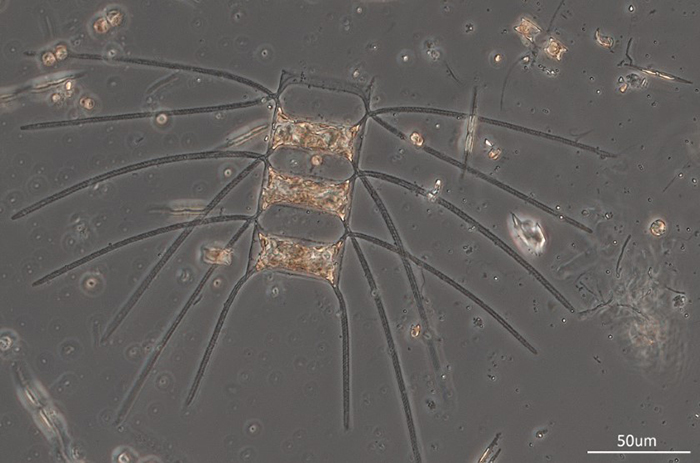
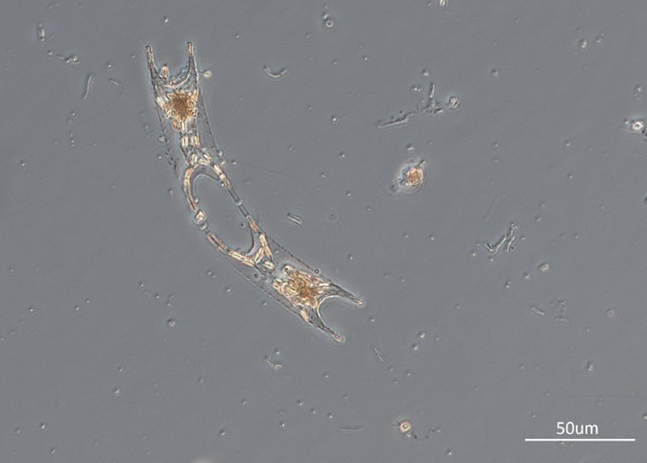
| Diatoms |
|
 |
|
 |
| |
|
Chaetoceros spp. |
|
Eucampia cornuta |
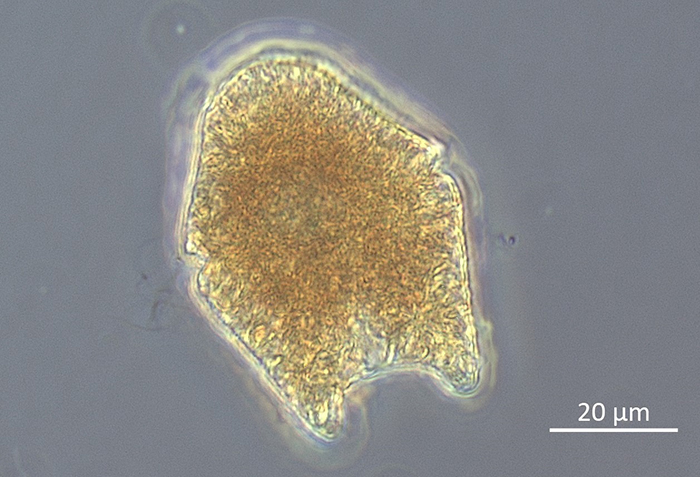
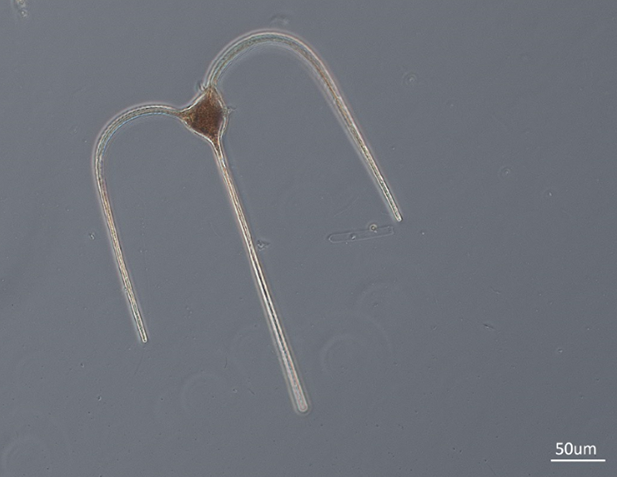
| Dinoflagellates |
|
 |
|
 |
| |
|
Akashiwo sanguinea |
|
Tripos spp. |
Marine Phytoplankton Monitoring
The Environmental Protection Department (EPD) initiated a routine phytoplankton monitoring programme in local marine waters in the late 1980s. At present, the EPD collects surface marine water samples monthly from 26 monitoring stations across 10 Water Control Zones (WCZs) in Hong Kong marine waters for phytoplankton identification and enumeration. The programme emphasizes on monitoring long term changes in density and composition of different phytoplankton groups, including diatoms and dinoflagellates.
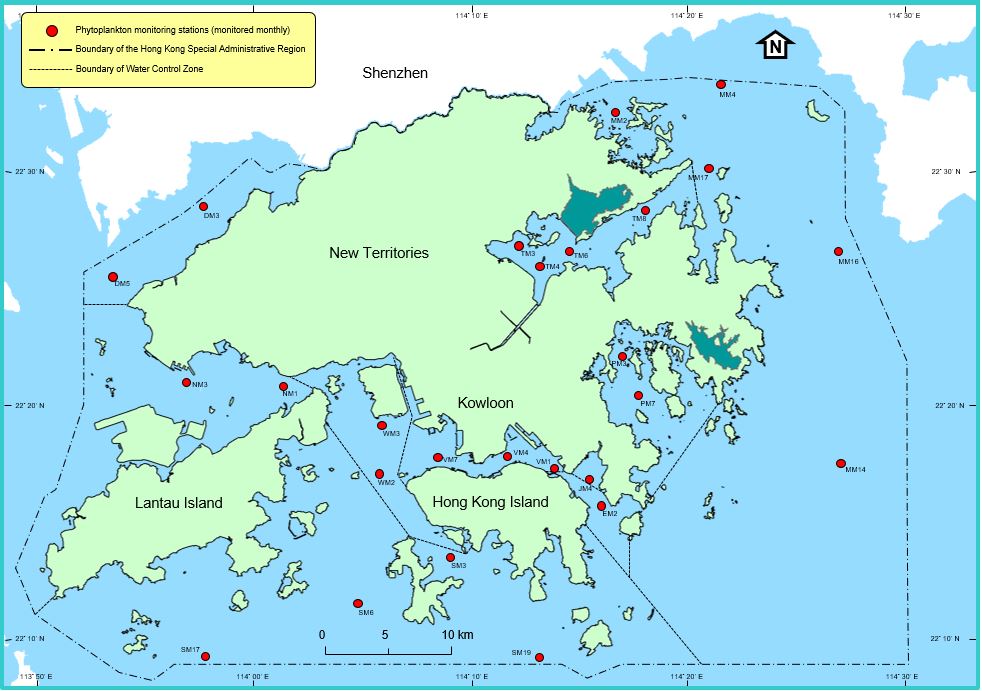 Phytoplankton monitoring stations in Hong Kong marine waters
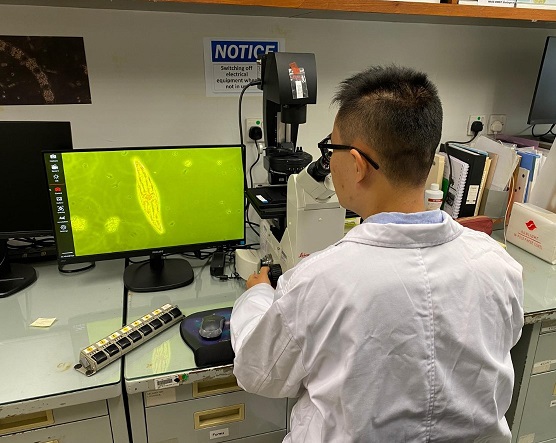 Phytoplankton identification and enumeration
Phytoplankton Community Integrity Index (PCII)
In addition to routine monitoring of nutrients levels in the aquatic environment, the evaluation of potential eutrophication impacts also requires the gathering of scientific evidence of undesirable disturbance to the biological system such as the balance of community structures of relevant marine organisms, particularly phytoplankton community which are the primary producers of the ecosystem and are most vulnerable to the direct impact of eutrophication.
Referencing the latest international practices and trends, the EPD successfully developed and established a biological indicator namely the Phytoplankton Community Integrity Index (PCII) in recent years. The index is used to gauge the status of eutrophication in our local marine waters, and assess the biological impacts of nutrient enrichment on the phytoplankton community therein in a more scientifically sound and robust manner. It can also be used to supplement the prevailing Water Quality Objectives (WQOs) on nutrients (i.e. Total Inorganic Nitrogen (TIN) and Chlorophyll-a). The development and applications of the PCII and the associated study findings were reviewed by academic scholars and published in an international scientific journal in February 2024 (*1).
The computation and assessment method for the PCII essentially involves the study of the abundance and change in the community structure of the two major phytoplankton lifeforms (i.e. diatoms and dinoflagellates) commonly found in Hong Kong coastal waters during a specific period, and compared the data with those obtained from a reference period when minimum TIN levels were recorded. Such “reference condition” represents a more desirable status of phytoplankton communities with minimal impacts of nutrient enrichment.
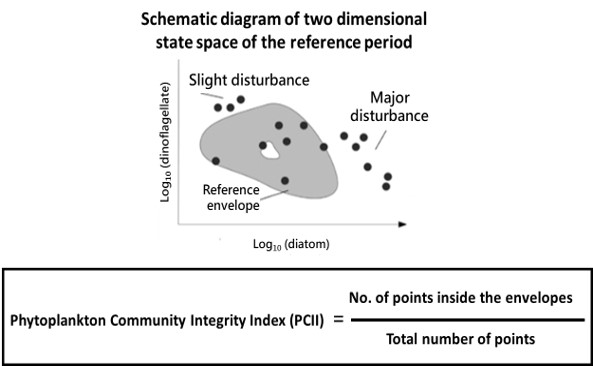
The computed PCII values are between one and zero with “1” representing no change from the reference condition and “0” representing a complete change. A five-tiered ranking system was adopted to describe the ecological status of phytoplankton community. A PCII value of 0.6 or above was operationally set as the Biological Water Quality Criterion target of acceptable disturbance to the phytoplankton community in all WCZs of Hong Kong based on a local study conducted previously (*2) as well as the latest international practices including European Union Water Framework Directive (EU WFD) (*3) and the Convention for the Protection of the Marine Environment of the North-East Atlantic (OSPAR Convention) (*4).
|
Rank
|
Range of PCII values
|
Status of Phytoplankton Community
|
|
1
|
≥0.8 to 1.0
|
High
|
|
2
|
≥0.6 to <0.8
|
Good
|
|
3
|
≥0.4 to <0.6
|
Fair
|
|
4
|
≥0.2 to <0.4
|
Poor
|
|
5
|
0 to <0.2
|
Bad
|
Note: The color coding of the above levels is based on the classification of the ecological status of various water bodies in the EU WFD
Through the untiring efforts of the HKSAR Government in implementing pollution control and water environment management measures, including the expansion and enhancement of sewage collection and treatment infrastructures, the water quality of Hong Kong marine waters has been steadily good with the long-term improvement trends sustained. In recent years, the PCII values across Hong Kong marine waters has consistently ranked as “High” or “Good”, indicating no sign of eutrophication or no material impact of nutrient enrichment on phytoplankton communities in our local marine waters. For detailed monitoring results and findings of PCII, please refer to the “Marine Water Quality in Hong Kong”.
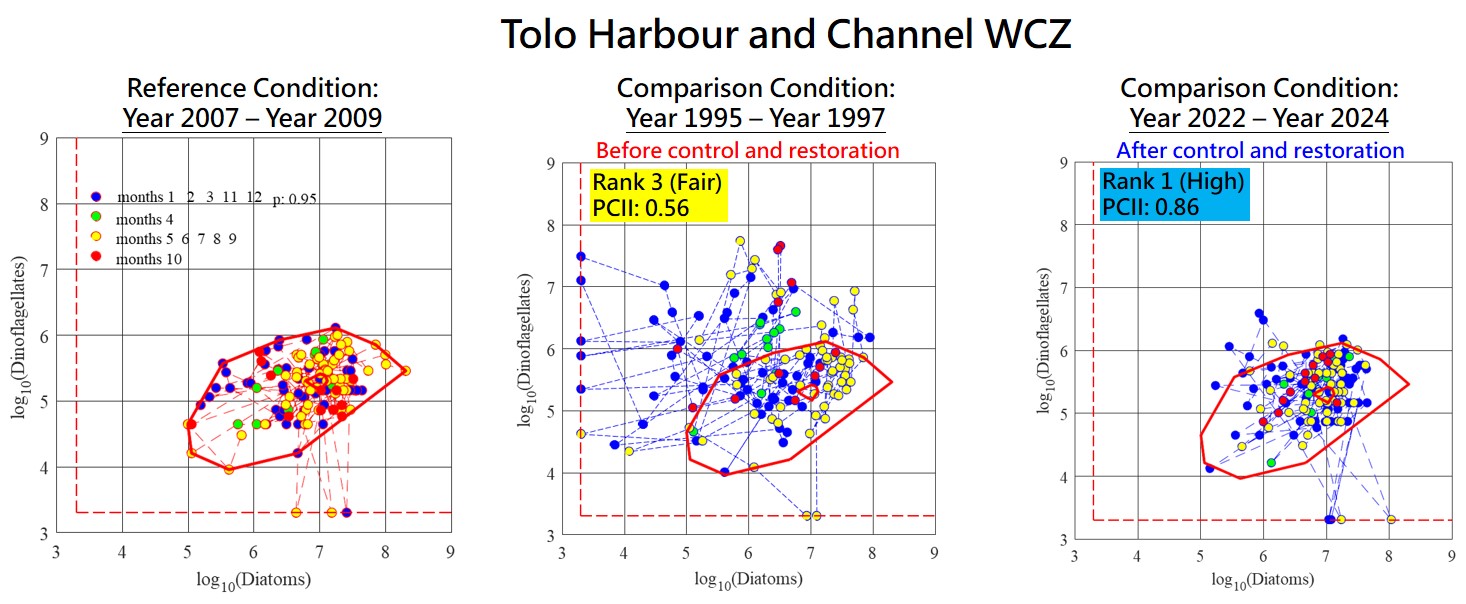
Graphs showing the Phytoplankton Community Integrity Index (PCII) for diatom and dinoflagellate lifeforms in Tolo Harbour and Channel WCZ before and after water pollution control and restoration measures
[Note: The HKSAR Government fully implemented the Tolo Harbour Action Plan in the mid-1990s, including the Tolo Harbour Effluent Export Scheme (full diversion of effluent from both Tai Po and Shatin STWs to Victoria Harbour).]
(*1: Mak, Y.L., Tett, P., Yung, Y.K., Sun, W.C., Tsang, H.L., Chan, C.T., Liu, H., Chiu, W.L., Leung, K.F., Yang, R. and Chui, H.K. (2024). Phytoplankton Community Integrity Index (PCII) – A potential supplementary tool for evaluating nutrient enrichment status of Hong Kong marine waters. Marine Pollution Bulletin 199: 115964. Available from: https://doi.org/10.1016/j.marpolbul.2023.115964)
(*2: Lei, Y., Whyte, C., Davidson, K., Tett, P., and Yin, K. (2018). A change in phytoplankton community index with water quality improvement in Tolo Harbour, Hong Kong. Marine Pollution Bulletin 127: 823-830. Available from: https://doi.org/10.1016/j.marpolbul.2017.10.005)
(*3: European Union (2000). Directive 2000/60/EC of the European Parliament and of the Council of 23 October 2000 establishing a framework for common action in the field of water policy. The Official Journal of the European Union 43 (L327): 1-72. Available from: https://eur-lex.europa.eu/eli/dir/2000/60/oj/eng)
(*4: OSPAR Commission (2013). Common Procedure for the Identification of the Eutrophication Status of the OSPAR Maritime Area (Agreement 2013-08). Available from: https://mcc.jrc.ec.europa.eu/documents/201606235331.pdf )
Marine Phytoplankton Monitoring and Other Relevant Information
Detailed information on Hong Kong's marine phytoplankton monitoring is presented in the annual report “Marine Water Quality in Hong Kong” published by EPD. The report has been uploaded to EPD's dedicated Web Page on “Marine Water Quality”, and is also made available in public libraries and EPD’s Environmental Resource Centres. For other information about environmental protection in Hong Kong, please visit EPD's homepage (https://www.epd.gov.hk/epd/english/top.html).
|


