|
Letter to the Editor of SCMP - Response to a letter on the Integrated Waste Management Facilities
I would like to respond to R. E. J. Bunker’s letter (“Island incinerator will not use Japan's clean-burn technology”, March 3).
Mr Bunker suggested that with the proposed Integrated Waste Management Facilities (IWMF) in place we would just “tow everything as far away as possible, and burn the lot”. This is not the case.
The Government has been working closely with the community to promote waste separation. This involves installation of waste separation facilities at residential, as well as commercial and industrial buildings, and engaging non-government organizations in promoting action change among the citizens.
Currently, about 80 per cent of Hong Kong’s population are served by waste separation bins. We welcome eligible building management to apply for waste separation bins. Thanks to the efforts to strengthen the provision of hardware for waste separation and step up education, the recycling rate for Hong Kong has increased from 43 per cent in 2005 to 49 per cent in 2009. For comparison, Tokyo has a waste recycling rate of about 23 per cent.
We are committed to further raise our waste recycling rate to 55 per cent by 2015. The target is accompanied by a concrete action agenda including facilitation of on-site food waste recycling at community level, and leveraging on the network of frontline government departments in deepening the work of waste recovery. At the same time, we will speed up legislative proposals for new and extended programmes under the Product Responsibility Scheme to encourage waste reduction at source and recycling. We will also consult the public on the controversial scheme to introduce municipal solid waste charging.
Mr Bunker also suggested that we intend to go back to the same old incinerators that were closed down in 1997. Again, this is not the case.
Due to significant technological advancement in the past 15 years, modern incinerators are completely different from the old ones, What we are proposing is a modern IWMF which comprises a mechanical sorting and recycling plant, an advanced waste-to-energy incinerator and an environmental education centre. Such modern waste-to-energy incinerators have been widely adopted in many countries.
Following a rigorous technology review and consultation with the Advisory Council on the Environment, it was recommended that IWMF will employ modern moving grate incineration technology, which is the mainstream treatment technology for municipal solid waste management facilities worldwide. It is a robust technology that has the highest capability to treat different sizes and qualities of the mixed municipal solid waste. Unlike old incinerators, the process of advanced incineration is designed to comply the advance 3Ts technology so that waste would undergo treatment in a high-Temperature environment of at least 850oC, with adequate flue gas combustion residence Time and in highly Turbulent conditions. This would ensure complete destruction of organic pollutants (e.g. dioxin).
The air emissions from the IWMF will fully comply with the internationally most stringent European Union emission standards for municipal solid waste incinerators. The IWMF will be equipped with the state-of-the-art air emission cleansing facilities. During the IWMF operation, we will carry out regular and continuous monitoring and disclose the relevant information.
It is also not true to say that the preference of building the IWMF near Shek Kwu Chau is simply because of its distance from urban areas. As we have explained, Shek Kwu Chau’s proximity to the existing refuse transfer stations in Hong Kong and Kowloon would mean that the distance for transporting wastes to IWMF should be shorter. Given that there are no other major emission sources within 10 km of Shek Kwu Chau, the cumulative air quality impacts in the surrounding would be less. The siting of the IWMF in Shek Kwu Chau could also generate potential economic synergy with the neighbouring islands. It will also achieve a more balanced distribution of waste facilities for Hong Kong as a whole.
The proposed IWMF site is 3.5 - 5km from Cheung Chau, the equivalence of the distance between North Point and Central (3.5km), or between Wan Chai and Ap Lei Chau (5km). Cheung Chau is not located in the prevailing downwind direction and is shielded from the IWMF by the 150m high Shek Kwu Chau Island.
Hong Kong faces an imminent pressure to tackle the waste problem, as our three strategic landfills will be filled up successively in 2014, 2016 and 2018. While we continue to pursue our waste reduction effort vigorously, we, like all other cities, urgently need to find a proper solution for waste treatment. We cannot afford to delay the preparatory work for building the IWMF. We will continue to discuss with the community and engage all stakeholders on the planning and design of the IWMF to make sure it is a modern and state-of-the-art facility, with the provision of community amenities that would meet the needs of the nearby residents.
Elvis WK Au
Assistant Director (Nature Conservation & Infrastructure Planning)
Environmental Protection Department
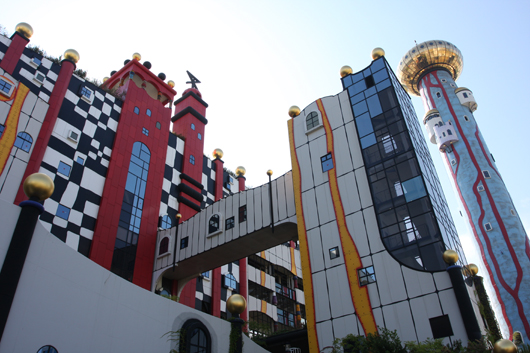
Japan's Maishima Waste-to-Energy Plant
|


