

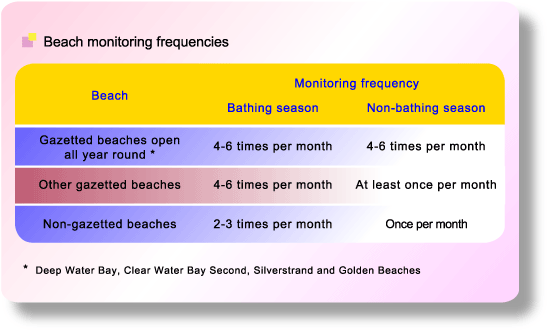
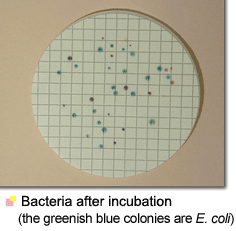
The Water Quality Objective (WQO) is the basic benchmark by which the EPD measures and analyses Hong Kong's beach water quality. It is a standard, reached after extensive epidemiological studies in Hong Kong in the late 1980s, which specifies acceptable levels for the presence of certain key bacteria in beach water. The WQO states that the level of E. coli bacteria present in water samples should not exceed 180 per 100mL. This figure for individual beaches is calculated by taking the geometric mean of all samples collected during the bathing season from March to the end of October. Samples are taken at least three times a month, at intervals of from three to 14 days.
The WQO standard is linked to E. coli bacteria because the presence of these bacteria was found to have the best correlation with illness rates (specifically skin and gastrointestinal illnesses) associated with swimming in Hong Kong. It is relatively simple, by observing the levels of E. coli in beach water, to estimate the precise health risks of swimming at beaches.
 |
|
|

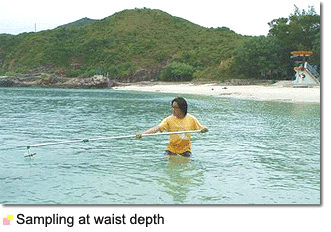
| EPD staff take the samples from water at thigh to waist level, a little distance away from the shoreline. Once collected, the water samples are kept at a steady temperature of 4 degrees Celsius until they are ready to be tested at the EPD's laboratory. Besides these core samples, staff also collect samples from streams and storm drains that flow into the bathing area or nearby. These samples are used to assess the impact, if any, of these external water sources on beach water quality. | |
|
 |
|
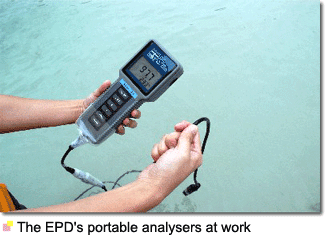
At the same time, EPD staff record a number of other important details about the beach water environment where the samples are taken. Besides recording the water temperature, they measure the levels of dissolved oxygen in the water, using a portable analyser. They also note details of the weather, and any other data which might be relevant to the testing process. Over the past year the EPD has introduced a new electronic data recording system tailored to its specific needs. Data is now input directly on site into hand-held Personal Digital Assistants (PDAs), and this information is then directly uploaded to the server of the system in the office, increasing the accuracy of reporting and minimising the possibilities for human error. |
 |
|
|
|
|


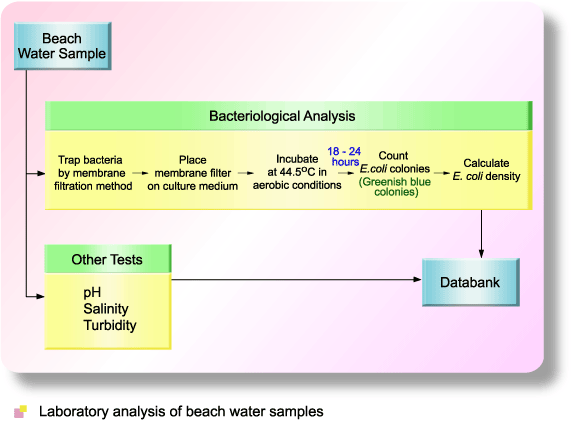 |

Two primary purposes lie behind the laboratory analysis of samples:
- grading beaches. This involves assigning each beach a grade based
on recent results of sample tests. The EPD's beach grading system is
designed to give the public an up-to-date picture of the state of any
beach at any time during the year, so they can make informed decisions
about when and where to swim.
- ranking beaches. The EPD ranks beaches on an annual basis, and rankings reflect the overall standards of any given beach across the entire bathing season. This information is particularly useful for seeing longer term trends in water quality across different areas of Hong Kong.

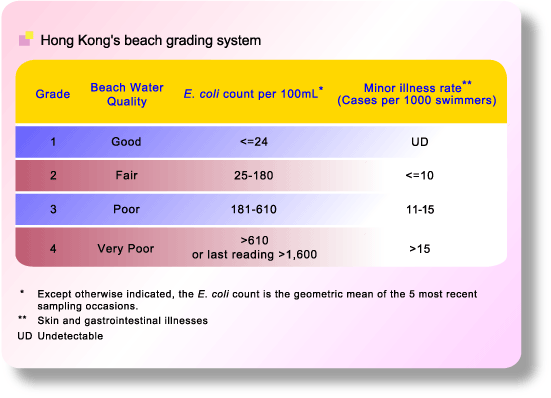
Because beach grading is designed to reflect the current state of a beach,
grading is based on the geometric mean E. coli levels of the five
most recent samples. On the basis of these samples, beaches are graded
into one of four categories (see the table below). Since sampling at gazetted
beaches takes place at least once a week during the bathing season, the
beach grading system generally reflects the state of a beach across the
previous month or so. However, if the most recent sample from a beach
shows E. coli levels exceeding 1600 per 100mL, this result overrides
the geometric mean figure and the beach is immediately given Grade 4,
representing very poor water quality. In this way, the beach grading system
can react quickly to sudden fluctuations in water quality that may arise
from periods of heavy rain, for example, or localised pollution incidents.
 |

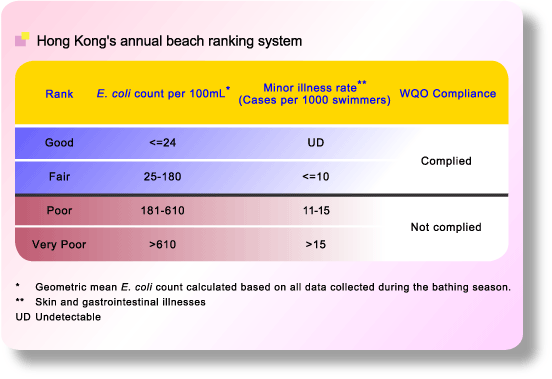
The beach annual ranking system is based on the geometric mean E. coli
level of all the samples collected from the bathing area of each beach
across the entire bathing season. As the table below shows, this information
is used to ascertain whether each beach complied with WQO standards. WQO
compliance is a simple yes/no status, but the EPD also uses test results
to issue a more fine-grained ranking. Beaches that comply with WQO standards
are further assigned either 'Good' or 'Fair' status, depending on E.
coli count, while beaches that do not comply are divided into 'Poor'
and 'Very Poor' to reflect the severity of their problems.
 |