The project life cycle of public works can be in general illustrated as below:
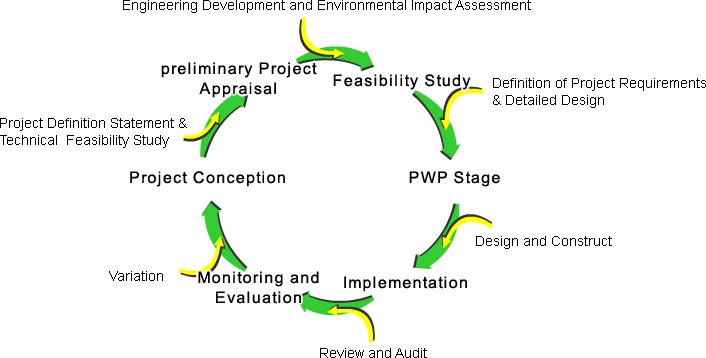
In each stage of project development, public works engineers can play an active role to enable that environmental considerations are being factored into decision making process so to affirm creditability of the decision making process, strengthen public trust, and ensure timely and efficient promise delivery.
Remarks :
In each step of project development cycle for public works, a project proponent can apply tips offered in relevant chapters in this e-learning platform for building up environmental considerations.
Chapter 1 of the Project Administration Handbook for Civil Engineering Works (thereafter call "the Handbook") says the need for a project must be established in the first place and it normally starts from an idea - a response to a problem or an opportunity.
The project department should identify and avoid environment problems, especially in project conceptual stage, by maintaining a close liaison with Environmental Protection Department during the whole project lifecycle.
If you want to download the Handbook, please click here.
Tips:
To facilitate progress in later stage of a project life cycle, a project proponent is advised to rigorously identify environmental impacts arising from a project and apply the cardinal principle of EIA, viz, avoidance-minimization-mitigation.
In light that the public very often want to understand the need, justification and alternatives of a project, these considerations should be recorded and presented with justifications in the project development history.
Click here for Chapter 2 of the e-learning platform "Learning the Fundamentals" and learn more about the basic principles of EIA mechanism and consideration of alternatives.
Once the need for a project is established, to gain a formal status in the Public Works Programme (PWP), the respective Bureau Secretary is required to sign off a Project Definition Statement (PDS) for the capital works project. Based on the PDS, the works department prepares the Technical Feasibility Study (TFS) to ascertain viability, identify development / environmental constraints, formulate implementation strategy and estimate cost. Thereafter, inclusion of the project in Category C of the PWP.
Completion of a Project Definition Statement (PDS) for inclusion into the PWP
The PDS explains the rationale for a project and the commitment to it. According to the Handbook, the PDS should determine that:
- the need for a project has been identified and justified;
- the proposed project will meet the need in full and part.
- The proposed project will not duplicate or be in conflict with any other existing or planned projects, and
- The proposed project is in line with approved policy and approved plans.
Tips:
As a good practice, a project proponent is advised to review and follow up recommendations of strategic planning studies, if available. Then, the project proponent should anticipate and avoid environmental problems as early as possible.
Please click here for Chapter 3 to learn more about "How to use information in strategic Environmental Assessment or Planning Studies?"
Completion of Technical Feasibility Study (TFS) for inclusion into Category C of the PWP
The Handbook requests preliminary considerations in TFS should be given to:
- The scope of the project
- Land requirements
- Development constraints
- Environmental consideration including whether a project is a Designated Project and application of avoidance-minimization-mitigation principle
- Project Programme
- Capital Cost Estimate
Environmental Considerations during TFS stage
With a more defined project scope, a project proponent should seek advice from EPD on whether the work is a Designated Project. Click here for Chapter 3 - "Know whether a project is a Designated Project".
Tips:
project proponent should plan the project programme to avoid putting environmental assessment in the critical path; might decide whether to commence EIA or gather background and baseline information at this stage.
For non-designated projects, the works departments' undertaking should be included to either provide the mitigation measures to implement standard pollution control measures during construction or to carry out a Preliminary Environmental Review of the project, as appropriate.
Good Practices of Proactive Planning of the EIA Mechanism during Project Feasibility Stage:
If an EIA is to be carried out, a project proponent is advised:
- To thoroughly understand the project and the issues in an EIA study brief;
- To seek early advice from EPD together with maintaining open, frank dialogue;
- To understand and anticipate both the adverse and beneficial impacts of a project at the start of an EIA;
- To get first-hand information on site conditions, environmental and physical constraints and update as appropriate;
- To find out stakeholders' concerns, rather than peripheral issues, and use an EIA as a tool to address them;
- To manage and lead EIA consultants and understand their assumptions; take ownership of the EIA process to facilitate project design and implementation;
- To set clear milestones in the EIA process including submission of working papers and draft reports;
- To steer agreement over parameters in quantitative assessment throughout the EIA process;
- To scrutinize input assumptions, e.g. construction sequence or plant inventory, and scenario to see that they are reasonable and practicable, but not underestimating nor overestimating;
- To build in flexibility in project implementation, a scenario approach can be set up in the study;
- To critically review recommendations of an EIA to see that they are practicable and effective measures, ready to be implemented by the project proponent.
Click here to learn about:
- Chapter 3 - Getting an EIA Process Started
- Chapter 4 - Getting to know your EIA Report
- Chapter 5 - Improving the EIA Process
PWP stage
Upon completion of detailed design, Works Departments can seek funding from the Legislative Council. After funding approval, works Departments will take out projects for tendering and construction.
Good Practices during Project Implementation
Feedback from public comments on EIA play an important part during project implementation.
The delivery of promises is essential in implementation stage together with handling of variation.
Please click here for Chapter 6 to learn more about "Promise Delivery".
- To ensure relevant parties, including the contractors and resident site staff at all levels understand the conditions listed in the environmental permit and fully implement them;
- To establish efficient and effective communication channels;
- To see that Environmental Team and Independent Environmental Checker are independent professionals to monitor and audit changes.
Click here for Chapter 6 to lean more about "An Effective Environmental Monitoring and Audit Programme".