Noise Control Ordinance
Details of the ordinance and related regulations can be found in the "Hong Kong e-legislation" website of the Department of Justice at
www.elegislation.gov.hk.
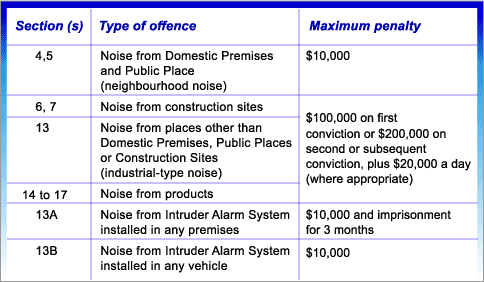
The NCO deals with the following forms of noise:
 |
(a) | noise from domestic premises and public places (often referred to as general neighbourhood noise); |
| (b) | noise from construction activities (including piling); |
|
| (c) | noise from places other than domestic premises, public places or construction sites (for example, noise from industrial or commercial premises); |
|
| (d) | noise from intruder alarm systems (installed in any premises or vehicles); |
|
| (e) | noise from individual items of plant or equipment (referred to in the Ordinance as Product Noise, for example, noise from hand-held breaker and air compressor); and |
|
| (f) | noise emission from motor vehicles (requiring noise emission from motor vehicles to comply with stringent international standards on first registration in Hong Kong). |
|
(a) | Occupational noise (that is, noise generated inside a factory or other industrial undertaking, which affects employees in that work-place). This type of noise is subject to control under the Factories and Industrial Undertakings Ordinance (Cap. 59), the enforcement of which is carried out by the Labour Department. (For details, please click here) |
| (b) | Aircraft
Noise. This type of noise is controlled
under the Civil Aviation (Aircraft Noise)
Ordinance (Cap. 312), Civil Aviation (Aircraft
Nose)(Certification) Regulations and Civil
Aviation (Aircraft Noise)(Aircraft Classes)
Notice. The enforcement of these legislations
is carried out by the Civil Aviation Department.
(For details, please click here) |
The main provisions of the NCO are summarized in the following sections. The numbers in brackets following the headings refer to the relevant section numbers in the Ordinance.
The following are some examples of noise from domestic premises and public places :
|
|||
|
|||
 |



Both sections
4 and 5 came into operation on 1 November 1989.
Section 4 of the Ordinance is a general provision
to control noise of this nature which is causing
annoyance to any person at night (11 p.m. to
7 a.m.) or on a general holiday.
Section 5 of the Ordinance provides control
over particular noise sources (in domestic premises
or public places) at any time of the day or
night. These sources are animals and birds,
musical instruments, loudspeakers, games, trades
or businesses and air conditioners.
It should be noted that the term 'domestic premises'
applies to individual dwellings or household
units and not to an entire building, which may
have mixed commercial and residential uses or
even industrial activities on lower floors.
Noise from the non-residential parts of such
buildings is controlled under section 13 of
the Ordinance.
The nature of the noise sources covered by these
provisions in sections 4 and 5 of the ordinance
is such that it is not possible to specify fixed
acceptable noise levels or noise measurement
procedures to be used in assessing the acceptability
of the noise. As is the case in other countries,
noise from domestic premises and public places
is to be responsively dealt with by the police on a reasonableness approach.
|
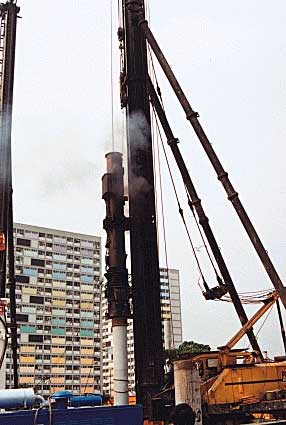
(a) | general construction work (for example, excavation, renovation, road work); and |
| (b) | percussive piling (for example, piling by means of a hydraulic hammer as a drop hammer). |
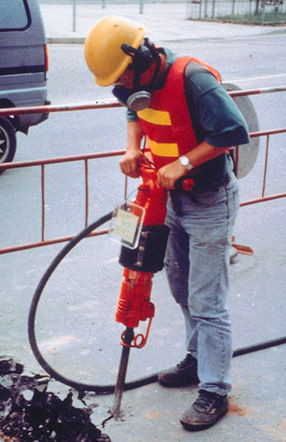
This photo
shows road work, which is a kind of general
construction work :
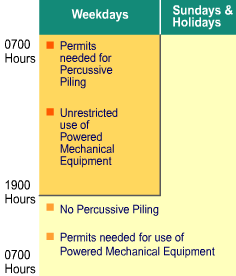
Each of these categories is controlled by means of a system of Construction Noise Permits, as described below. The carrying out of general construction work using powered mechanical equipment during the restricted hours, that is between 7 p.m. and 7 a.m. or at any time on a general holiday (including Sunday), is prohibited under the Ordinance unless a valid Construction Noise Permit is in force. During the restricted hours in Designated Areas, the use of specified powered mechanical equipment (for example, hand-held breakers and dump truck) and/or the carrying out of the prescribed construction activities (for example, erection or dismantling of formwork and hammering) is subject to more stringent control. The same system of Construction Noise Permits for controlling of powered mechanical equipment is used. The Designated Areas, referred to as densely populated built up areas, are defined under the Noise Control (Construction Work Designated Areas) Notice. The carrying out of percussive piling is prohibited between 7 p.m. and 7 a.m. and on holidays. A valid Construction Noise Permit issued by the Environmental Protection Department is required for the carrying out of percussive piling during the permitted hours. The permitted hours generally falls into the period of 7 a.m. to 7 p.m. on weekdays not being a public holiday including Sunday. Depending on the nature of the noise sensitive receivers, the Construction Noise Permit may allow carrying out percussive piling of a total duration of 3, 5 or 12 hours during the permitted hours. The use of noisy diesel, pneumatic and steam hammers for percussive piling is banned in built-up areas surrounded by noise sensitive uses from 1 October 1999. This chart summaries the statutory controls on noise from various construction activities at different times of the day :
An application
for a Construction Noise Permit for the
two categories of works must be made to
the Noise Control Authority in the respective
prescribed form and accompanied by a cheque
of the prescribed fee. In considering
applications for carrying out general
construction work and percussive piling
the Authority will assess the impact of
the noise generated by the equipment at
any Noise Sensitive Receiver (such as
domestic premises) in the vicinity in
accordance with the assessment procedures
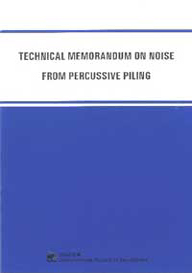
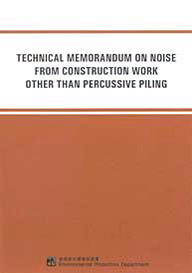
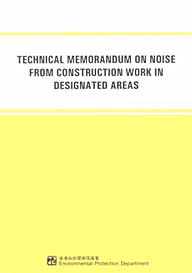
contained in the following Technical Memoranda
:
The picture below shows the front covers of the above three Technical Memoranda :
 |
 |
 |
|
 |
A Construction Noise Permit, with appropriate conditions, will be issued if EPD is satisfied that the noise which will be generated will comply with the requirements stipulated in the said Technical Memoranda. The conditions of a Construction Noise Permit for the carrying out of percussive piling are subject to appeal. Details of the appeal mechanism will be covered later. For an immediate access to details of the appeal mechanism, please click here.
These photographs show some examples of industrial/commercial noise :
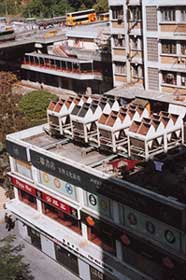 |
|
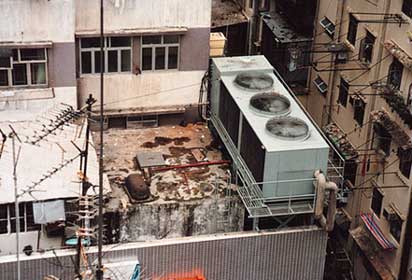 |
|
(a) | does
not comply with objective technical criteria
in the form of Acceptable Noise Levels as
set out in the Technical Memorandum for
the Assessment of Noise from Places other
than Domestic Premises, Public Places or
Construction Sites; |
| (b) | is
a source of annoyance to any person (other
than a person in the place from which the
noise is emanating) in any place considered
to be a noise sensitive receiver in the
Technical Memorandum mentioned in paragraph
(a); or |
|
| (c) | does
not comply with any standard or limit contained
in any Regulations which may be made in
future. |
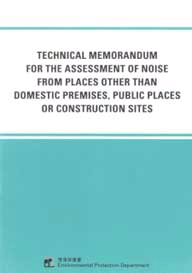
A Noise Abatement Notice may require the owner or occupier to bring his noise emissions into a state of compliance by certain date and non-compliance with such a Notice will be an offence. Details of the appeal mechanism will be covered later. For an immediate access to details of the appeal mechanism, please click here.
It should be noted that there is no requirement for industry in general to achieve the Acceptable Noise Levels (ANL) immediately, but to bring the noise level to or below the ANL by the date specified on the Noise Abatement Notice. The EPD will, in practice, respond to complaints lodged by members of the public and compliance with the Acceptable Noise Levels will be required only after a Noise Abatement Notice has been served.
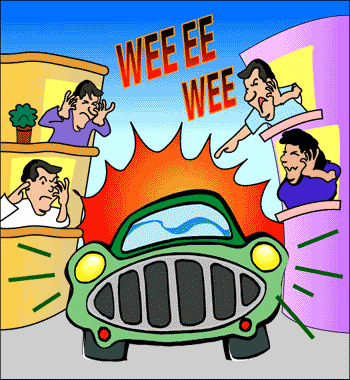
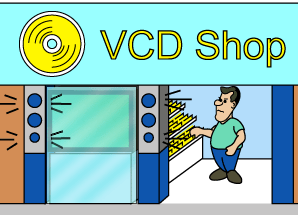
Intruder alarm systems for premises such as shops can be equally annoying.
Under the provisions in section 13A and 13B of the NCO, intruder alarm system installed in any premises and vehicle shall not sound for more than 15 minutes and 5 minutes respectively after being triggered. In addition, the vehicle alarms shall not sound unless the vehicles are being tampered with. The controllers or registered owners have to ensure their Intruder Alarm Systems comply with the requirements.
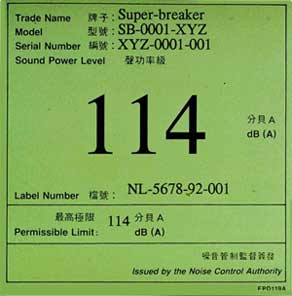
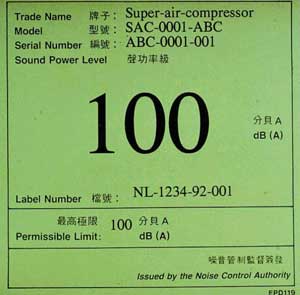
At present, the Noise Control (Hand Held Percussive Breakers) Regulations and the Noise Control (Air Compressors) Regulations stipulate that only the handheld breakers and air compressors complying with the noise emission standards shall be allowed to be imported, manufactured or supplied for use in Hong Kong and be attached with a Noise Emission Label before its usage.
An application for such a label must be made to EPD in the prescribed form and accompanied by a cheque of the prescribed fee. A Noise Emission Label will be issued if EPD is satisfied that the relevant noise emission standard has been complied with. This would in effect phase out the particularly noisy equipment items and minimize the noise disturbances emanated from the work sites.
The following photographs show two Noise Emission Labels: one for a hand-held pneumatic breaker and one for an air-compressor:
 |
|
 |
|
(a) | Construction
Noise Permits for the carrying out
of percussive piling; |
| (b) | Noise
Abatement Notices; and |
|
| (c) | notices
in connection with the testing of
products. |