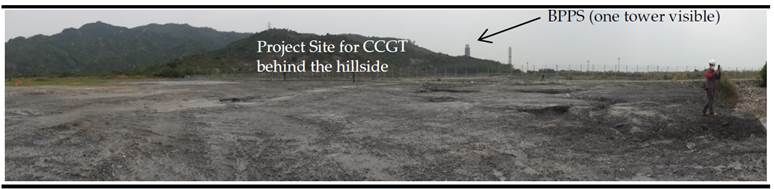
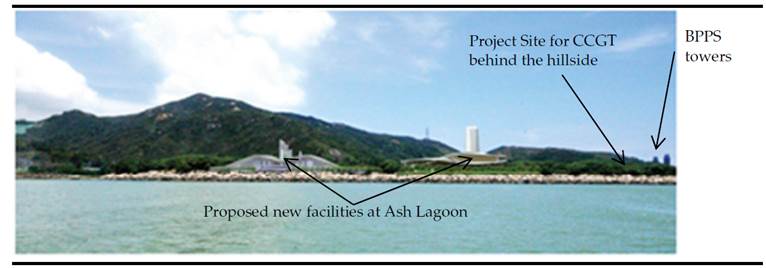
This Section presents a landscape and visual impact
assessment (LVIA) which has been conducted based on a review of available
literature, as well as field surveys to help identify the existing conditions
so as to be able to accurately assess the potential landscape and visual
impacts associated with the Project.
Figure 12.1 shows an aerial image of
the Project Site and in addition to land-based construction works, minor marine
dredging works adjacent to the BPPS seawall, close to the existing seawater
intake and outfall, will be required should a second CCGT unit be installed.
The remainder of the LVIA provides
details on the following:
·
Environmental
Legislation, Standards and Guidelines;
·
Review
of Planning and Development Framework;
·
Methodology
for LVIA;
·
Baseline
Conditions, for Landscape and Visual elements;
·
Identification
of Impacts;
·
Impact
Assessment Prior to Mitigation, for Landscape and Visual elements;
·
Suggested
Mitigation Measures;
·
Residual
Impacts;
·
Cumulative
Impacts; and
·
Conclusion.
This LVIA has been prepared according
to Clause 3.2.1 (ix), Clause 3.4.11.1-3 and Appendix G of the EIA Study Brief
No. ESB-286/2015.
Environmental
Impact Assessment Ordinance
(EIAO) legislation (Cap.499, S.16) and the Technical Memorandum on EIA Process
(EIAO-TM), particularly Annexes 10 (Criteria for Evaluating Visual and
Landscape Impact, and Impact on Sites of Cultural Heritage) and 18 (Guidelines
for Landscape and Visual Impact Assessment) have been referred to in carrying
out this assessment.
In addition, the following standards
and guidelines have been referred to for assessing the landscape and visual
impacts associated with the Project:
·
Environmental Impact
Assessment Ordinance Guidance Note 8/2010 (Preparation of Landscape and Visual
Impact Assessment under the Environmental Impact Assessment Ordinance);
·
Hong Kong Planning Standards
and Guidelines
(HKPSG) issued by the Planning Department;
·
Lands Administration Office
(LAO) Practice Note No. 7/2007 Tree Preservation & Removal;
·
DEVB TC(W) No. 7/2015 –
Tree Preservation;
·
DEVB TC(W) No.6/2015 –
Maintenance of Vegetation and Hard Landscape Features;
·
ETWB TCW No. 11/2004 –
Cyber Manual for Greening;
·
ETWB TCW No. 29/2004 –
Registration of Old and Valuable Trees, and Guidelines for their Preservation;
·
Hong Kong Planning
Standards and Guidelines
(November 2015), Chapter 11 Urban Design Guidelines; and
·
Study on Landscape Value
Mapping of Hong Kong
([1]).
The Project
will be implemented within the boundary of the existing BPPS which is not
covered by any Outline Zoning Plan
(OZP). The coast does not form
part of any Coastal Protection Area (CPA), and the Sha Chau and Lung Kwu Chau Marine Park is located at least 4.4 km by sea
from the BPPS. Pak Nai Site of Special Scientific Interest (SSSI), which is an
intertidal mudflat/ mangrove habitat, is approximately 5 km to the north. Figure 12.2 helps illustrate this.
It should be
noted that Lung Kwu Tan at Tuen
Mun is one of five potential near-shore reclamation
sites that are being considered as part of the Enhancing Land Supply Strategy:
Reclamation Outside Victoria Harbour and Rock Cavern Development (). If selected it would provide
200-300 ha of land to the south of Black Point that is currently
positioned for business, residential, and complimentary Government,
Institution and Community (GIC) facility uses, with local open space. Details of heights of buildings in this
area have not been finalised but are assumed to be no
greater than 50 m ()
i.e. they should not reach over the height of Black
Point ridgeline which is just over 130m at its peak, and therefore are not
considered as future VRSs. In
addition there is a lack of detailed information or scheduling of the potential
project currently, and therefore it is not included as part of the assessment.
This following
section presents the methodology for the landscape and visual impact assessment
for the
Project.
The
methodology follows the criteria and guidelines state in section 1 of Annex 10
and Annex 18 of the TM respectively, the EIAO Guidance Note GN 8/2010 Preparation of Landscape and Visual Impact Assessment under the Environmental
Impact Assessment Ordinance, and the report of Landscape Value Mapping of Hong Kong, for evaluating and assessing
the landscape and visual impacts.
Assessment Areas
As per Clause 3.4.11.2 of the Study Brief, the
Assessment Area for Landscape Impact Assessment (LIA) shall include areas
within a 500 m distance from the boundary of the Project site as indicated
in Figure 12.1.
As per Clause 3.4.11.2 of the Study Brief, the
Assessment Area for visual impact assessment shall be defined by the visual envelope of
the Project.
Identification of the visual envelope
has been achieved by site visit and desk-top study of topographic maps and
photographs, and GIS analysis, to determine potential visibility of the Project
from various locations. GIS
analysis uses known data regarding the proposed built structures to model the
area that can potentially see the developments. Building heights provided by CLP at the
time of preparing this LVIA have been used to generate the models and assume
the highest facility is the +106mPD stack.
This is a worst case scenario as the stack height may be reduced. It should be noted that GIS analysis
uses topographic data as a baseline, disregarding existing built forms and
vegetation which reduce the actual visual envelope.
Landscape Baseline
LR and LCA identification
Site visits
and desktop study of topographical maps, information databases and photographs
were used to identify
the baseline landscape resources (LRs) and landscape character areas (LCAs)
found within the 500 m Assessment Area.
LR types have been mapped based on their principal physical landscape
and visual characteristics which link them together, rather than their habitat
function. In mapping these
resources, contiguous areas of the LR types have been identified which may not
always match ecological habitat maps.
LCAs are generally broader categorizations than LRs, and each one
encompasses a number of different LRs.
Broad Brush Tree Survey
A broad brush tree survey to identify
dominant tree species, maturity, rarity and any plant species of conservation
interest, etc. was conducted within the Assessment Area to provide baseline
information on the landscape resources and landscape character areas.
LR and LCA Sensitivity
Assessment of the sensitivity of LRs
and LCAs is influenced by a number of factors including the following:
·
Quality
and maturity, condition and value of LRs/ LCAs, taking into account information
from general quality, maturity and condition of other types of vegetation.
(Ranked as high, medium or low);
·
Important
/ rarity of LRs/ LCAs (Ranked as high, medium or low);
·
Whether
a LR/ LCA is considered to be of local, regional, national or global importance
(taken into account and included in the descriptive text only if relevant);
·
Whether
there are any statutory or regulatory limitations / requirements relating to
the LRs/ LCAs (taken into account and included in the descriptive text only if
relevant); and
·
Ability
of the LRs/ LCAs to accommodate change without compromising their essential
nature (ranked high, medium or low).
The sensitivity of each LR
and LCA is based on the values of all the above factors in totality and will be
classified as follows:
High: Important
landscape or landscape resources of particularly distinctive character of high
importance, sensitive to relatively small changes.
Medium: Landscape
or landscape resources of moderately valued landscape characteristics
reasonably to tolerant to change.
Low: Landscape
or landscape resources of relatively unimportant landscape characteristics
largely tolerant to change.
Visual Baseline
Identification
of Visual Sensitive Receivers (VSRs) & Vantage Points (VPs)
Having
determined the Assessment Area for the VIA, VSRs have been identified within
the visual envelope. As shown in Figure 12.7, no nearby residents or villagers, (e.g. from
Tuen Mun, Lung Kwu Tan, Lung Kwu Sheung Tan or Ha Pak Nai) appear
to fall within the visible area.
Vantage Points or Viewpoints (VPs) have been selected from which to help
illustrate the visual change that would be brought about by the proposed
Project, ensuring in combination they give a good overall representation of how
the Project will appear to different VSRs, both near and far.
Photomontages
have been prepared from the VPs to conceptually illustrate the visual impacts,
both unmitigated and mitigated at Day 1 and mitigated at Year 10 of operation
and to supplement the visual changes described in the text.
VSR
Sensitivity
Assessment of the sensitivity of VSRs
is influenced by a number of factors including the following:
·
Type
of VSR. VSRs are categorized
according to whether the viewer is at home, at work or school, at play or
leisure, or travelling (ranked by the major VSR types, as described below):
-
Residential VSRs – These VSRs are people
living in the area and who view the proposed Project from their homes. They are
considered the most sensitive VSRs due to the character of the view from their
homes having a substantial effect on their perception of quality and
acceptability of their home environment and general quality of life.
-
Occupational VSRs – These VSRs are people
working or in education in the area, who view the proposed Project from their
workplace or education centre.
Visual amenity is in general not considered a top priority within the
average workplace and these VSRs are considered to be relatively less sensitive
than residential VSRs as their view will have a less important, although still
material, effect on their perception of quality of life. The degree to which this applies to
workers depends on whether their location is industrial, retail or
commercial. The VSRs in industrial
areas, such as factories, are generally considered to be the least sensitive,
due to the relatively low quality of their existing view in an industrial area.
-
Recreational VSRs – These VSRs are people
engaging in recreational activities such as hikers on established trails and
footpaths, people participating in team sports at recreation grounds or at
leisure. Sensitivity of these VSRs depends on duration of stay, nature of the
activity and how enclosed the location is.
-
Travelling VSRs – These VSRs are people
travelling on public roads and railways, both in public and private vehicles
and on foot. They have varying
sensitivity depending on the speed, nature and frequency of travel, but are
generally considered to be transitory to the area with less regard for the
surrounding views and with low sensitivity.
·
Number
of individuals (ranked as very many, many, few or very few);
·
Quality
of existing view (ranked as good, fair or poor);
·
Availability
of alternative views (ranked as yes or no);
·
Degree
of visibility (ranked as full, partial or glimpse);
·
Duration
of view (ranked as long, medium or short); and
·
Frequency
of view (ranked as frequent, occasional or rare).
The sensitivity of each VSR is based
on the values of all the above factors in totality and classified as follows:
High: The VSR is highly sensitive
to any change in their viewing experience.
Medium: The
VSR is moderately sensitive to any change in their viewing experience.
Low: The VSR is only slightly
sensitive to any change in their viewing experience.
There are various construction works
elements and operational procedures that have the potential to generate
landscape and visual impacts. These
have been identified and the significance of the impact assessed relative to
the sensitivity of the resource/receptor and the magnitude of change caused by
the impact.
Magnitude
of Change
Landscape
The magnitude
of change caused by a landscape impact is quantified according to a number of
factors including the following:
·
The
physical extent of the impact. This
is assessed using a number of factors, including: absolute area/length within
the Project Site; relative area/length within the Project Site compared to the
Assessment Area; impacts on existing trees; and current land use compared to
proposed land use i.e. taking into account some land, even though within the
Project Site, may not be directly impacted (ranked as small, medium or large);
·
Compatibility
of the Project and associated works with the existing and planned landscape in
the vicinity (ranked as good, fair, or poor);
·
Duration
of impacts (i.e. whether it is temporary or permanent, under construction and
operational phases); and
·
Reversibility
of change (ranked as reversible or irreversible).
The magnitude of landscape change on
each LR/LCA will be based on the values of all the above factors in totality
and classified as follows:
Large: LRs
or LCAs would incur a major change.
Intermediate: LRs or LCAs would
incur moderate change.
Small: LRs or LCAs would incur slight or barely perceptible change.
Negligible: LRs or LCAs would incur no discernible change.
Visual
The magnitude
of change caused by a visual impact is quantified according to a number of
factors including the following:
·
Distance
between the closest source of impact and the VSR (given in meters);
·
Scale
of the development. This is
assessed using a number of factors, including: absolute dimensions of new built
structures visible to the VSR; relative dimensions of the new built structures
compared to other structures visible to the VSRs in their existing view (ranked
as small, medium or large);
·
Potential
blockage of view (ranked as full, partial or nil);
·
Duration
of the impacts (ranked as temporary [short/medium term] or permanent);
·
Compatibility
of the Project and associated works with the existing and planned landscape in
the vicinity (ranked as good, fair or poor); and
·
Reversibility
of change (ranked as reversible or irreversible).
The magnitude of change
caused by visual impacts on each VSR is based on the values of all the above
factors in totality and classified as follows:
Large: VSRs would suffer a major change in their viewing
experience.
Intermediate:
VSRs would suffer a moderate in their
viewing experience.
Small: VSRs would suffer a small change in their viewing experience.
Negligible: VSRs would suffer no
discernible change in their viewing experience.
Significance
of Potential Impacts
Significance of
an impact is categorised according to the
relationship between the magnitude of change it causes and the sensitivity of
the receptor it acts upon.
Following the implementation of mitigation measures, the significance of
the impact (the residual impact) may be reduced.
Ranking Significance of
Impact
By understanding the magnitude of
change caused by an impact on a particular receptor prior to mitigation, and
the sensitivity of that receptor, it is possible to categorize significance of
impact for each receptor in a logical, well-reasoned and consistent fashion. Table 12.1 shows the rationale for dividing the
degree of significance into four thresholds, namely insignificant, slight,
moderate, and substantial, depending on the combination of a magnitude of change
and sensitivity of sensitive receiver and can be applied on assessing impacts
before and after mitigation.
Table 12.1 Relationship between receptor
sensitivity and magnitude of change in defining impact significance
|
|
|
Magnitude of Change
|
|
|
|
Negligible
|
Small
|
Intermediate
|
Large
|
|
Receptor Sensitivity (LR/LCA or VSR)
|
Low
|
Insignificant
|
Slight
|
Slight/ Moderate
|
Moderate
|
|
Medium
|
Insignificant
|
Slight/ Moderate
|
Moderate
|
Moderate/ Substantial
|
|
High
|
Insignificant
|
Moderate
|
Moderate/ Substantial
|
Substantial
|
The four thresholds for the degree of
significance are explained below.
All impacts will be assumed to be adverse in the text of the Report,
unless specifically identified otherwise.
Substantial: Adverse / beneficial impact where the proposed Project
will cause significant deterioration or improvement in existing landscape
quality
Moderate: Adverse / beneficial impact where the
proposed Project will cause a noticeable deterioration or improvement in
existing landscape quality
Slight: Adverse / beneficial impact where the proposed Project
will cause barely perceptible deterioration or improvement in existing
landscape quality
Insignificant: No discernible change in the existing landscape quality.
Having
identified and ranked the significance of potential impacts, measures have been
proposed to mitigate the impacts and reduce them to an acceptable level. Firstly, means by which impacts can be
avoided will be considered, then possible means that might reduce the impact
magnitude, and also measures that potentially enhance existing landscape and visual
quality. Mitigation measures may take the form of:
·
Adopting
alternative design or revising the basic engineering and / or architectural
design, to prevent and / or minimize adverse impacts. Alternative alignment(s),
design(s) and construction methods that avoid or reduce the identified
landscape impacts will be evaluated for comparison before adopting other
mitigation or compensatory measures to alleviate impacts;
·
Remedial
measures such as colour and textural treatment of physical, engineering and
building features; and
·
Compensatory
measures such as the implementation of landscape design measures (e.g. tree
planting, creation of new open space etc.) to compensate for unavoidable
adverse impacts and to attempt to generate potentially beneficial long-term
impacts.
To ensure their effectiveness
throughout the construction and operational phases of the Project and
associated works, the relevant responsible parties for the on-going management
and maintenance of the proposed mitigation measures have been identified. Approval-in-principle of the funding,
implementation, management and maintenance of the proposed mitigation measures has
been sought
from the appropriate authorities, according to the principles in ETWB TCW No.
2/2004.
An overall assessment of the
acceptability, or otherwise, of landscape and visual impacts is provided in the
Conclusion, in accordance with the five criteria set out in Annex 10 of the
EIAO-TM is provided, considering the guidelines in paragraph 3.11 of
Environmental Impact Assessment Ordinance GN
No. 8/2010.
Black Point,
where the BPPS is situated, is located in the western-most part of the New
Territories. It comprises a
headland extending from the east (land) to the west (sea) with granitic soil
underneath, typical of the Tuen Mun
and Castle Peak areas. The major
development at Black Point is the BPPS (the first natural gas-fired power plant
in Hong Kong), which is located to the north of the headland on reclaimed land
and its construction was completed in 1996. To the east and south, BPPS is
surrounded by mountains which largely shield its viewshed,
while to the immediate north and west is the mouth of Deep Bay. The Urmston
Road shipping channel, a major vessel fairway that connects the Pearl River
Estuary, the west and northwestern Hong Kong waters and the waters between Chek Lap Kok and Tuen Mun, is also to the west of
BPPS.
The proposed
location for the Project is within the existing boundaries of the BPPS
site. The proposed location for
each of the additional CCGT units is illustrated in Figure 3.1. The size of the land reserved for the
additional generation units and the associated facilities (the Project Site) is
about 4 ha. It has been used
for material storage in warehouse and temporary structures. The northern half of the reserved land
is not occupied by any buildings or facilities, whereas the southern half is
occupied by a single storey warehouse. There are no other facilities or
utilities within the reserved land except the surrounding chain link fence.
Broad
Brush Tree Survey
A broad brush tree survey was carried
out in the Assessment Area and a visual inspection of the soft landscaping
carried out within the BPPS site.
Full details are provided in Annex 12A and key details relating to trees within the
LCAs and LRs are included below.
Landscape
Resources
As shown in Figure 12.3, nine (9) Landscape Resources (LRs) have been
identified in the vicinity of the Project.
These are described below and Figure 12.4 provides
representative photographs of each LR.
LR1 Artificial
Shoreline – This is comprised of a revetment structure along the edge of the
BPPS that provides sea defence to
the BPPS and an artificial sea edge.
This LR is of low quality, low rarity and low maturity. It is considered to have low sensitivity.
LR2 Natural
Rocky Shore – This LR makes up the natural coastal edge of Black point and is
generally comprised of rocks with some pockets of vegetation. It is an attractive feature of the
headland and is considered to have high
sensitivity.
LR3 Highly
Modified Area – This LR predominantly consists of infrastructure associated
with power generation including engineering structures, hardstand areas and
access roads but also part of the Tsang Tsui Ash
Lagoon.
There is some
soft landscaping within this LR including species in moveable planters as well
as at-grade, planted species.
Species in the
moveable planters include trees such as Araucaria heterophylla, Ficus microcarpa and Hibiscus tiliaceus, and palms such as Livistona chinensis. At-grade species include shrubs such as Duranta erecta, ground
cover such as Ixora chinensis and
Wedelia trilobata and
trees/ palms such as Acacia confusa, Casuarina equisetifolia,
Schefflera octophylla
and Bauhinia x blackeana.
As illustrated in Figure 12.3, although there is some soft landscaping,
this LR is predominantly modified by the existence of a power station, with any
soft landscaping within the Project Site boundary being in moveable
planters. This LR has a high
ability to accommodate change and its sensitivity is considered low.
LR4 Plantation
- The LR is mainly found along road/ BPPS boundary edges, and planted on
cut/fill slopes. It is dominated by
exotic species such as Acacia confusa, Melaleuca cajuputi Roxb. subsp. cumingiana, Lophostemon confertus and Cassia surratensis. The plants are generally less than 20
years old. Within these areas, some
Aquilaria sinensis
trees have been found and overall this LR is considered to have medium sensitivity.
LR5 Rocky
Grassland/ Shrubland Slopes – This LR consists of
natural exposed rocky outcrops amongst grassland and shrubland
on the southern slopes of Black Point headland, including native species such
as Alocasia macrorrhizos, Cyclosorus parasiticus, Pteris semipinnata grasses
and Glochidion eriocarpum, Melastoma sanguineum and Viburnum odoratissimum
shrubs, as well as exotic species such as Bidens pilosa and Mikania micrantha grasses and Lantana camara
and Gardenia jasminoides
shrubs. Rocky outcrops are a rarer
HK feature and overall this LR is considered to have medium sensitivity.
LR6 Mixed Shrubland – This LR is dominated by tall shrubs/trees which
were predominantly exotic along the transects walked, including Acacia auriculiformis,
Acacia confusa, Aleurites moluccana, Casuarina equisetifolia,
Eucalyptus citriodora, Eucalyptus robusta,
Eucalyptus tereticornis, Ficus
elastica and the weedy Leucaena leucocephala, as well as shrubs
including Clerodendrum japonicum and
Lantana camara. There are areas where the mixed shrubland is less dense. Some exotic species within this LR have
been planted, such as Acacia spp. and
Eucalyptus spp. trees but it also
contains some species of conservation interest such as young Aquilaria sinensis. This LR is relatively abundant within
the Assessment Area and of low rarity.
It is considered to have medium
sensitivity.
LR7 Vegetated
Modified Slopes – This LR comprises areas where slopes have been modified by
cut/fill in the past and are sparsely vegetated with species such as Pennisetum purpureum, Youngia japonica and Miscanthus sinensis, with some bare rock areas also. Although vegetation is relatively
immature, given the bare rock outcrops which are a rarer HK feature, this LR is
considered to have medium
sensitivity.
LR8 Water
Channel – This LR is comprised of storm-water drainage channels which are
man-made and concrete lined. They
run along the northern edge of the Black Point headland hill slope and along
Yung Long Road. This LR is
considered to have low sensitivity
LR9 Seascape –
The seascape in this area has no significant characteristics such as rock
formations etc. It is abundant and
of low rarity. While important in
Hong Kong, it is abundant, of high maturity and medium quality in the Assessment
Area, therefore overall is considered of medium
sensitivity.
Landscape
Character Areas
As illustrated
in Figure 12.5, four Landscape Character Areas (LCAs) have
been identified in the vicinity of the Project. These are described below and Figure 12.6 provides representative photographs of each.
LCA1 Deep Bay
Inshore Landscape – This is a coastal area of water to the west of the Project
with a largely open, tranquil and natural aspect. It is dominated by the presence of the
BPPS at its eastern edge. The main
shipping channel of Urmston Road is outside this
boundary and relatively few vessels transit the area, with some small fishing
vessels also frequenting it. It is
considered to have medium sensitivity.
LCA2 Black
Point Power Station Landscape – This LCA encompasses the existing BPPS. It is a highly modified landscape with
some limited soft landscape planting within the BPPS, including species in moveable
planters as well as at-grade, planted species.
Species in the
moveable planters include trees such as Araucaria heterophylla, Ficus microcarpa and Hibiscus tiliaceus, and palms such as Livistona chinensis. At-grade species include shrubs such as Duranta erecta, ground
cover such as Ixora chinensis and
Wedelia trilobata and
trees/ palms such as Acacia confusa, Casuarina equisetifolia,
Schefflera octophylla
and Bauhinia x blackeana.
As illustrated in Figure 12.5 although there is some soft landscaping, the
LCA has a predominantly industrial nature and any soft landscaping within the
Project Site boundary is in moveable planters. This LCA has a high ability to accommodate
change and it is considered to have low sensitivity.
LCA3 Black
Point Headland Landscape - This LCA comprises the vegetated hill slopes with
occasional protruding rocky outcrops.
The vegetation is made up of shrubs and grasses with some trees and
there is a transmission tower near the summit of Black Point. It is considered to have medium sensitivity.
LCA4 Tsang Tsui Hillside Landscape – This LCA generally has a natural
appearance although much of it in the vicinity of the Project is on modified
slopes. It is vegetated with
grassland, shrubs and trees in differing degrees of density in different
patches. This LCA is considered to
have a medium sensitivity
As detailed in
Section 12.5 and illustrated in Figure 12.7, the BPPS, where the Project is located, is
located in a relatively isolated area from a visual perspective. According to the predicted visual
envelope, the Project will not be visible to the nearest residential areas in
Lung Kwu Sheung Tan, and
the Tsang Tsui hills also shield Tuen
Mun from seeing the Project. Only workers at the BPPS, those driving
nearby and users of the sea in the vicinity of the Project will have views to
the site. Overall, six Visual
Sensitive Receivers (VSRs) have been identified within the Visual Envelope and
these are illustrated in Figure 12.8 and their details and sensitivity summarised in Table 12.2.
Table 12.2 VSRs
within the Visual Envelope
|
VSR *
|
Name
|
Quality of existing views
|
Alternative Views
|
Receiver population
|
Duration of view
|
Frequency of view
|
Degree of visibility
|
Sensitivity
|
|
R1
|
Transient Recreational Vessels
|
Fair
|
Yes
|
Very few
|
Short
|
Rare
|
Full
|
Low
|
|
R2
|
Recreational Hikers
|
Fair
|
Yes
|
Few
|
Short
|
Rare
|
Partial
|
Low
|
|
O1
|
Workers at BPPS
|
Fair
|
No
|
Few
|
Long
|
Frequent
|
Full
|
Medium
|
|
O2
|
Fishermen
|
Fair
|
Yes
|
Few
|
Short
|
Occasional
|
Full
|
Low
|
|
O3
|
Workers on Transient Marine Vessels
|
Fair
|
Yes
|
Few
|
Short
|
Occasional
|
Full
|
Low
|
|
T1
|
Travellers along
Yung Long and Nim Wan Roads
|
Fair
|
Yes
|
Few
|
Short
|
Frequent
|
Glimpse
|
Low
|
* Type of VSR is denoted in the code where R =
Recreational; O = Occupational; T = Travelling
To help assess
visual impacts, four Vantage Points (VPs) have been selected from which to
create photomontages. They have
been selected to provide, in combination, an overall impression of what the new
structures will look like to relevant VSRs. The VPs are located both further away
from the Project Site, at sea near the Urmston Road
key shipping channel, as well as on land where the visual envelope is more
contained. They are:
·
VP1
– View to Project Site from Urmston Road (e.g.
representing vessels travelling along Urmston Road);
·
VP2
– View to Project Site from near shore (e.g.
representing fishermen or recreational vessels);
·
VP3
– View to Project Site from trail on Black Point (Lan Kok Tsui) headland (e.g. representing
hikers);
and
·
VP4
–View to Project Site from just off Nim Wan Road
(e.g. representing travellers along the nearby roads).
Section 3 Project Description provides a
good overview of the Project. The
key new components which may cause landscape and visual impacts are as follows,
as shown in Figure 3.2.
·
Up
to two CCGT units;
·
Cooling
water intake facility including a new cooling water pumping station, a foam
monitor house and underground water pipelines; and
·
Cooling
water discharge facility including a new water treatment building and
underground water pipelines and potentially a new outfall for the second CCGT
unit.
Given the
possibility of a second CCGT unit being installed, in order to assess the worst
case scenario, the LVIA assumes two units will be built. If only one CCGT unit is built, the LVIA
impacts will be slightly reduced.
Construction
landscape and visual impacts are considered to be limited to within the BPPS
site and its seawall and will be caused by:
·
site
clearance;
·
excavation
and other civil and building works;
·
minor
marine dredging (over two areas of about 100 m x 100 m each with an
estimated volume of around 20,000 m3 each, as further described
in Section 3.3.2 of the Project
Description); and
·
installation of the new facilities
outlined above and as detailed in Section
3.3 of the Project Description.
Operational
landscape and visual impacts are expected to be minimal and arise from:
·
the
presence and operation of the new facilities within the existing BPPS site; and
·
potentially
include maintenance dredging near the cooling water intake and outfall
locations, possibly every 4 to 5 years with dredged volume around 33% of the
capital dredging.
Full details
of these new facilities and dredging are provided in Section 3.4 of the Project Description.
The Landscape
Assessment Area covers a large area, including nine LRs and four LCAs. The Project only entails work within the
existing BPPS and its seafront, and therefore the landscape impacts are confined
to this area. Overall three LRs and
two LCAs are affected, as illustrated in Figure 12.9 and Figure 12.10 and detailed below. A summary of the magnitude of change to
LRs and LCAs prior to mitigation is provided in.Table 12.3
and later Table 12.6 summarises impacts on LRs and LCAs.
Landscape
Resources
The Project
works will affect:
·
LR1 Artificial
Shoreline – during the construction of the cooling water intake facilities and
discharge facilities of CCGT Unit No.2 only. Only a minimal area will be affected and
the magnitude of change is considered small during construction. Once construction is complete the
artificial shoreline will be reinstated once again as artificial shoreline and
therefore magnitude of change is considered negligible during operation. Given this is a low sensitivity LR, the
significance of impact is slight during
construction and insignificant at
operation.
·
LR3 Highly
Modified Area – This LR will be affected by the installation of CCGT Unit No.1
and No.2 mainly, but also the installation of underground water pipes, a new cooling water pumping
station, a foam monitor house, and a new water treatment facility. All these structures are typical of
power stations and highly compatible with the existing landscape, which is an
existing power station. One
existing structure (single-storey warehouse) will be
demolished and removed and various plants, all in movable planters
(approximately 92 moveable planters) on the boundary of the Project Site, will
need to be removed. No at-grade,
planted trees will be affected and therefore no tree felling or transplantation
will be required. As detailed in Annex 12A, there are no rare plants or species of
conservation interest within this LR, either in planters or at-grade. The magnitude of change is therefore
considered to be small. Given this
is a low sensitivity LR, the significance of impact is slight both during construction and at operation.
·
LR9 Seascape
– This LR will be affected by the installation of cooling water intake
facilities & discharge facilities and any necessary dredging work should
CCGT Unit No.2 be installed (construction dredging estimated to fall over two
areas of approximately 100 m x 100 m each with an estimated total volume of
around 40,000 m3).
The areas affected are relatively small and the impact is temporary such
that the magnitude of change is considered to be small during construction and
negligible during operation. This
is a medium sensitivity LR, but given the relatively small area affected and it
being close to the existing modified BPPS modified landscape, the significance
of impact is slight during
construction. At operation,
there is some potential operational maintenance dredging over the same areas
possibly every 4 to 5 years with dredged volume of around 6,600 m3
in each area. This is a low volume impact and the
magnitude of change is considered almost negligible over this time period but
rated as small to be cautious,
thereby leading to slight
impact.
Landscape
Character Areas
The Project
works will affect:
·
LCA1 Deep
Bay Inshore Landscape – This LCA will be affected similarly to LR9 as well as
LR1, by the installation of cooling water intake facilities & discharge
facilities and any necessary dredging work (construction dredging estimated to
fall over two areas of approximately 100 m x 100 m each with an estimated
total volume of around 40,000 m3) of CCGT Unit No.2. The area of this LCA affected is so
small in the context of the whole LCA, that the magnitude of change is almost
negligible even at construction.
However given some small changes will occur,
the magnitude of change is given as small during construction. At operation changes are
negligible. This is a medium
sensitivity LR, and the significance of impact is slight during construction.
At operation, there is some potential operational maintenance
dredging over the same areas possibly every 4 to 5 years with dredged volume
around 6,600 m3 in each area.
This is a low volume
impact and the magnitude of change is considered almost negligible over this
time period but rated as small to be
cautious, thereby leading to slight
impact.
·
LCA2 Black
Point Power Station Landscape – This LCA will be affected by the installation
of CCGT Unit No.1 and No.2, underground water pipes, a new cooling water pumping station, a
foam monitor house, and a new water treatment facility. All these structures are typical of
power stations and highly compatible with the existing landscape character,
which is an existing power station.
There magnitude of change is therefore considered to be small. Given this is a low sensitivity LR, the
significance of impact is slight both
during construction and at operation.