|
AIR POLLUTION CONTROL STRATEGIES Air Quality Objectives
Stationary Pollution Sources
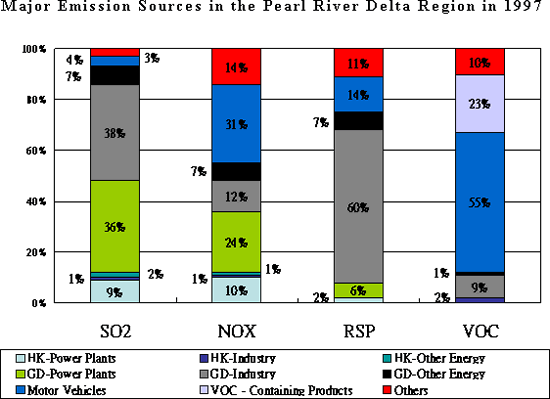
In the past decade, most of the factories in Hong Kong had been relocated to the Mainland. Power plants have become increasingly dominant among local stationary emission sources of SO2, NOx and RSP in Hong Kong. According to the Joint Study on Regional Air Quality (the "Joint Study") conducted by EPD and the Guangdong Environmental Protection Bureau between 1999 and 2002, our power plants contributed to 71%, 49% and 30% respectively of the local SO2, NOx and RSP emissions while our industrial sources accounted for only 8%, 3% and 2% respectively. As to volatile organic compounds (VOC), contribution by local power plants to the local emissions was less than 1% while industrial sources accounted for 16%. The other major VOC emission sources were vehicles, paint, printing inks and consumer products. According to the Joint Study, power plants contributed to 41%, 31% and 7% respectively of its emissions of SO2, NOx and RSP on the Mainland side. The corresponding contributions by its industrial sources were 43%, 16% and 62% respectively. As to VOC, contribution by power plants was less than 1% whereas industrial sources accounted for 10% of the VOC emissions in PRD. The other major VOC sources were vehicles, paint, printing inks, pesticides and consumer products.
|